From Similar Examples to Error Types: Extending PathFinder-PRM with Retrieval-Augmented Verification
Seminar project · Institute for Computational Linguistics, Heidelberg University Pratik Goyal & Ashhad Raza Quadri · Supervisor: Lei Tang
Report: report/main.pdf (ACL format) · Numbers: docs/RESULTS.md · Artefacts: results/
Two papers improve step-level math graders in unrelated ways. RetrievalPRM (Zhu et al. 2025, arXiv:2502.14361) shows the grader similar solved problems before it judges a step — an open-book exam. PathFinder-PRM (Pala et al. 2025, arXiv:2505.19706) replaces the binary correct/wrong verdict with a hierarchical one: first what kind of error, then how good the step is. Nobody had combined them.
Does inserting retrieval in front of PathFinder-PRM's error-typing stage make it better at identifying errors, especially on out-of-distribution problems — and does any gain survive a length-matched control?
Broken into three research questions:
No training, no new data. Inference only, on the released 7B checkpoint, with the model's prompt contract held byte-identical across conditions.
No. Retrieval does not help, and most of the damage comes from how the references' labels are written.
| references shown | average F1 | vs A | |
|---|---|---|---|
| A baseline | none | 67.3 | |
| E ablation | retrieved, labels as words | 62.9 | −4.4 |
| D ablation | retrieved, labels stripped | 60.9 | −6.5 |
| B treatment | retrieved, labels as <+> / <-> | 50.0 | −17.3 |
| C control | random, labels as <+> / <-> | 44.3 | −23.0 |
Three readings, in the order they matter:
The verdict tokens do the damage, not the judgement. Each reference in Condition B ends
with Teacher's judgement: Math reasoning: <->, Consistency: <->. Those two tokens are what
the scoring rule compares at the mask positions, and B puts four of them in the user turn on
every query. Writing the identical judgement as correct / incorrect (E) recovers 12.9
points (E→B, 95% CI [−19.0, −7.7], p < 0.0001) and is indistinguishable from showing no
label at all (D→E +2.0, [−2.2, +6.4]).
Relevance helps a little, mainly where RetrievalPRM says it should. C→B is +5.8 ([−1.1, +12.8], p = 0.10) on average, +2.3 once pool-contaminated items are dropped. It is ~0 on GSM8K and MATH and +14.4 / +11.6 on OlympiadBench and Omni-MATH, the hardest and uncontaminated subsets. Suggestive, not established, and never enough to offset the loss.
The failure has a shape, and it is not in the error typing. Stage 1 (math / consistency) does not measurably change in any arm. The verdict tokens depress stage 2's correctness score instead: false alarms on clean solutions rise from 16.4% to 34.2%, the blame lands before the real error, and the only figure that improves is the miss rate. D and E barely move any of it.
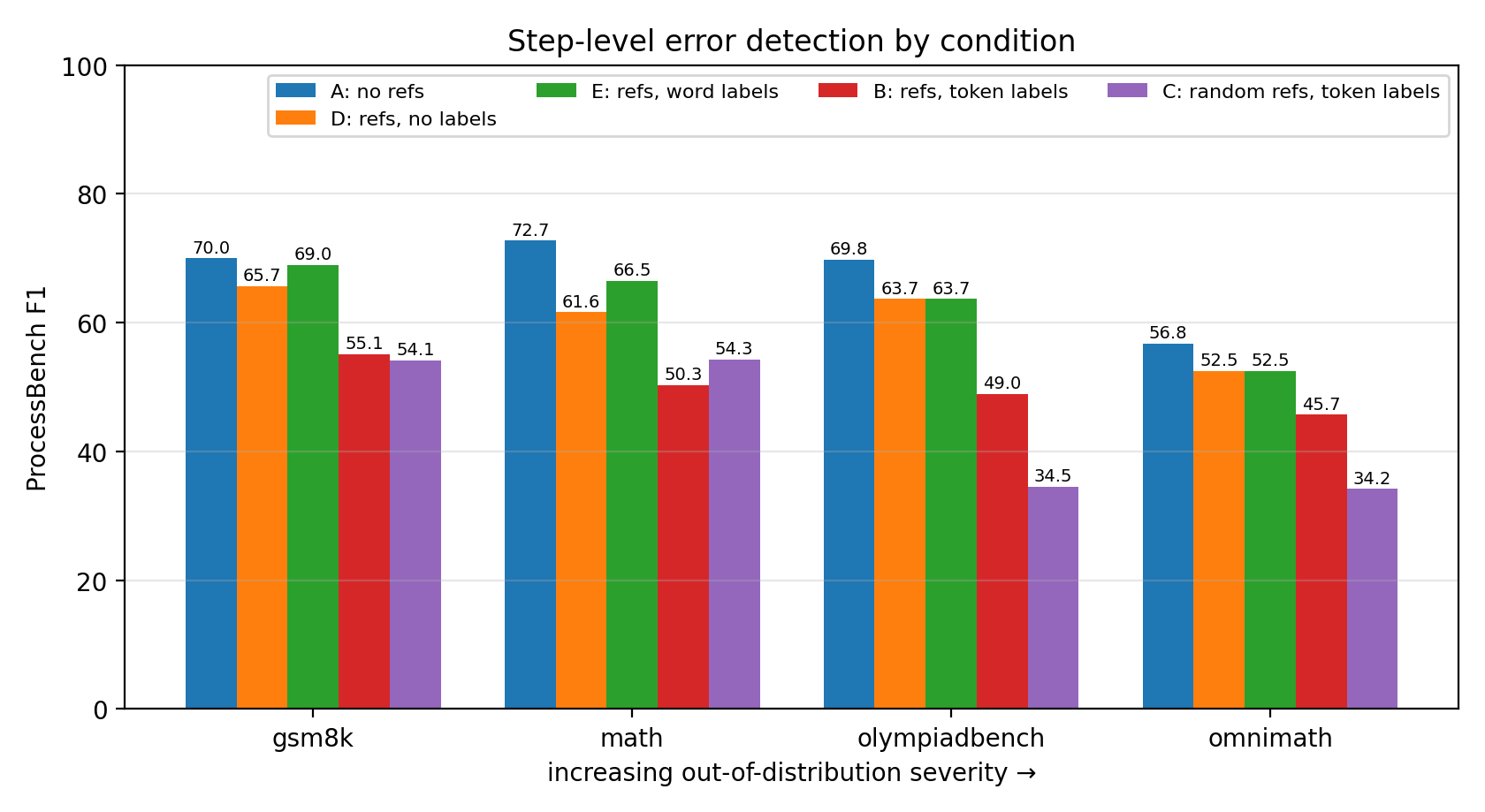
Condition A lands at 67.3 against the paper's published 69.5, which is the anchor that makes the rest worth reading. Measured at int4 on 50 solutions per subset; deltas between arms are valid because all arms ran at identical precision, absolute values are not comparable to bf16.
Correction. The first run of B (46.3) silently used a fallback encoder that skipped Sentence-BERT's normalisation step, which degraded retrieval. It was caught because E's references did not match B's, fixed in
retrieval/encoder.pywith a regression test, and B was re-run. C draws random references and was verified unaffected. The degraded run is kept inresults/int4-b-fallback-encoder/for the record.
Full numbers, intervals, significance tests and limitations: docs/RESULTS.md.
The artefacts behind them: results/.
The finding rests on five arms differing by one thing each, so the machinery that enforces that is the important part of this repository.
| Guard | What it prevents |
|---|---|
scripts/check_parity.py | Two arms differing anywhere but their one defining key. An ablation must declare the key it varies. |
| Stratified sampling | ProcessBench lists every erroneous solution first, so --limit draws a seeded, nested sample instead of slicing an all-error prefix. |
| Contamination guard + exclusion | 59.6% of MATH appears verbatim in the retrieval pool. The guard filters neighbours; the exclusion recomputes every table without the affected eval items. |
| Undefined ≠ zero | An absent population makes F1 undefined, and the metric says so instead of scoring it 0. This is what caught the sampling bug. |
| Pooled contrasts | Per-subset McNemar runs out of discordant solutions at this scale; the pooled test does not. |
| Frozen prompt contract | <extra> may never reach the user turn, the assistant turn must carry exactly two mask positions, and scripts/verify_model_interface.py re-checks both against the model card. |
| Encoder parity | The transformers-only fallback encoder is tested against Sentence-BERT vector for vector, and B, D and E were checked to receive identical references. This is what caught the fallback bug. |
python -m venv .venv
.venv\Scripts\activate           # Windows; source .venv/bin/activate elsewhere
pip install -r requirements.txt
pip install -e .
Check the plumbing — no GPU needed:
python scripts/smoke.py
pytest
smoke.py needs no downloads and takes about five seconds. One test compares the fallback
encoder with Sentence-BERT and downloads the 90 MB all-MiniLM-L6-v2 on first run; it skips
itself when the model cannot be loaded.
smoke.py runs every stage against a mock PRM and bundled fixtures, and asserts that the
control arm really is one: same reference count as the treatment, far lower similarity. Its
numbers are meaningless by construction; what it proves is that the pipeline is intact.
Check the model contract before trusting any real number:
python scripts/verify_model_interface.py
python scripts/build_pool.py          --config configs/retrieval.yaml
python scripts/build_index.py         --config configs/retrieval.yaml
python scripts/check_contamination.py --config configs/retrieval.yaml   # read this first

python scripts/run_eval.py --config configs/pilot-int4.yaml           --limit 50  # A
python scripts/run_eval.py --config configs/pilot-int4-retrieval.yaml --limit 50  # B
python scripts/run_eval.py --config configs/pilot-int4-random.yaml    --limit 50  # C
python scripts/run_eval.py --config configs/pilot-int4-nolabels.yaml  --limit 50  # D
python scripts/run_eval.py --config configs/pilot-int4-wordlabels.yaml --limit 50 # E

# copy the five run directories into results/, then every contrast, profile and figure:
python report/collect_numbers.py
report/collect_numbers.py runs all eight contrasts (each with its uncontaminated- twin),
the verdict profile, the arm figure and the step-level stage analysis behind the report.
Runs are resumable: every solution is flushed to predictions.jsonl as it finishes, and
--resume skips what is already there, so an interrupted run costs at most one solution.
The configs/pilot-int4-*.yaml set is what produced the reported numbers on an 8 GB laptop.
On a 24 GB or larger GPU use configs/baseline.yaml, retrieval.yaml,
control-random.yaml, ablation-nolabels.yaml and ablation-wordlabels.yaml instead —
same design at bf16, where absolute F1 becomes comparable to the published 69.5. Compare
arms only within one precision; never an int4 number against a bf16 one.
Everything reported was run on one laptop: an Acer Nitro 16S AI with an NVIDIA GeForce RTX 5070 Laptop GPU (8 GB VRAM). A 7B in bf16 needs ~15.2 GB of weights, so the reported run uses int4 weight-only quantisation via torchao.
| Backend | prm.backend | Needs | Notes |
|---|---|---|---|
| int4 (torchao) | int4 | ~6.3 GB VRAM | what produced these results; lm_head stays in bf16 |
| bf16 | hf | 20 GB+ VRAM | for numbers comparable to the paper |
| mock | mock | nothing | development only, numbers meaningless |
| fp16 + offload | hf + max_memory | any VRAM + disk | ~12 s per forward pass; correctness pilots only |
int4_packing_format: tile_packed_to_4d is the kernel that works on Blackwell (sm_120).
lm_head and the embeddings stay in bf16 deliberately: the verdict is a comparison of the
<+> and <-> logits from that head, so quantising it would inject noise straight into the
measured quantity.
Cost of the reported run, 200 solutions per arm: A 55 min, C 2 h 38 m, B 3 h 01 m,
D 4 h 59 m, E about 5 h 35 m; about 17 GPU hours for the five arms and about 40 hours for the
whole project. The reference-carrying arms are slower because their prompts are two to three
times longer; retrieval itself is about 1% of step time. The longest Omni-MATH solutions spill
out of 8 GB into shared system RAM and can hit CUDA out-of-memory; rerun with --resume.
A Windows Application Control policy can block pyarrow's DLLs, sometimes only its Parquet
extension and sometimes only for a while. sentence-transformers then fails to import through
datasets. src/rapfprm/compat.py, loaded by every script, handles both shapes: it hides
pyarrow or datasets when they cannot load, so evaluation still works (only
scripts/build_pool.py genuinely needs datasets). If the log says Falling back to the transformers-only mean-pooling encoder, retrieval is using the fallback, which is now
numerically identical to Sentence-BERT.
configs/      one YAML per arm; int4 pilots and bf16 equivalents
src/rapfprm/
  data/       ProcessBench loading and stratified sampling, retrieval-pool construction
  retrieval/  SBERT encoder, PCA + cosine index, two-stage retriever, random control
  prm/        PRM backends and prompt builders (the frozen contract lives here)
  eval/       the scoring runner and the official ProcessBench metric
  analysis/   contrasts, pooled tests, verdict profiling, figures
scripts/      command-line entry points
tests/        139 tests, including an end-to-end run on fixtures
results/      the committed artefacts behind docs/RESULTS.md
docs/         protocol, results, model-interface notes
report/       the ACL-format seminar report (main.tex, main.pdf) and its analysis scripts
docs/RESULTS.md — what was found, with intervals and limitationsdocs/EXPERIMENTS.md — the protocol: arms, controls, sampling, what must be reporteddocs/MODEL_INTERFACE.md — the frozen PathFinder-PRM contract and why it must not driftresults/README.md — what each committed artefact istop_k_steps: 4 — have not
been run.Qwen/ProcessBenchdeclare-lab/PathFinder-PRM-7B · Pool: declare-lab/PathFinder-600KFrom Similar Examples to Error Types: Extending PathFinder-PRM with Retrieval-Augmented Verification
Seminar project · Institute for Computational Linguistics, Heidelberg University Pratik Goyal & Ashhad Raza Quadri · Supervisor: Lei Tang
Report: report/main.pdf (ACL format) · Numbers: docs/RESULTS.md · Artefacts: results/
Two papers improve step-level math graders in unrelated ways. RetrievalPRM (Zhu et al. 2025, arXiv:2502.14361) shows the grader similar solved problems before it judges a step — an open-book exam. PathFinder-PRM (Pala et al. 2025, arXiv:2505.19706) replaces the binary correct/wrong verdict with a hierarchical one: first what kind of error, then how good the step is. Nobody had combined them.
Does inserting retrieval in front of PathFinder-PRM's error-typing stage make it better at identifying errors, especially on out-of-distribution problems — and does any gain survive a length-matched control?
Broken into three research questions:
No training, no new data. Inference only, on the released 7B checkpoint, with the model's prompt contract held byte-identical across conditions.
No. Retrieval does not help, and most of the damage comes from how the references' labels are written.
| references shown | average F1 | vs A | |
|---|---|---|---|
| A baseline | none | 67.3 | |
| E ablation | retrieved, labels as words | 62.9 | −4.4 |
| D ablation | retrieved, labels stripped | 60.9 | −6.5 |
| B treatment | retrieved, labels as <+> / <-> | 50.0 | −17.3 |
| C control | random, labels as <+> / <-> | 44.3 | −23.0 |
Three readings, in the order they matter:
The verdict tokens do the damage, not the judgement. Each reference in Condition B ends
with Teacher's judgement: Math reasoning: <->, Consistency: <->. Those two tokens are what
the scoring rule compares at the mask positions, and B puts four of them in the user turn on
every query. Writing the identical judgement as correct / incorrect (E) recovers 12.9
points (E→B, 95% CI [−19.0, −7.7], p < 0.0001) and is indistinguishable from showing no
label at all (D→E +2.0, [−2.2, +6.4]).
Relevance helps a little, mainly where RetrievalPRM says it should. C→B is +5.8 ([−1.1, +12.8], p = 0.10) on average, +2.3 once pool-contaminated items are dropped. It is ~0 on GSM8K and MATH and +14.4 / +11.6 on OlympiadBench and Omni-MATH, the hardest and uncontaminated subsets. Suggestive, not established, and never enough to offset the loss.
The failure has a shape, and it is not in the error typing. Stage 1 (math / consistency) does not measurably change in any arm. The verdict tokens depress stage 2's correctness score instead: false alarms on clean solutions rise from 16.4% to 34.2%, the blame lands before the real error, and the only figure that improves is the miss rate. D and E barely move any of it.
Condition A lands at 67.3 against the paper's published 69.5, which is the anchor that makes the rest worth reading. Measured at int4 on 50 solutions per subset; deltas between arms are valid because all arms ran at identical precision, absolute values are not comparable to bf16.
Correction. The first run of B (46.3) silently used a fallback encoder that skipped Sentence-BERT's normalisation step, which degraded retrieval. It was caught because E's references did not match B's, fixed in
retrieval/encoder.pywith a regression test, and B was re-run. C draws random references and was verified unaffected. The degraded run is kept inresults/int4-b-fallback-encoder/for the record.
Full numbers, intervals, significance tests and limitations: docs/RESULTS.md.
The artefacts behind them: results/.
The finding rests on five arms differing by one thing each, so the machinery that enforces that is the important part of this repository.
| Guard | What it prevents |
|---|---|
scripts/check_parity.py | Two arms differing anywhere but their one defining key. An ablation must declare the key it varies. |
| Stratified sampling | ProcessBench lists every erroneous solution first, so --limit draws a seeded, nested sample instead of slicing an all-error prefix. |
| Contamination guard + exclusion | 59.6% of MATH appears verbatim in the retrieval pool. The guard filters neighbours; the exclusion recomputes every table without the affected eval items. |
| Undefined ≠ zero | An absent population makes F1 undefined, and the metric says so instead of scoring it 0. This is what caught the sampling bug. |
| Pooled contrasts | Per-subset McNemar runs out of discordant solutions at this scale; the pooled test does not. |
| Frozen prompt contract | <extra> may never reach the user turn, the assistant turn must carry exactly two mask positions, and scripts/verify_model_interface.py re-checks both against the model card. |
| Encoder parity | The transformers-only fallback encoder is tested against Sentence-BERT vector for vector, and B, D and E were checked to receive identical references. This is what caught the fallback bug. |
python -m venv .venv
.venv\Scripts\activate           # Windows; source .venv/bin/activate elsewhere
pip install -r requirements.txt
pip install -e .
Check the plumbing — no GPU needed:
python scripts/smoke.py
pytest
smoke.py needs no downloads and takes about five seconds. One test compares the fallback
encoder with Sentence-BERT and downloads the 90 MB all-MiniLM-L6-v2 on first run; it skips
itself when the model cannot be loaded.
smoke.py runs every stage against a mock PRM and bundled fixtures, and asserts that the
control arm really is one: same reference count as the treatment, far lower similarity. Its
numbers are meaningless by construction; what it proves is that the pipeline is intact.
Check the model contract before trusting any real number:
python scripts/verify_model_interface.py
python scripts/build_pool.py          --config configs/retrieval.yaml
python scripts/build_index.py         --config configs/retrieval.yaml
python scripts/check_contamination.py --config configs/retrieval.yaml   # read this first

python scripts/run_eval.py --config configs/pilot-int4.yaml           --limit 50  # A
python scripts/run_eval.py --config configs/pilot-int4-retrieval.yaml --limit 50  # B
python scripts/run_eval.py --config configs/pilot-int4-random.yaml    --limit 50  # C
python scripts/run_eval.py --config configs/pilot-int4-nolabels.yaml  --limit 50  # D
python scripts/run_eval.py --config configs/pilot-int4-wordlabels.yaml --limit 50 # E

# copy the five run directories into results/, then every contrast, profile and figure:
python report/collect_numbers.py
report/collect_numbers.py runs all eight contrasts (each with its uncontaminated- twin),
the verdict profile, the arm figure and the step-level stage analysis behind the report.
Runs are resumable: every solution is flushed to predictions.jsonl as it finishes, and
--resume skips what is already there, so an interrupted run costs at most one solution.
The configs/pilot-int4-*.yaml set is what produced the reported numbers on an 8 GB laptop.
On a 24 GB or larger GPU use configs/baseline.yaml, retrieval.yaml,
control-random.yaml, ablation-nolabels.yaml and ablation-wordlabels.yaml instead —
same design at bf16, where absolute F1 becomes comparable to the published 69.5. Compare
arms only within one precision; never an int4 number against a bf16 one.
Everything reported was run on one laptop: an Acer Nitro 16S AI with an NVIDIA GeForce RTX 5070 Laptop GPU (8 GB VRAM). A 7B in bf16 needs ~15.2 GB of weights, so the reported run uses int4 weight-only quantisation via torchao.
| Backend | prm.backend | Needs | Notes |
|---|---|---|---|
| int4 (torchao) | int4 | ~6.3 GB VRAM | what produced these results; lm_head stays in bf16 |
| bf16 | hf | 20 GB+ VRAM | for numbers comparable to the paper |
| mock | mock | nothing | development only, numbers meaningless |
| fp16 + offload | hf + max_memory | any VRAM + disk | ~12 s per forward pass; correctness pilots only |
int4_packing_format: tile_packed_to_4d is the kernel that works on Blackwell (sm_120).
lm_head and the embeddings stay in bf16 deliberately: the verdict is a comparison of the
<+> and <-> logits from that head, so quantising it would inject noise straight into the
measured quantity.
Cost of the reported run, 200 solutions per arm: A 55 min, C 2 h 38 m, B 3 h 01 m,
D 4 h 59 m, E about 5 h 35 m; about 17 GPU hours for the five arms and about 40 hours for the
whole project. The reference-carrying arms are slower because their prompts are two to three
times longer; retrieval itself is about 1% of step time. The longest Omni-MATH solutions spill
out of 8 GB into shared system RAM and can hit CUDA out-of-memory; rerun with --resume.
A Windows Application Control policy can block pyarrow's DLLs, sometimes only its Parquet
extension and sometimes only for a while. sentence-transformers then fails to import through
datasets. src/rapfprm/compat.py, loaded by every script, handles both shapes: it hides
pyarrow or datasets when they cannot load, so evaluation still works (only
scripts/build_pool.py genuinely needs datasets). If the log says Falling back to the transformers-only mean-pooling encoder, retrieval is using the fallback, which is now
numerically identical to Sentence-BERT.
configs/      one YAML per arm; int4 pilots and bf16 equivalents
src/rapfprm/
  data/       ProcessBench loading and stratified sampling, retrieval-pool construction
  retrieval/  SBERT encoder, PCA + cosine index, two-stage retriever, random control
  prm/        PRM backends and prompt builders (the frozen contract lives here)
  eval/       the scoring runner and the official ProcessBench metric
  analysis/   contrasts, pooled tests, verdict profiling, figures
scripts/      command-line entry points
tests/        139 tests, including an end-to-end run on fixtures
results/      the committed artefacts behind docs/RESULTS.md
docs/         protocol, results, model-interface notes
report/       the ACL-format seminar report (main.tex, main.pdf) and its analysis scripts
docs/RESULTS.md — what was found, with intervals and limitationsdocs/EXPERIMENTS.md — the protocol: arms, controls, sampling, what must be reporteddocs/MODEL_INTERFACE.md — the frozen PathFinder-PRM contract and why it must not driftresults/README.md — what each committed artefact istop_k_steps: 4 — have not
been run.Qwen/ProcessBenchdeclare-lab/PathFinder-PRM-7B · Pool: declare-lab/PathFinder-600K