
Offline flashcards from PDFs, slides, and notes. Generate locally, study with SM-2, export to Anki.
Python
0
5 commits
updated Sep 30, 2026
See what people are saying
README
cardsmith
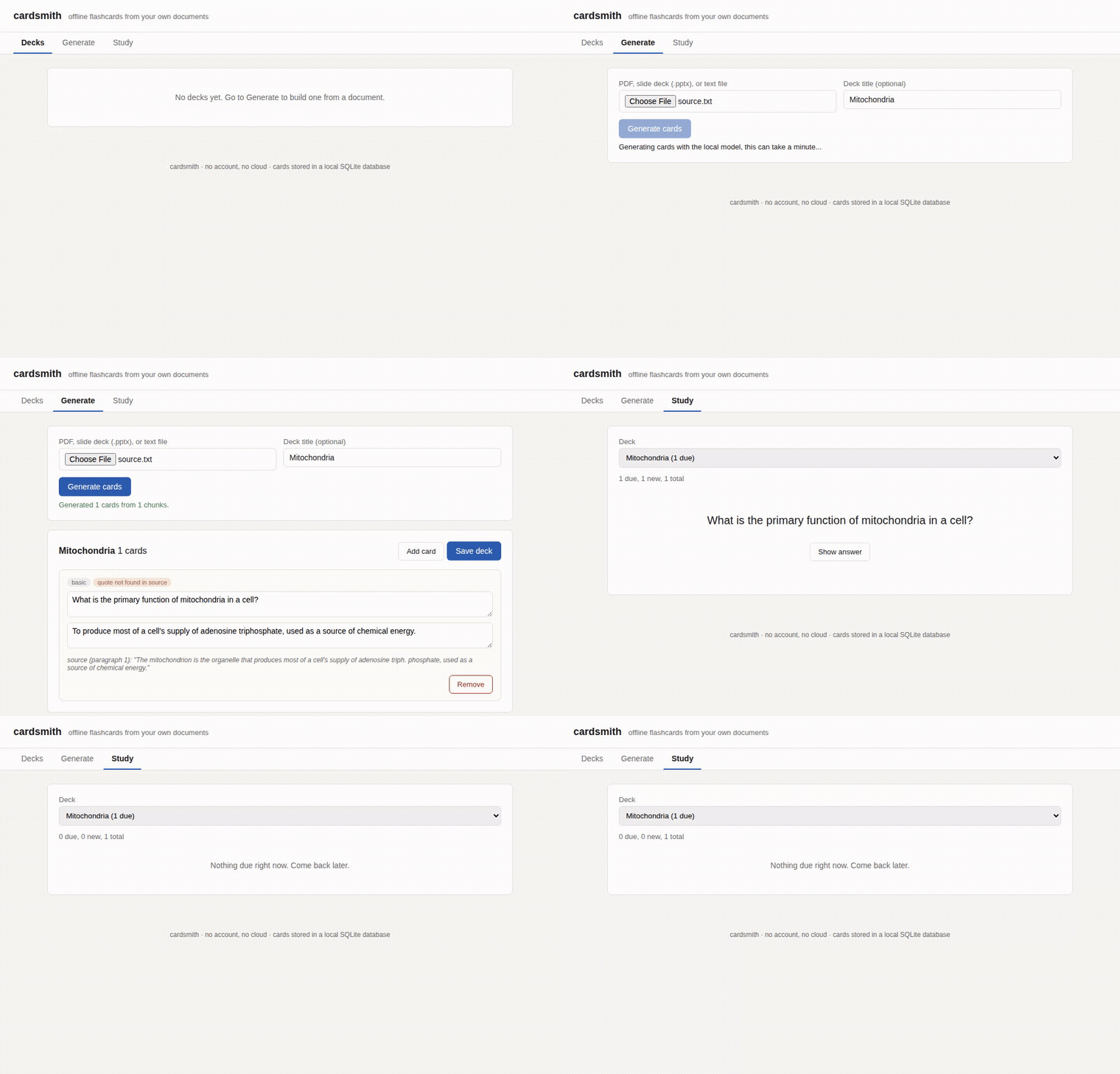
Offline flashcards. Drop a PDF, a slide deck, or a text file, get a spaced-repetition deck built by a local LLM, study it in the browser, export to Anki. No account, no cloud, nothing leaves your machine.
On a 3,248-word public-domain biology chapter, cardsmith generated 152 cards in 775.5 seconds. Its mechanical source-quote check matched 142 of 152 cards to an exact substring of the input. A 40-card hand rating against the source text found 37 factually accurate, 1 inaccurate, and 2 unusable, for 92.5 percent accuracy.1


Why
Quizlet offers paid tiers and stores synced notes on its servers. Making flashcards by hand from a chapter of reading is slow enough that most people skip it and re-read instead, which is a worse way to study. The AI tools that exist either need an account and a subscription, or they generate cards with no way to check them against the source text before you start memorizing something wrong. cardsmith runs entirely on your machine: the LLM, the scheduler, and the database.
Install
uvx --from git+https://github.com/Arthur031221/cardsmith cardsmith
This starts the local web UI and opens it in your browser. It needs
Ollama running with qwen3:4b pulled to generate cards:
ollama pull qwen3:4b
Studying existing decks and exporting to Anki work even without Ollama running.
Quick start
ollama pull qwen3:4b(once)uvx --from git+https://github.com/Arthur031221/cardsmith cardsmith- In the browser tab that opens, go to Generate, pick a PDF,
.pptx, or.txtfile, and click Generate cards. - Edit any card in the preview, or delete the ones you do not want.
- Click Save deck, then Study to review it, or Export .apkg to load it into Anki.
How it works
- Ingest:
pymupdfextracts text per PDF page,python-pptxextracts text per slide (including speaker notes), plain text and Markdown files are split by paragraph. Small adjacent pages or paragraphs are merged and long ones are split, so each chunk sent to the model is 120 to 900 words. - Generate: each chunk goes to Ollama's native
/api/chat(not its chat-completions compatibility endpoint, which was found to ignorethink: falsefor qwen3 models and burn the output budget on hidden reasoning) withthink: falseand a JSON schema passed asformat, so the reply is always parseable. The model is told to use only facts in the chunk and to attach a verbatimsource_quoteto every card. cardsmith checks whether that quote is actually a substring of the chunk and flags the card in the preview if it is not, rather than trusting the model's claim. - Preview: generated cards are not written to the database until you click Save deck. Everything in the preview is editable first.
- Study: a plain SM-2 scheduler (SuperMemo 2, the same algorithm Anki started from) in SQLite. Four grade buttons (Again, Hard, Good, Easy) map to SM-2 quality scores of 1, 3, 4, and 5.
- Export:
genankibuilds a.apkgwith a Basic note type and a Cloze note type. Deck and note model ids are derived deterministically from the database deck id, so exporting the same deck twice updates it in Anki instead of creating a duplicate.
Comparison
| cardsmith | quenti | AnkiAIUtils | QuizFlow | Quizlet | |
|---|---|---|---|---|---|
| Runs offline | yes | no, cloud web app | no, calls a cloud LLM API | no, cloud web app | no |
| Generates cards from a document | PDF, PPTX, text | manual entry only | Anki add-on, works on existing notes | manual entry only | PDF/notes import (cloud, paid tiers) |
| Native Anki export | .apkg via genanki | no | is an Anki add-on | no | no |
| Source quote per card | yes, with a verbatim check | no | no | no | no |
| Spaced repetition | SM-2, built in | its own scheduler | uses Anki's | none found | Quizlet's own |
| Account required | no | yes (hosted) | no (runs inside Anki) | yes (hosted) | yes |
| Price | free, local compute only | free, self-host or hosted | free | free | paid tiers |
| GitHub stars (2026-09-30) | new | 474 | 882 | 43 | n/a |
quenti is a well-built cloud app, not something you run offline. AnkiAIUtils is the closest in spirit but is an Anki add-on that improves existing notes with a cloud LLM call rather than building a deck from a source document. QuizFlow is a small manual flashcard app with no generation step. None of the three write a verbatim source quote onto the card or check it against the text.
Reference
cardsmith [--host HOST] [--port PORT] [--db PATH] [--ollama-url URL]
          [--model NAME] [--cards-per-chunk N] [--no-browser]
          [--check] [--json] [--version]
--hostbind host, default127.0.0.1--portbind port, default8420--dbSQLite database path, default~/.cardsmith/cardsmith.db--ollama-urlOllama server URL, defaulthttp://localhost:11434--modelmodel for card generation, defaultqwen3:4b--cards-per-chunkcards requested per text chunk, default4--no-browserdo not open a browser tab on start--checkcheck the Ollama connection and exit instead of starting the server--jsonwith--check, print the result as JSON
API
The web UI is a thin client over a JSON API on the same port:
POST /api/generate(multipart file + optional title) returns draft cardsPOST /api/deckssaves a deckGET /api/decks,GET /api/decks/{id}list decks and their cardsPUT /api/decks/{id}/cards/{card_id},DELETE /api/decks/{id}/cards/{card_id}GET /api/decks/{id}/study/next,POST /api/decks/{id}/study/{card_id}with{"quality": 0-5}to record a reviewGET /api/decks/{id}/exportdownloads the.apkg
Limits and FAQ
- Card quality depends on the source text and on
qwen3:4b. It is a 4B model: it occasionally paraphrases a quote instead of copying it verbatim, which is why every card is flagged with a grounded/not-grounded check rather than presented as always correct. Larger models pulled into Ollama (pass--model) generally do better. - One generation run is capped at 60 chunks (roughly a 40 to 60 page document at the default chunk size) to keep a single request from running for a very long time on shared hardware. Split larger documents.
- No OCR. A scanned PDF with no text layer will extract no text. Run it through an OCR tool first.
- No image cards, no audio.
- Single user, single machine. There is no sync between devices and no login, by design.
- Card generation needs Ollama reachable with the model pulled. Studying and exporting decks that already exist do not.
- Factual accuracy was hand-rated at 92.5 percent on the 40-card sample (see eval/results.md). An exact source quote checks provenance, not whether the question and answer are correct: the errors found were a merged fact from two unrelated source lines and a cloze card whose answer word was still visible outside the blank.
Related projects
- papercompass: Recommends papers from your own library the way cardsmith turns your own PDFs into cards, both local-first.
- labexplain: Same shape: a PDF in, a local model does the extraction, nothing leaves your machine.
- snipmd: If a source PDF has an equation cardsmith's cards would mangle, snip it separately and paste the LaTeX in.
Contributing
See CONTRIBUTING.md.
License
MIT, see LICENSE.
Footnotes
-
Source: Project Gutenberg ebook #39969, A Civic Biology, Presented in Problems by George W. Hunter (1914), Chapter IV, "The Functions and Composition of Living Things" (3,248 words). Model:
qwen3:4bthrough Ollama's native/api/chat,think: false. Hardware: MacBook Air M5, 24 GB unified memory, one Ollama process. The benchmark recorded generation time, counts, and exact quote matches. Results and raw cards are ineval/. Measured 2026-09-30. ↩
Similar repos


Languages
Python
81.5%
HTML
18.5%
Offline flashcards from PDFs, slides, and notes. Generate locally, study with SM-2, export to Anki.
Python
0
5 commits
updated Sep 30, 2026
See what people are saying
README
cardsmith
Offline flashcards. Drop a PDF, a slide deck, or a text file, get a spaced-repetition deck built by a local LLM, study it in the browser, export to Anki. No account, no cloud, nothing leaves your machine.
On a 3,248-word public-domain biology chapter, cardsmith generated 152 cards in 775.5 seconds. Its mechanical source-quote check matched 142 of 152 cards to an exact substring of the input. A 40-card hand rating against the source text found 37 factually accurate, 1 inaccurate, and 2 unusable, for 92.5 percent accuracy.1
Why
Quizlet offers paid tiers and stores synced notes on its servers. Making flashcards by hand from a chapter of reading is slow enough that most people skip it and re-read instead, which is a worse way to study. The AI tools that exist either need an account and a subscription, or they generate cards with no way to check them against the source text before you start memorizing something wrong. cardsmith runs entirely on your machine: the LLM, the scheduler, and the database.
Install
uvx --from git+https://github.com/Arthur031221/cardsmith cardsmith
This starts the local web UI and opens it in your browser. It needs
Ollama running with qwen3:4b pulled to generate cards:
ollama pull qwen3:4b
Studying existing decks and exporting to Anki work even without Ollama running.
Quick start
ollama pull qwen3:4b(once)uvx --from git+https://github.com/Arthur031221/cardsmith cardsmith- In the browser tab that opens, go to Generate, pick a PDF,
.pptx, or.txtfile, and click Generate cards. - Edit any card in the preview, or delete the ones you do not want.
- Click Save deck, then Study to review it, or Export .apkg to load it into Anki.
How it works
- Ingest:
pymupdfextracts text per PDF page,python-pptxextracts text per slide (including speaker notes), plain text and Markdown files are split by paragraph. Small adjacent pages or paragraphs are merged and long ones are split, so each chunk sent to the model is 120 to 900 words. - Generate: each chunk goes to Ollama's native
/api/chat(not its chat-completions compatibility endpoint, which was found to ignorethink: falsefor qwen3 models and burn the output budget on hidden reasoning) withthink: falseand a JSON schema passed asformat, so the reply is always parseable. The model is told to use only facts in the chunk and to attach a verbatimsource_quoteto every card. cardsmith checks whether that quote is actually a substring of the chunk and flags the card in the preview if it is not, rather than trusting the model's claim. - Preview: generated cards are not written to the database until you click Save deck. Everything in the preview is editable first.
- Study: a plain SM-2 scheduler (SuperMemo 2, the same algorithm Anki started from) in SQLite. Four grade buttons (Again, Hard, Good, Easy) map to SM-2 quality scores of 1, 3, 4, and 5.
- Export:
genankibuilds a.apkgwith a Basic note type and a Cloze note type. Deck and note model ids are derived deterministically from the database deck id, so exporting the same deck twice updates it in Anki instead of creating a duplicate.
Comparison
| cardsmith | quenti | AnkiAIUtils | QuizFlow | Quizlet | |
|---|---|---|---|---|---|
| Runs offline | yes | no, cloud web app | no, calls a cloud LLM API | no, cloud web app | no |
| Generates cards from a document | PDF, PPTX, text | manual entry only | Anki add-on, works on existing notes | manual entry only | PDF/notes import (cloud, paid tiers) |
| Native Anki export | .apkg via genanki | no | is an Anki add-on | no | no |
| Source quote per card | yes, with a verbatim check | no | no | no | no |
| Spaced repetition | SM-2, built in | its own scheduler | uses Anki's | none found | Quizlet's own |
| Account required | no | yes (hosted) | no (runs inside Anki) | yes (hosted) | yes |
| Price | free, local compute only | free, self-host or hosted | free | free | paid tiers |
| GitHub stars (2026-09-30) | new | 474 | 882 | 43 | n/a |
quenti is a well-built cloud app, not something you run offline. AnkiAIUtils is the closest in spirit but is an Anki add-on that improves existing notes with a cloud LLM call rather than building a deck from a source document. QuizFlow is a small manual flashcard app with no generation step. None of the three write a verbatim source quote onto the card or check it against the text.
Reference
cardsmith [--host HOST] [--port PORT] [--db PATH] [--ollama-url URL]
          [--model NAME] [--cards-per-chunk N] [--no-browser]
          [--check] [--json] [--version]
--hostbind host, default127.0.0.1--portbind port, default8420--dbSQLite database path, default~/.cardsmith/cardsmith.db--ollama-urlOllama server URL, defaulthttp://localhost:11434--modelmodel for card generation, defaultqwen3:4b--cards-per-chunkcards requested per text chunk, default4--no-browserdo not open a browser tab on start--checkcheck the Ollama connection and exit instead of starting the server--jsonwith--check, print the result as JSON
API
The web UI is a thin client over a JSON API on the same port:
POST /api/generate(multipart file + optional title) returns draft cardsPOST /api/deckssaves a deckGET /api/decks,GET /api/decks/{id}list decks and their cardsPUT /api/decks/{id}/cards/{card_id},DELETE /api/decks/{id}/cards/{card_id}GET /api/decks/{id}/study/next,POST /api/decks/{id}/study/{card_id}with{"quality": 0-5}to record a reviewGET /api/decks/{id}/exportdownloads the.apkg
Limits and FAQ
- Card quality depends on the source text and on
qwen3:4b. It is a 4B model: it occasionally paraphrases a quote instead of copying it verbatim, which is why every card is flagged with a grounded/not-grounded check rather than presented as always correct. Larger models pulled into Ollama (pass--model) generally do better. - One generation run is capped at 60 chunks (roughly a 40 to 60 page document at the default chunk size) to keep a single request from running for a very long time on shared hardware. Split larger documents.
- No OCR. A scanned PDF with no text layer will extract no text. Run it through an OCR tool first.
- No image cards, no audio.
- Single user, single machine. There is no sync between devices and no login, by design.
- Card generation needs Ollama reachable with the model pulled. Studying and exporting decks that already exist do not.
- Factual accuracy was hand-rated at 92.5 percent on the 40-card sample (see eval/results.md). An exact source quote checks provenance, not whether the question and answer are correct: the errors found were a merged fact from two unrelated source lines and a cloze card whose answer word was still visible outside the blank.
Related projects
- papercompass: Recommends papers from your own library the way cardsmith turns your own PDFs into cards, both local-first.
- labexplain: Same shape: a PDF in, a local model does the extraction, nothing leaves your machine.
- snipmd: If a source PDF has an equation cardsmith's cards would mangle, snip it separately and paste the LaTeX in.
Contributing
See CONTRIBUTING.md.
License
MIT, see LICENSE.
Footnotes
-
Source: Project Gutenberg ebook #39969, A Civic Biology, Presented in Problems by George W. Hunter (1914), Chapter IV, "The Functions and Composition of Living Things" (3,248 words). Model:
qwen3:4bthrough Ollama's native/api/chat,think: false. Hardware: MacBook Air M5, 24 GB unified memory, one Ollama process. The benchmark recorded generation time, counts, and exact quote matches. Results and raw cards are ineval/. Measured 2026-09-30. ↩
Similar repos
Languages
Python
81.5%
HTML
18.5%