[EMNLP 2025 Findings] Compositional Translation: A Novel LLM-based Approach for Low-resource Machine Translation
See the codeOfficial implementation of Compositional Translation: A Novel LLM-based Approach for Low-resource Machine Translation with code, prompts and model outputs.
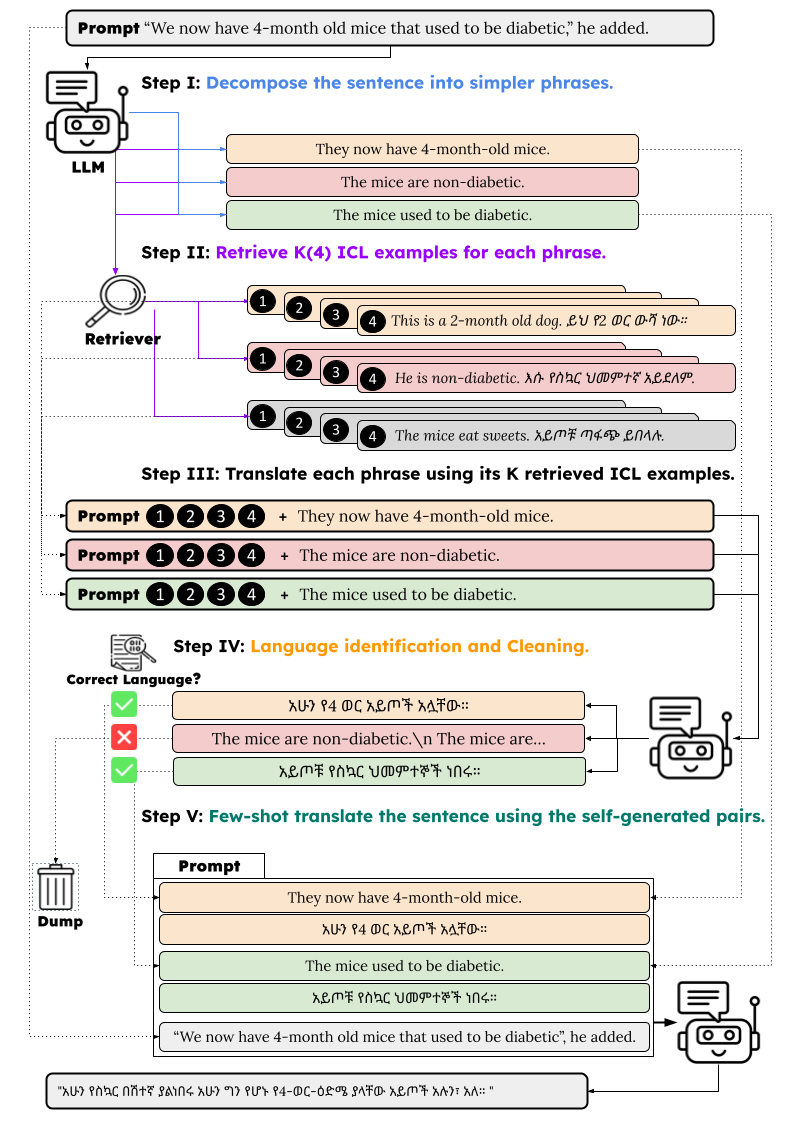
Compositional Translation (CompTra) is designed to help LLMs (in particular decoder-based) perform the Machine Translation (MT) task step by step. As a matter of fact, this technique was designed in order to improve the capabilities of LLMs to perform MT from english to low-resource languages (LRLs), a setup where they still lag behind supervised models such as NLLB. So, how does CompTra work?
The task consists into translating a sentence $x$, written in a source language src (typically English, language in which most LLMs are proficient) into a target language tgt (e.g. Amharic). There is selection pool $\mathcal{P} = {(x_i, y_i)}_{i=1}^{|\mathcal{P}|}$, i.e. a small set of sentence-translation pairs which can be used to translate $x$ (They do not need to have any sort of relatedness with $x$).
CompTra works as follow:
In this form, CompTra only has one hyperparameter, that is $k$: the number of pairs to retrieve for each phrase. The LLM has three main roles:
The Decompose task can be delegated to a component that is not LLM-based (e.g. space-separator, entity extractor etc.), even LLM-based decomposition can be done in different ways by varying the divide prompt (e.g. paraphrase). Similarly, the Translate task can be attributed to another system (typically a supervised MT model) or we can replace few-shot MT with another prompting approach to MT. This modularity shows the strenghts of the CompTra as a MT framework. However, its native form is intentionally entirely LLM-based in order to assess whether this framework can help LLM use their intrinsic knowledge (with minimal help) to output better translations.
The most natural baseline approach in such a scenario is few-shot translation with examples retrieved via similarity search. That is, given $x$, we use $\mathcal{R}$ to retrieve $k$ pairs ${(x_{i_1}, y_{i_1}), \ldots, (x_{i_k}, y_{i_k})} = \mathcal{T}$ and obtain the final translation $\mathcal{L}(\mathcal{T}, x)$ by prompting the model with them as in-context examples.
We intentionally focus on the English $\rightarrow X$ setup as it is most challenging and LLMs have a good mastery of the english language.
This repository supports the application of $CompTra$ to open-source models via vLLM and Transformers. It also supports Cohere and OpenAI models via their respective API.
Before using this repository, make sure to install PyTorch in accordance to the characteristics of your device. The rest of the required libraries can be installed via
git clone https://github.com/XXX/compositional-translation
cd compositional-translation/
pip install -r requirements.txt
In case you want to use SONAR and/or BLASER, you will need to do pip install sonar-space. Feel free to refer to SONAR's repository for more information. The sonar package depends on fairseq2 which may be conflicting with vLLM. If you do encounter any compatibility issue between both packages, you can have 2 separate environments: one where sonar works and vllm doesn't and the other way around; and switch between the two depending on what you want to use.
You might also require FlashInfer (pip install flashinfer==0.1.2 -i https://flashinfer.ai/whl/cu121/torch2.3) if you work with Gemma models and Flash Attention (MAX_JOBS=4 pip install flash-attn --no-build-isolation --no-cache-dir) for fast inference. It is worth mentioning that this repository was developed with vllm==0.5.3.post1, more recent versions might need slight modifications to allow beam search.
We start by evaluating CompTra on the FLORES 200 benchmark which supports more than 200 languages. It is divided into a devtest set of 1012 sentences (used for evaluation) and a dev set of 997 sentences (used as the selection). We consider 10 target languages, that are low-resource: Amharic, Burmese, Fijian, Khmer, Lao, Samoan, Sinhala, Tsonga, Turkmen and Uyghur. The following command applies $CompTra$ on MT from English to Amharic with gemma-2-9b-it.
python main.py\
    --model_name_or_path $MODEL_NAME_OR_PATH\ # google/gemma-2-9b-it
    --tokenizer_name_or_path $TOKENIZER_NAME_OR_PATH\ # google/gemma-2-9b-it
    --src $SRC\ # English
    --tgt $TGT\ # Amharic
    --request_batch_size 16\
    --inference_api vllm\
    --api_key <YOUR_API_KEY>\ # Only necessary with Cohere, OpenAI, Anthropic etc.
    --max_samples 10000\
    --num_return_sequences 1\
    --num_beams 1\
    --max_new_tokens 2000\
    --temperature 0.0\
    --top_p 1.0\
    --repetition_penalty 1.0\
    --output_dir ./out/GENERATIONS/FLORES/bm25s\
    --k $K\ # 5
    --seed $SEED\ # 122
    --method_divide $METHOD_DIVIDE\ # llm
    --merge_prompt $MERGE_PROMPT\ # vanilla
    --method_translate vanilla\
    --selection_method greedy\
    --steps $STEPS\ # 1
    --verbose\
    --number_of_subproblems $NUMBER_OF_SUBPROBLEMS\ # -1
    --number_of_refining_steps $NUMBER_OF_REFINING_STEPS\ # 0
    --template_key 11\
    --retriever_type bm25s\
    --dataset_name_or_path flores\
    --number_of_merge_demonstrations 0\
src represents the source language, with the first letter capitalized (e.g. English), same for tgt which corresponds to the target language (e.g. Amharic). inference_api indicates how the model is served, it can be vllm, hf, cohere etc. method_divide indicates how the decomposition is done, when set to llm it does the few-shot decomposition. k is the number of demonstrations per phrase, number_of_subproblems the number of phrases.
Using --steps 0 and --number_of_refining_steps 0 is equivalent to using few-shot MT (in $k$-shot) with the retriever specified by --retriever_type (we recommend bm25s). When --number_of_refining_steps is non-zero, we apply as many refining steps as specified on the few-shot MT translation.
$CompTra$ requires setting --steps 1, which sort of specify that how many times each sentence in a given benchmark is splitted (recursively). --number_of_subproblems indicates the number of phrases ($N$ in 1. overview) which we usually set to -1. In $CompTra$, --number_of_refining_steps is set to zero by default because it does not require to refine the phrases translation though compatible with such an option.
We also test CompTra on two more benchmarks: NTREX 128 and TICO-19. NTREX 128 contains 1997 sentences written in 128 languages, we consider the 1000 first for the evaluation and the 997 last for the selection pool. TICO-19 has a test set of 2100 samples and a validation set of 971 samples (selection pool). We consider 5 languages in NTREX 128: Amharic, Fijian, Shona, Somali and Tswana. We consider 5 languages in TICO-19: Amharic, Khmer, Lingala, Luganda and Tamil. The command to apply $CompTra$ on these benchmarks is the same as the commands above, you just have to change dataset_name_or_path to either ntrex or tico and tgt accordingly.
In the paper, we compare CompTra to Multi-Aspect Prompting and Selection (MAPS), Translate, Estimate and Refine (TEaR), Step by Step Translation (SBYS), Self-Refine and CoT. In order to apply any of these methods, you just have to change the --method_translate from vanilla (i.e. few-shot) to the corresponding value: maps for MAPS, TEaR for TEaR, step_by_step for SBYS and cot for CoT. When it comes to Self-Refine, this is done by setting --number_of_refining_steps to 1.
SBYS and MAPS do not use demonstrations (so --k 0) while TEaR uses --k 5. Zero-shot + CoT logically requires --k 0, as well as Zero-shot + Refine.
Here is a table summarizing the most crucial arguments to replicate the results obtained in the paper.
| parameters | Zero-shot | + CoT | +REFINE | SBYS | MAPS | TEaR | 5-shot BM25 | + CoT | + REFINE | CompTra |
|---|---|---|---|---|---|---|---|---|---|---|
| k | 0 | 0 | 0 | 0 | 0 | 5 | 5 | 5 | 5 | 5 |
| method_divide | llm | llm | llm | llm | llm | llm | llm | llm | llm | llm |
| merge_prompt | vanilla | vanilla | vanilla | vanilla | vanilla | vanilla | vanilla | vanilla | vanilla | vanilla |
| method_translate | vanilla | cot | cot | step_by_step | maps | TEaR | vanilla | cot | vanilla | vanilla |
| number_of_subproblems | 0 | 0 | 0 | 0 | 0 | 0 | 0 | 0 | 0 | -1 |
| number_of_refining_steps | 0 | 0 | 1 | 0 | 0 | 0 | 0 | 0 | 0 | 0 |
| steps | 0 | 0 | 0 | 0 | 0 | 0 | 0 | 0 | 1 | 1 |
It is recommended (expected) to store $CompTra$'s generations in the same folder as few-shot MT's generations in order to facilitate the ensembling and the pairwise evaluation.
This repository supports multiple possibilities for the evaluation. For COMET-based metrics, whose checkpoints can be found here. We also support the evaluation with MetricX-23 models and string-matching metrics (BLEU, chrF++) via sacrebleu. All those metrics can be evaluated with statistical significance.
You can also evaluate with Gemba and MTRanker. See compositional-translation/scripts for example scripts.
You can apply $CompTra$ with the model of your choice by changing --model_name_or_path and --inference_api which specify how the model is downloaded. You can vary the number of demonstrations per phrase with --k. Similarly, the retriever depends on the parameter --retriever_type which links to the retrievers defined in compositional-translation/comptra/retriever.py (e.g. LCS, SONAR, bm25, bm25s etc.). The out-of-domain evaluation is done by setting --dataset_name_or_path ood.
If you want to use NLLB and try NLLB + CompTra, set --method_translate nllb and provide --nllb_name_or_path facebook/nllb-200-distilled-600M. It will automatically ignore $k$ and use NLLB instead for the translation of the phrases.
When it comes to ablation studies on the impact of the decomposition algorithm, there are few adjustments to be made. Words --method_divide keyword; Structure --method_divide structural, Repeat --method_divide identity specifying the number of repetitions with --number_of_repetitions 4. Paraphase still uses --method_divide llm but you have to specify the following --mode_divide paraphrase.
We do not handle models in the best way possible. We have lists of models in compositional-translation/comptra/models.py. If you want to use a model that is not in one of these lists, make sure to add its name in the right list depending on whether it is instruction-tuned or not. After that, open compositional-translation/comptra/apply_chat_template.py and write its instruction/chat template function.
We designed this repository in a way that it is extremely simple to add a new dataset. However, its construction does not make it very fast when it comes to large corpus (+100K, +1M sentences).
dev (selection pool) and devtest (evaluation set).In compositional-translation/comptra/sampler.py it is possible to define a function for any translation technique. This is done in the abstract class Sampler where you can find functions such as cot, maps, step_by_step, tear etc. These functions are called in translate to map Sampler's method_divide argument to the corresponding function. Adding a new MT method amounts to create such a function and call it accordingly in the function translate.
By using compositional-translation/data/embed.py, you can store in advance the SONAR sentence representations of each element of a dataset of interest as it is done with flores, ntrex and tico. You can do the same with phrases obtained after decomposition with the function second (it is particularly useful if you have 2 environments, one with SONAR and the other with vLLM).
This work was made possible by the INRIA Paris' NLP research team, ALMAnaCH.
If you find this repository valuable, please give it a star!
Please cite the following if you use the data or code in this repository.
@misc{zebaze2025compositionaltranslationnovelllmbased,
    title={Compositional Translation: A Novel LLM-based Approach for Low-resource Machine Translation},
    author={Armel Zebaze and Benoît Sagot and Rachel Bawden},
    year={2025},
    eprint={2503.04554},
    archivePrefix={arXiv},
    primaryClass={cs.CL},
    url={https://arxiv.org/abs/2503.04554},
}
[EMNLP 2025 Findings] Compositional Translation: A Novel LLM-based Approach for Low-resource Machine Translation
See the codeOfficial implementation of Compositional Translation: A Novel LLM-based Approach for Low-resource Machine Translation with code, prompts and model outputs.
Compositional Translation (CompTra) is designed to help LLMs (in particular decoder-based) perform the Machine Translation (MT) task step by step. As a matter of fact, this technique was designed in order to improve the capabilities of LLMs to perform MT from english to low-resource languages (LRLs), a setup where they still lag behind supervised models such as NLLB. So, how does CompTra work?
The task consists into translating a sentence $x$, written in a source language src (typically English, language in which most LLMs are proficient) into a target language tgt (e.g. Amharic). There is selection pool $\mathcal{P} = {(x_i, y_i)}_{i=1}^{|\mathcal{P}|}$, i.e. a small set of sentence-translation pairs which can be used to translate $x$ (They do not need to have any sort of relatedness with $x$).
CompTra works as follow:
In this form, CompTra only has one hyperparameter, that is $k$: the number of pairs to retrieve for each phrase. The LLM has three main roles:
The Decompose task can be delegated to a component that is not LLM-based (e.g. space-separator, entity extractor etc.), even LLM-based decomposition can be done in different ways by varying the divide prompt (e.g. paraphrase). Similarly, the Translate task can be attributed to another system (typically a supervised MT model) or we can replace few-shot MT with another prompting approach to MT. This modularity shows the strenghts of the CompTra as a MT framework. However, its native form is intentionally entirely LLM-based in order to assess whether this framework can help LLM use their intrinsic knowledge (with minimal help) to output better translations.
The most natural baseline approach in such a scenario is few-shot translation with examples retrieved via similarity search. That is, given $x$, we use $\mathcal{R}$ to retrieve $k$ pairs ${(x_{i_1}, y_{i_1}), \ldots, (x_{i_k}, y_{i_k})} = \mathcal{T}$ and obtain the final translation $\mathcal{L}(\mathcal{T}, x)$ by prompting the model with them as in-context examples.
We intentionally focus on the English $\rightarrow X$ setup as it is most challenging and LLMs have a good mastery of the english language.
This repository supports the application of $CompTra$ to open-source models via vLLM and Transformers. It also supports Cohere and OpenAI models via their respective API.
Before using this repository, make sure to install PyTorch in accordance to the characteristics of your device. The rest of the required libraries can be installed via
git clone https://github.com/XXX/compositional-translation
cd compositional-translation/
pip install -r requirements.txt
In case you want to use SONAR and/or BLASER, you will need to do pip install sonar-space. Feel free to refer to SONAR's repository for more information. The sonar package depends on fairseq2 which may be conflicting with vLLM. If you do encounter any compatibility issue between both packages, you can have 2 separate environments: one where sonar works and vllm doesn't and the other way around; and switch between the two depending on what you want to use.
You might also require FlashInfer (pip install flashinfer==0.1.2 -i https://flashinfer.ai/whl/cu121/torch2.3) if you work with Gemma models and Flash Attention (MAX_JOBS=4 pip install flash-attn --no-build-isolation --no-cache-dir) for fast inference. It is worth mentioning that this repository was developed with vllm==0.5.3.post1, more recent versions might need slight modifications to allow beam search.
We start by evaluating CompTra on the FLORES 200 benchmark which supports more than 200 languages. It is divided into a devtest set of 1012 sentences (used for evaluation) and a dev set of 997 sentences (used as the selection). We consider 10 target languages, that are low-resource: Amharic, Burmese, Fijian, Khmer, Lao, Samoan, Sinhala, Tsonga, Turkmen and Uyghur. The following command applies $CompTra$ on MT from English to Amharic with gemma-2-9b-it.
python main.py\
    --model_name_or_path $MODEL_NAME_OR_PATH\ # google/gemma-2-9b-it
    --tokenizer_name_or_path $TOKENIZER_NAME_OR_PATH\ # google/gemma-2-9b-it
    --src $SRC\ # English
    --tgt $TGT\ # Amharic
    --request_batch_size 16\
    --inference_api vllm\
    --api_key <YOUR_API_KEY>\ # Only necessary with Cohere, OpenAI, Anthropic etc.
    --max_samples 10000\
    --num_return_sequences 1\
    --num_beams 1\
    --max_new_tokens 2000\
    --temperature 0.0\
    --top_p 1.0\
    --repetition_penalty 1.0\
    --output_dir ./out/GENERATIONS/FLORES/bm25s\
    --k $K\ # 5
    --seed $SEED\ # 122
    --method_divide $METHOD_DIVIDE\ # llm
    --merge_prompt $MERGE_PROMPT\ # vanilla
    --method_translate vanilla\
    --selection_method greedy\
    --steps $STEPS\ # 1
    --verbose\
    --number_of_subproblems $NUMBER_OF_SUBPROBLEMS\ # -1
    --number_of_refining_steps $NUMBER_OF_REFINING_STEPS\ # 0
    --template_key 11\
    --retriever_type bm25s\
    --dataset_name_or_path flores\
    --number_of_merge_demonstrations 0\
src represents the source language, with the first letter capitalized (e.g. English), same for tgt which corresponds to the target language (e.g. Amharic). inference_api indicates how the model is served, it can be vllm, hf, cohere etc. method_divide indicates how the decomposition is done, when set to llm it does the few-shot decomposition. k is the number of demonstrations per phrase, number_of_subproblems the number of phrases.
Using --steps 0 and --number_of_refining_steps 0 is equivalent to using few-shot MT (in $k$-shot) with the retriever specified by --retriever_type (we recommend bm25s). When --number_of_refining_steps is non-zero, we apply as many refining steps as specified on the few-shot MT translation.
$CompTra$ requires setting --steps 1, which sort of specify that how many times each sentence in a given benchmark is splitted (recursively). --number_of_subproblems indicates the number of phrases ($N$ in 1. overview) which we usually set to -1. In $CompTra$, --number_of_refining_steps is set to zero by default because it does not require to refine the phrases translation though compatible with such an option.
We also test CompTra on two more benchmarks: NTREX 128 and TICO-19. NTREX 128 contains 1997 sentences written in 128 languages, we consider the 1000 first for the evaluation and the 997 last for the selection pool. TICO-19 has a test set of 2100 samples and a validation set of 971 samples (selection pool). We consider 5 languages in NTREX 128: Amharic, Fijian, Shona, Somali and Tswana. We consider 5 languages in TICO-19: Amharic, Khmer, Lingala, Luganda and Tamil. The command to apply $CompTra$ on these benchmarks is the same as the commands above, you just have to change dataset_name_or_path to either ntrex or tico and tgt accordingly.
In the paper, we compare CompTra to Multi-Aspect Prompting and Selection (MAPS), Translate, Estimate and Refine (TEaR), Step by Step Translation (SBYS), Self-Refine and CoT. In order to apply any of these methods, you just have to change the --method_translate from vanilla (i.e. few-shot) to the corresponding value: maps for MAPS, TEaR for TEaR, step_by_step for SBYS and cot for CoT. When it comes to Self-Refine, this is done by setting --number_of_refining_steps to 1.
SBYS and MAPS do not use demonstrations (so --k 0) while TEaR uses --k 5. Zero-shot + CoT logically requires --k 0, as well as Zero-shot + Refine.
Here is a table summarizing the most crucial arguments to replicate the results obtained in the paper.
| parameters | Zero-shot | + CoT | +REFINE | SBYS | MAPS | TEaR | 5-shot BM25 | + CoT | + REFINE | CompTra |
|---|---|---|---|---|---|---|---|---|---|---|
| k | 0 | 0 | 0 | 0 | 0 | 5 | 5 | 5 | 5 | 5 |
| method_divide | llm | llm | llm | llm | llm | llm | llm | llm | llm | llm |
| merge_prompt | vanilla | vanilla | vanilla | vanilla | vanilla | vanilla | vanilla | vanilla | vanilla | vanilla |
| method_translate | vanilla | cot | cot | step_by_step | maps | TEaR | vanilla | cot | vanilla | vanilla |
| number_of_subproblems | 0 | 0 | 0 | 0 | 0 | 0 | 0 | 0 | 0 | -1 |
| number_of_refining_steps | 0 | 0 | 1 | 0 | 0 | 0 | 0 | 0 | 0 | 0 |
| steps | 0 | 0 | 0 | 0 | 0 | 0 | 0 | 0 | 1 | 1 |
It is recommended (expected) to store $CompTra$'s generations in the same folder as few-shot MT's generations in order to facilitate the ensembling and the pairwise evaluation.
This repository supports multiple possibilities for the evaluation. For COMET-based metrics, whose checkpoints can be found here. We also support the evaluation with MetricX-23 models and string-matching metrics (BLEU, chrF++) via sacrebleu. All those metrics can be evaluated with statistical significance.
You can also evaluate with Gemba and MTRanker. See compositional-translation/scripts for example scripts.
You can apply $CompTra$ with the model of your choice by changing --model_name_or_path and --inference_api which specify how the model is downloaded. You can vary the number of demonstrations per phrase with --k. Similarly, the retriever depends on the parameter --retriever_type which links to the retrievers defined in compositional-translation/comptra/retriever.py (e.g. LCS, SONAR, bm25, bm25s etc.). The out-of-domain evaluation is done by setting --dataset_name_or_path ood.
If you want to use NLLB and try NLLB + CompTra, set --method_translate nllb and provide --nllb_name_or_path facebook/nllb-200-distilled-600M. It will automatically ignore $k$ and use NLLB instead for the translation of the phrases.
When it comes to ablation studies on the impact of the decomposition algorithm, there are few adjustments to be made. Words --method_divide keyword; Structure --method_divide structural, Repeat --method_divide identity specifying the number of repetitions with --number_of_repetitions 4. Paraphase still uses --method_divide llm but you have to specify the following --mode_divide paraphrase.
We do not handle models in the best way possible. We have lists of models in compositional-translation/comptra/models.py. If you want to use a model that is not in one of these lists, make sure to add its name in the right list depending on whether it is instruction-tuned or not. After that, open compositional-translation/comptra/apply_chat_template.py and write its instruction/chat template function.
We designed this repository in a way that it is extremely simple to add a new dataset. However, its construction does not make it very fast when it comes to large corpus (+100K, +1M sentences).
dev (selection pool) and devtest (evaluation set).In compositional-translation/comptra/sampler.py it is possible to define a function for any translation technique. This is done in the abstract class Sampler where you can find functions such as cot, maps, step_by_step, tear etc. These functions are called in translate to map Sampler's method_divide argument to the corresponding function. Adding a new MT method amounts to create such a function and call it accordingly in the function translate.
By using compositional-translation/data/embed.py, you can store in advance the SONAR sentence representations of each element of a dataset of interest as it is done with flores, ntrex and tico. You can do the same with phrases obtained after decomposition with the function second (it is particularly useful if you have 2 environments, one with SONAR and the other with vLLM).
This work was made possible by the INRIA Paris' NLP research team, ALMAnaCH.
If you find this repository valuable, please give it a star!
Please cite the following if you use the data or code in this repository.
@misc{zebaze2025compositionaltranslationnovelllmbased,
    title={Compositional Translation: A Novel LLM-based Approach for Low-resource Machine Translation},
    author={Armel Zebaze and Benoît Sagot and Rachel Bawden},
    year={2025},
    eprint={2503.04554},
    archivePrefix={arXiv},
    primaryClass={cs.CL},
    url={https://arxiv.org/abs/2503.04554},
}



