A small LLM inference engine, built to understand how engines like vLLM work by building the core ideas and measuring each one:
POST /v1/completions endpoint that streams tokens
over SSE;Every change is measured against a baseline server (baseline_server.py,
kept unchanged so it can be re-run) that keeps a separate KV cache per user and
pads all of them to the same length every decode step.
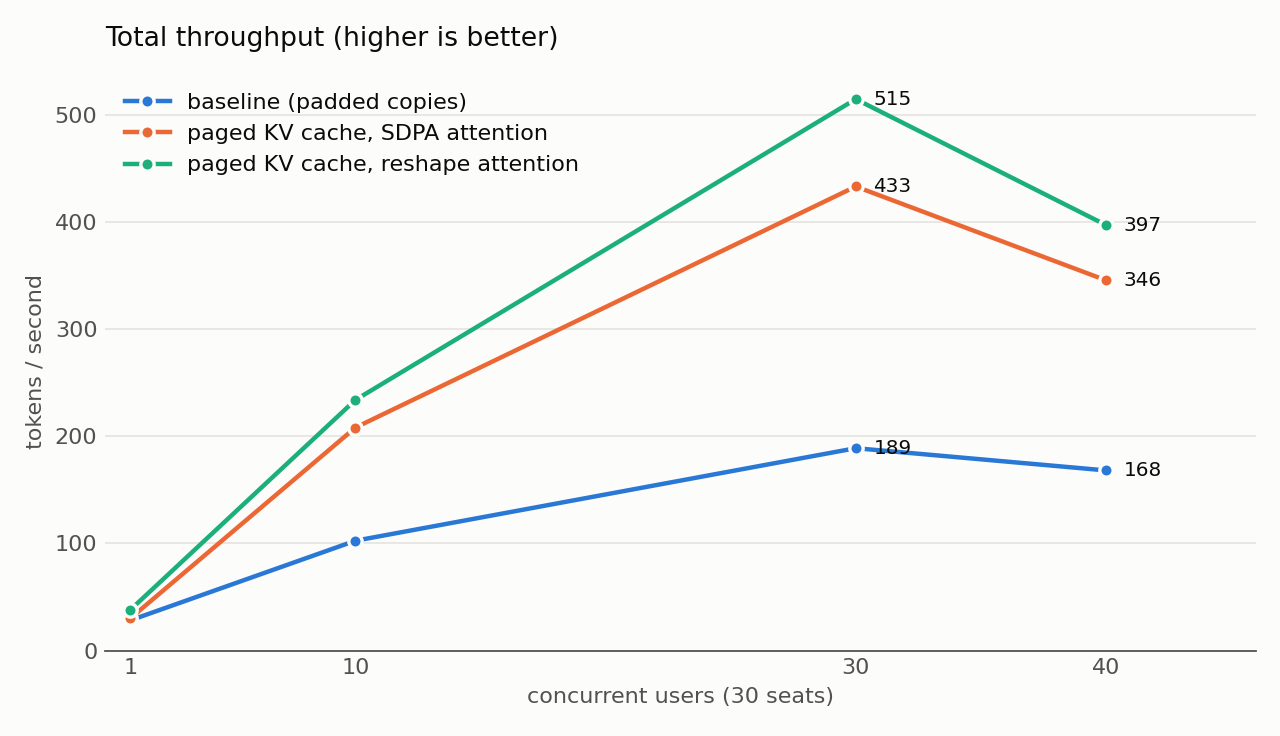
Apple M4, 16 GB, Mac GPU (MPS), SmolLM2-135M at fp32, each user asks for 100 tokens, at most 30 users decoding at once.
| Baseline | nano-vLLM | Change | |
|---|---|---|---|
| Total throughput, 30 users | 189 tok/s | 515 tok/s | 2.7× |
| One decode step, ~30 users | 132 ms | 48 ms | 2.8× faster |
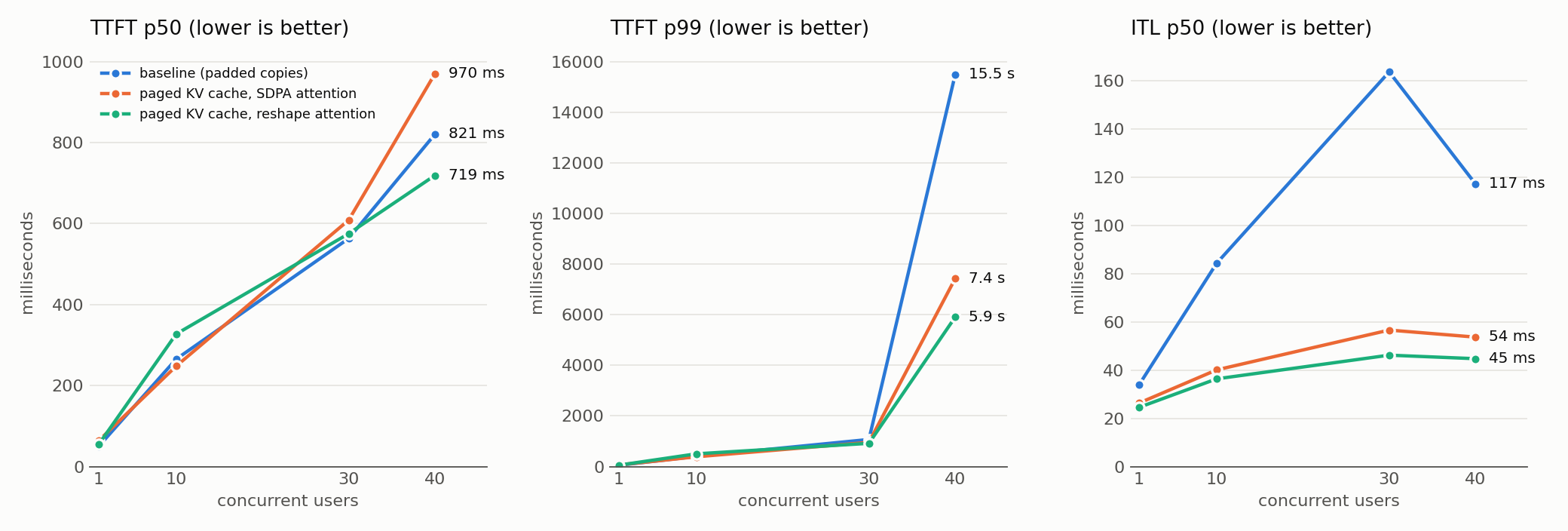
| Gap between tokens (ITL p50), 30 users | 164 ms | 46 ms | 3.6× smaller |
| Throughput, 1 user | 28 tok/s | 38 tok/s | 1.4× |
| TTFT p99, 40 users (10 wait for a seat) | 15.5 s | 5.9 s | 2.6× smaller |
| TTFT p50, 30 users sharing a 500-token prompt | 2.4 s (caching off) | 0.70 s (caching on) | 3.4× smaller |
 client ──POST /v1/completions──▶ FastAPI handler (event loop)
                                    │ tokenize, check the length
                                    ▼
                               waiting line ──▶ BatchEngine thread, one round at a time:
                                                 1. free the blocks of finished or disconnected users
                                                 2. seat users from the front of the line while a seat
                                                    and enough blocks for prompt + max_tokens are free;
                                                    reuse cached blocks for a known prompt prefix
                                                 3. prefill each new user (only the uncached part)
                                                 4. decode one token for every seated user
 client ◀──SSE, one token each── handler ◀──── tokens through an asyncio.Queue

 inside one decode step, for each of the 30 layers:
   new token ─▶ RMSNorm ─▶ Q, K, V ─▶ RoPE at position n
                                  ├─▶ write K, V into block table[n // 16], slot n % 16
                                  └─▶ gather every user's blocks (one gather per layer, short
                                      tables filled out with dummy block 0) ─▶ masked attention
                                      (query heads grouped onto their shared K/V head) ─▶ o_proj
                ─▶ RMSNorm ─▶ SwiGLU MLP
 shared pool (one K and one V tensor per layer: [blocks, 16, 3 KV heads, 64])
 ┌───┬───┬───┬───┬───┬───┬───┬───┬───┐
 │ 0 │ 1 │ 2 │ 3 │ 4 │ 5 │ 6 │ 7 │...│   block 0: dummy, never handed out
 └───┴───┴───┴───┴───┴───┴───┴───┴───┘
 user A table: [1, 2, 5]    user B table: [1, 2, 6]    ← both start with the same
                                                          32-token system prompt,
                                                          so blocks 1 and 2 are shared
| File | What it is |
|---|---|
server.py | The API, the waiting line, and the paged BatchEngine |
model.py | Our SmolLM2: plain forward pass, paged prefill, paged batched decode |
blocks.py | BlockAllocator (free list, reference counts, prefix cache) and KVPool |
baseline_server.py | The starting point, kept for comparisons |
bench.py | Load test: N users at once, saves every token's arrival time |
profile_decode.py | Times each part of one paged decode step |
plot.py | Draws the charts in docs/ from results/ |
test_*.py | Correctness checks (see below) |
python3 server.py
In a second terminal:
curl -N -X POST localhost:8080/v1/completions -H "Content-Type: application/json" \
     -d '{"prompt": "The cat sat on the", "max_tokens": 20}'
python3 baseline_server.py runs the baseline instead, on the same port, so
run only one at a time. NANO_PREFIX_CACHE=0 python3 server.py turns prefix
caching off.
Load test (the server must be running), then redraw the charts:
nice -n 10 python3 bench.py --label my-run --users 1 10 30 40
nice -n 10 python3 bench.py --label shared --users 1 10 30 --system-repeats 35
python3 plot.py
Tests, each printing what it compares:
python3 test_blocks.py      # allocator: toy pool, sharing, reviving, eviction
python3 test_kv_pool.py     # write path: values read back exactly through tables
python3 test_forward.py     # our forward pass against Hugging Face, piece by piece
python3 test_paged.py       # paged prefill/decode/prefix against Hugging Face
python3 test_engine.py      # the server's engine: greedy answers equal HF generate
The baseline's stopwatches (waiting for the GPU before each reading) showed where one decode step goes:
| Part | 1 user | 10 users | 28 users |
|---|---|---|---|
| pad/concat | 7.9 (23%) | 23.0 (30%) | 65.8 (50%) |
| forward | 23.4 (69%) | 48.3 (63%) | 58.1 (44%) |
| sampling | 2.3 | 4.0 | 6.0 |
| slice-back | 0.1 | 0.8 | 2.4 |
| sending | 0.01 | 0.01 | 0.02 |
| whole step | 33.7 | 76.2 | 132.3 |
At 30 users, every step padded each user's K and V separately in every layer: 1,800 pads and 60 concatenates, all to build a rectangle that was thrown away after one step. Slicing back was almost free because slicing makes a view, not a copy.
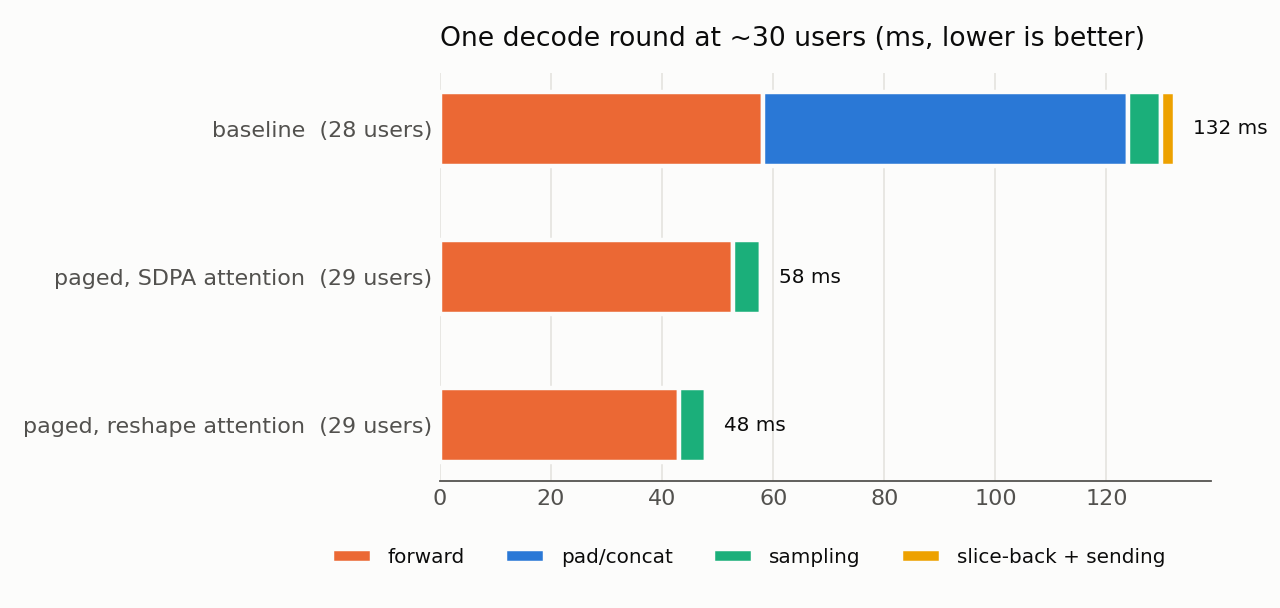
profile_decode.py with every part timed separately:
| Users | Context | Step | norm+QKV+RoPE | write | gather | attention | o_proj+MLP |
|---|---|---|---|---|---|---|---|
| 1 | 64 | 19 ms | 11.6 | 6.0 | 6.4 | 8.5 | 13.6 |
| 28 | 64 | 39 ms | 13.8 | 6.0 | 13.2 | 16.8 | 18.0 |
| 28 | 512 | 180–190 ms | 13.7 | 6.1 | 45.4 | 134.1 | 16.7 |
(The parts add up to more than the step because of the extra GPU waits.)
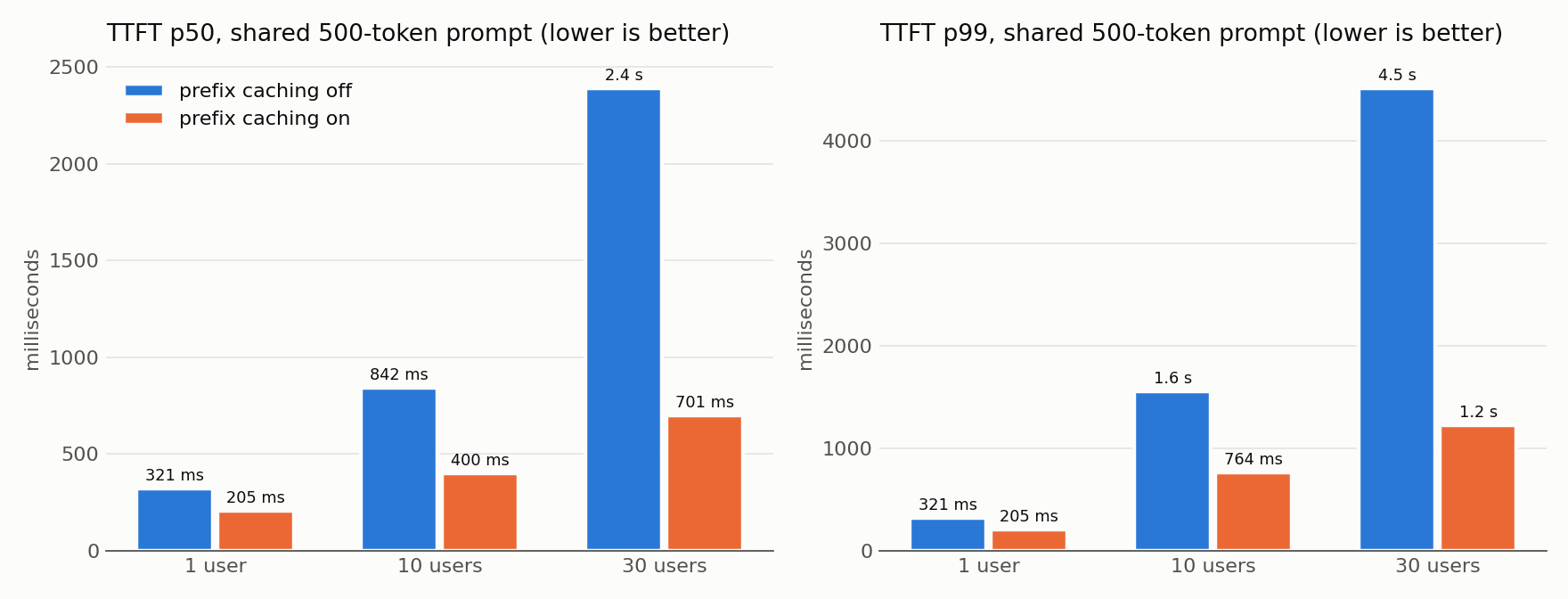
Every user sends the same ~500-token system prompt plus their own question. With caching on, the first user prefills everything; everyone after reuses the cached full blocks and prefills only the last block and their question.
| Users | TTFT p50 off | TTFT p50 on | TTFT p99 off | TTFT p99 on |
|---|---|---|---|---|
| 1 | 321 ms | 205 ms | 321 ms | 205 ms |
| 10 | 842 ms | 400 ms | 1.56 s | 764 ms |
| 30 | 2.39 s | 701 ms | 4.51 s | 1.22 s |
Speed means nothing if the answers change, so every step has a test that compares against Hugging Face with sampling turned off:
| Test | What it proves | Result |
|---|---|---|
test_forward.py | Each piece of our model (RMSNorm, RoPE, attention, MLP) and the full logits equal HF's | 0 difference on CPU, ≤ 2.1e-5 on MPS |
test_paged.py | Paged prefill and decode, teacher-forced across block boundaries, 1 user and 4 users of different lengths (one joining late), with the pool filled with garbage first | Same tokens as HF everywhere, logits within 3.5e-4 |
test_paged.py (prefix) | A user reusing another user's cached blocks still matches HF | Same tokens, logits within 9e-5 |
test_engine.py | The server's engine gives exactly HF generate's greedy answers, with a big pool and with a pool so small users must wait | 7 of 7 prompts identical |
test_blocks.py, test_kv_pool.py | Tables, free lists and reference counts after every step; values read back exactly | All asserts pass |
Two lessons from testing:
| # | Question | My decision | Why |
|---|---|---|---|
| 1 | Where to start | The baseline server, unchanged | It already has the API, SSE and continuous batching; the project is about the engine inside |
| 2 | What to do first | Measure a baseline before changing anything | Without a "before" number, no change can be proven |
| 3 | Largest load test | 40 users | 60 users made the Mac hang; 40 still tests the waiting line (30 seats) |
| 4 | Model | SmolLM2-135M at fp32 instead of distilgpt2 | distilgpt2 (2019) is an old design. SmolLM2 has the modern Llama design (RoPE, GQA, RMSNorm, SwiGLU), is barely bigger, and writes far better English |
| 5 | Context limit | 1,024 tokens, our own setting | SmolLM2 allows 8,192, but 1,024 keeps the comparison with distilgpt2 fair and memory small |
| 6 | How to find the slow part | Stopwatches around each part of a decode step, waiting for the GPU before each reading | The GPU runs in the background; without waiting, the forward time would hide inside sampling |
| 7 | How to remove the pad/concat cost | Write our own SmolLM2 forward pass (option B) instead of refilling Hugging Face's cache every step (option A) | We control every copy, it is what vLLM does, and it is the only way to attack the 1-user forward overhead later |
| 8 | How attention reads a paged cache | One shared pool of 16-token blocks, one block table per user, tables filled out with a reserved dummy block 0, one gather per layer for K and one for V, and a mask that hides dummy and unused slots | 60 gathers per step whatever the number of users, instead of 1,800 pads and 60 concatenates. Honest limit: the gather is still a copy |
| 9 | How attention handles GQA (9 query heads, 3 K/V heads) in prefill | SDPA with enable_gqa=True instead of copying K/V 3× with repeat_kv | One call and no copy written by us. Measured on MPS: about the same speed as repeat_kv. Later replaced for paged attention (decision 14) |
| 10 | How big the block pool is | A setting, default 1,920 blocks (30 users × 1,024 tokens, 1.32 GiB) | The server never runs out at the default, and tests use a tiny pool to force the "pool full" case |
| 11 | What the allocator does when it can't satisfy a request | All or nothing: it raises PoolFull and hands out no blocks; a bad free also changes nothing | A half-seated user or a half-freed list would leave the pool in a state nobody can reason about |
| 12 | Shape of the pool | One K and one V tensor per layer, [blocks, block_size, kv_heads, head_dim]; token n lives in block table[n // 16], slot n % 16 | After a gather, blocks × block_size merge into one token axis for free, and swapping heads and tokens is only a view |
| 13 | When the pool is full | Reserve at the door: a user is seated only if blocks for prompt + max_tokens are free; otherwise they wait at the front of the line | It can never run out in the middle of a step, so no user has to be evicted and recomputed. It wastes blocks when answers end early; vLLM's preemption is the upgrade |
| 14 | Attention in paged prefill and decode | Matmul-softmax-matmul, with each group of query heads reshaped onto its K/V head, instead of SDPA | Measured on MPS: 3.3–3.5× faster than SDPA with a mask, same results to 6e-7; took a step at 30 users from 58 ms to 48 ms |
| 15 | Test tolerance for paged decode | 5e-4 on CPU, 1e-3 on MPS, plus "same token at every step" | Hugging Face's own step-by-step decoding differs from its own full forward by 1e-4; logits reach about 40, so 3e-4 is a relative error of about 1e-5 |
| 16 | What prefix caching shares | Full 16-token prompt blocks, found by a chained hash (each block's fingerprint covers every token before it), with reference counts; the last prompt token is always recomputed | A chained hash means a match always covers the whole prefix. The last token must be computed to get its logits. Decode never writes into a full prompt block, so shared blocks are never changed |
| 17 | What happens to a cached block when its users leave | It goes back to the free list but keeps its fingerprint, and is revived if someone asks for it before it is handed out again | Free memory doubles as a cache at no cost; reuse order is oldest freed first |
| 18 | When users arrive together | Seat and prefill them one at a time | Otherwise everyone arriving in the same moment would look up the cache before anyone had filled it, and nobody would share |
| 19 | Seats | Keep 30 | Not re-measured for the paged engine; 30 users fit easily in the pool, and keeping the cap makes every before/after comparison fair |
prompt + max_tokens at the door wastes blocks when answers stop
early; there is no preemption.bench.py and the server's
stopwatch reports.max_tokens up front./metrics endpoint with TTFT, ITL, batch size and free blocks while the
server runs.A small LLM inference engine, built to understand how engines like vLLM work by building the core ideas and measuring each one:
POST /v1/completions endpoint that streams tokens
over SSE;Every change is measured against a baseline server (baseline_server.py,
kept unchanged so it can be re-run) that keeps a separate KV cache per user and
pads all of them to the same length every decode step.
Apple M4, 16 GB, Mac GPU (MPS), SmolLM2-135M at fp32, each user asks for 100 tokens, at most 30 users decoding at once.
| Baseline | nano-vLLM | Change | |
|---|---|---|---|
| Total throughput, 30 users | 189 tok/s | 515 tok/s | 2.7× |
| One decode step, ~30 users | 132 ms | 48 ms | 2.8× faster |
| Gap between tokens (ITL p50), 30 users | 164 ms | 46 ms | 3.6× smaller |
| Throughput, 1 user | 28 tok/s | 38 tok/s | 1.4× |
| TTFT p99, 40 users (10 wait for a seat) | 15.5 s | 5.9 s | 2.6× smaller |
| TTFT p50, 30 users sharing a 500-token prompt | 2.4 s (caching off) | 0.70 s (caching on) | 3.4× smaller |
 client ──POST /v1/completions──▶ FastAPI handler (event loop)
                                    │ tokenize, check the length
                                    ▼
                               waiting line ──▶ BatchEngine thread, one round at a time:
                                                 1. free the blocks of finished or disconnected users
                                                 2. seat users from the front of the line while a seat
                                                    and enough blocks for prompt + max_tokens are free;
                                                    reuse cached blocks for a known prompt prefix
                                                 3. prefill each new user (only the uncached part)
                                                 4. decode one token for every seated user
 client ◀──SSE, one token each── handler ◀──── tokens through an asyncio.Queue

 inside one decode step, for each of the 30 layers:
   new token ─▶ RMSNorm ─▶ Q, K, V ─▶ RoPE at position n
                                  ├─▶ write K, V into block table[n // 16], slot n % 16
                                  └─▶ gather every user's blocks (one gather per layer, short
                                      tables filled out with dummy block 0) ─▶ masked attention
                                      (query heads grouped onto their shared K/V head) ─▶ o_proj
                ─▶ RMSNorm ─▶ SwiGLU MLP
 shared pool (one K and one V tensor per layer: [blocks, 16, 3 KV heads, 64])
 ┌───┬───┬───┬───┬───┬───┬───┬───┬───┐
 │ 0 │ 1 │ 2 │ 3 │ 4 │ 5 │ 6 │ 7 │...│   block 0: dummy, never handed out
 └───┴───┴───┴───┴───┴───┴───┴───┴───┘
 user A table: [1, 2, 5]    user B table: [1, 2, 6]    ← both start with the same
                                                          32-token system prompt,
                                                          so blocks 1 and 2 are shared
| File | What it is |
|---|---|
server.py | The API, the waiting line, and the paged BatchEngine |
model.py | Our SmolLM2: plain forward pass, paged prefill, paged batched decode |
blocks.py | BlockAllocator (free list, reference counts, prefix cache) and KVPool |
baseline_server.py | The starting point, kept for comparisons |
bench.py | Load test: N users at once, saves every token's arrival time |
profile_decode.py | Times each part of one paged decode step |
plot.py | Draws the charts in docs/ from results/ |
test_*.py | Correctness checks (see below) |
python3 server.py
In a second terminal:
curl -N -X POST localhost:8080/v1/completions -H "Content-Type: application/json" \
     -d '{"prompt": "The cat sat on the", "max_tokens": 20}'
python3 baseline_server.py runs the baseline instead, on the same port, so
run only one at a time. NANO_PREFIX_CACHE=0 python3 server.py turns prefix
caching off.
Load test (the server must be running), then redraw the charts:
nice -n 10 python3 bench.py --label my-run --users 1 10 30 40
nice -n 10 python3 bench.py --label shared --users 1 10 30 --system-repeats 35
python3 plot.py
Tests, each printing what it compares:
python3 test_blocks.py      # allocator: toy pool, sharing, reviving, eviction
python3 test_kv_pool.py     # write path: values read back exactly through tables
python3 test_forward.py     # our forward pass against Hugging Face, piece by piece
python3 test_paged.py       # paged prefill/decode/prefix against Hugging Face
python3 test_engine.py      # the server's engine: greedy answers equal HF generate
The baseline's stopwatches (waiting for the GPU before each reading) showed where one decode step goes:
| Part | 1 user | 10 users | 28 users |
|---|---|---|---|
| pad/concat | 7.9 (23%) | 23.0 (30%) | 65.8 (50%) |
| forward | 23.4 (69%) | 48.3 (63%) | 58.1 (44%) |
| sampling | 2.3 | 4.0 | 6.0 |
| slice-back | 0.1 | 0.8 | 2.4 |
| sending | 0.01 | 0.01 | 0.02 |
| whole step | 33.7 | 76.2 | 132.3 |
At 30 users, every step padded each user's K and V separately in every layer: 1,800 pads and 60 concatenates, all to build a rectangle that was thrown away after one step. Slicing back was almost free because slicing makes a view, not a copy.
profile_decode.py with every part timed separately:
| Users | Context | Step | norm+QKV+RoPE | write | gather | attention | o_proj+MLP |
|---|---|---|---|---|---|---|---|
| 1 | 64 | 19 ms | 11.6 | 6.0 | 6.4 | 8.5 | 13.6 |
| 28 | 64 | 39 ms | 13.8 | 6.0 | 13.2 | 16.8 | 18.0 |
| 28 | 512 | 180–190 ms | 13.7 | 6.1 | 45.4 | 134.1 | 16.7 |
(The parts add up to more than the step because of the extra GPU waits.)
Every user sends the same ~500-token system prompt plus their own question. With caching on, the first user prefills everything; everyone after reuses the cached full blocks and prefills only the last block and their question.
| Users | TTFT p50 off | TTFT p50 on | TTFT p99 off | TTFT p99 on |
|---|---|---|---|---|
| 1 | 321 ms | 205 ms | 321 ms | 205 ms |
| 10 | 842 ms | 400 ms | 1.56 s | 764 ms |
| 30 | 2.39 s | 701 ms | 4.51 s | 1.22 s |
Speed means nothing if the answers change, so every step has a test that compares against Hugging Face with sampling turned off:
| Test | What it proves | Result |
|---|---|---|
test_forward.py | Each piece of our model (RMSNorm, RoPE, attention, MLP) and the full logits equal HF's | 0 difference on CPU, ≤ 2.1e-5 on MPS |
test_paged.py | Paged prefill and decode, teacher-forced across block boundaries, 1 user and 4 users of different lengths (one joining late), with the pool filled with garbage first | Same tokens as HF everywhere, logits within 3.5e-4 |
test_paged.py (prefix) | A user reusing another user's cached blocks still matches HF | Same tokens, logits within 9e-5 |
test_engine.py | The server's engine gives exactly HF generate's greedy answers, with a big pool and with a pool so small users must wait | 7 of 7 prompts identical |
test_blocks.py, test_kv_pool.py | Tables, free lists and reference counts after every step; values read back exactly | All asserts pass |
Two lessons from testing:
| # | Question | My decision | Why |
|---|---|---|---|
| 1 | Where to start | The baseline server, unchanged | It already has the API, SSE and continuous batching; the project is about the engine inside |
| 2 | What to do first | Measure a baseline before changing anything | Without a "before" number, no change can be proven |
| 3 | Largest load test | 40 users | 60 users made the Mac hang; 40 still tests the waiting line (30 seats) |
| 4 | Model | SmolLM2-135M at fp32 instead of distilgpt2 | distilgpt2 (2019) is an old design. SmolLM2 has the modern Llama design (RoPE, GQA, RMSNorm, SwiGLU), is barely bigger, and writes far better English |
| 5 | Context limit | 1,024 tokens, our own setting | SmolLM2 allows 8,192, but 1,024 keeps the comparison with distilgpt2 fair and memory small |
| 6 | How to find the slow part | Stopwatches around each part of a decode step, waiting for the GPU before each reading | The GPU runs in the background; without waiting, the forward time would hide inside sampling |
| 7 | How to remove the pad/concat cost | Write our own SmolLM2 forward pass (option B) instead of refilling Hugging Face's cache every step (option A) | We control every copy, it is what vLLM does, and it is the only way to attack the 1-user forward overhead later |
| 8 | How attention reads a paged cache | One shared pool of 16-token blocks, one block table per user, tables filled out with a reserved dummy block 0, one gather per layer for K and one for V, and a mask that hides dummy and unused slots | 60 gathers per step whatever the number of users, instead of 1,800 pads and 60 concatenates. Honest limit: the gather is still a copy |
| 9 | How attention handles GQA (9 query heads, 3 K/V heads) in prefill | SDPA with enable_gqa=True instead of copying K/V 3× with repeat_kv | One call and no copy written by us. Measured on MPS: about the same speed as repeat_kv. Later replaced for paged attention (decision 14) |
| 10 | How big the block pool is | A setting, default 1,920 blocks (30 users × 1,024 tokens, 1.32 GiB) | The server never runs out at the default, and tests use a tiny pool to force the "pool full" case |
| 11 | What the allocator does when it can't satisfy a request | All or nothing: it raises PoolFull and hands out no blocks; a bad free also changes nothing | A half-seated user or a half-freed list would leave the pool in a state nobody can reason about |
| 12 | Shape of the pool | One K and one V tensor per layer, [blocks, block_size, kv_heads, head_dim]; token n lives in block table[n // 16], slot n % 16 | After a gather, blocks × block_size merge into one token axis for free, and swapping heads and tokens is only a view |
| 13 | When the pool is full | Reserve at the door: a user is seated only if blocks for prompt + max_tokens are free; otherwise they wait at the front of the line | It can never run out in the middle of a step, so no user has to be evicted and recomputed. It wastes blocks when answers end early; vLLM's preemption is the upgrade |
| 14 | Attention in paged prefill and decode | Matmul-softmax-matmul, with each group of query heads reshaped onto its K/V head, instead of SDPA | Measured on MPS: 3.3–3.5× faster than SDPA with a mask, same results to 6e-7; took a step at 30 users from 58 ms to 48 ms |
| 15 | Test tolerance for paged decode | 5e-4 on CPU, 1e-3 on MPS, plus "same token at every step" | Hugging Face's own step-by-step decoding differs from its own full forward by 1e-4; logits reach about 40, so 3e-4 is a relative error of about 1e-5 |
| 16 | What prefix caching shares | Full 16-token prompt blocks, found by a chained hash (each block's fingerprint covers every token before it), with reference counts; the last prompt token is always recomputed | A chained hash means a match always covers the whole prefix. The last token must be computed to get its logits. Decode never writes into a full prompt block, so shared blocks are never changed |
| 17 | What happens to a cached block when its users leave | It goes back to the free list but keeps its fingerprint, and is revived if someone asks for it before it is handed out again | Free memory doubles as a cache at no cost; reuse order is oldest freed first |
| 18 | When users arrive together | Seat and prefill them one at a time | Otherwise everyone arriving in the same moment would look up the cache before anyone had filled it, and nobody would share |
| 19 | Seats | Keep 30 | Not re-measured for the paged engine; 30 users fit easily in the pool, and keeping the cap makes every before/after comparison fair |
prompt + max_tokens at the door wastes blocks when answers stop
early; there is no preemption.bench.py and the server's
stopwatch reports.max_tokens up front./metrics endpoint with TTFT, ITL, batch size and free blocks while the
server runs.


