[ICML 2026] Official codebase for "Flash-VAED: Plug-and-Play VAE Decoders for Efficient Video Generation"
Python
46
13 commits
updated Aug 5, 2026



Lunjie Zhu1, Yushi Huang1, Xingtong Ge1, Yufei Xue1, Zhening Liu1, Yumeng Zhang1, Zehong Lin2, Jun Zhang1*
1iComAI Lab, The Hong Kong University of Science and Technology 2School of Data Science, Lingnan University
The Forty-Third International Conference on Machine Learning (ICML), 2026
* Corresponding author: [email protected]
Latent diffusion models have enabled high-quality video synthesis, yet their inference remains costly and time-consuming. As diffusion transformers become increasingly efficient, the latency bottleneck inevitably shifts to VAE decoders. To reduce their latency while maintaining quality, we propose a universal acceleration framework for VAE decoders that preserves full alignment with the original latent distribution. Specifically, we propose (1) an independence-aware channel pruning method to effectively mitigate severe channel redundancy, and (2) a stage-wise dominant operator optimization strategy to address the high inference cost of the widely used causal 3D convolutions in VAE decoders. Based on these innovations, we construct a Flash-VAED family. Moreover, we design a three-phase dynamic distillation framework that efficiently transfers the capabilities of the original VAE decoder to Flash-VAED. Extensive experiments on Wan and LTX-Video VAE decoders demonstrate that our method outperforms baselines in both quality and speed, achieving approximately a 6× speedup while maintaining the reconstruction performance up to 96.9%. Notably, Flash-VAED accelerates the end-to-end generation pipeline by up to 36% with negligible quality drops on VBench-2.0.
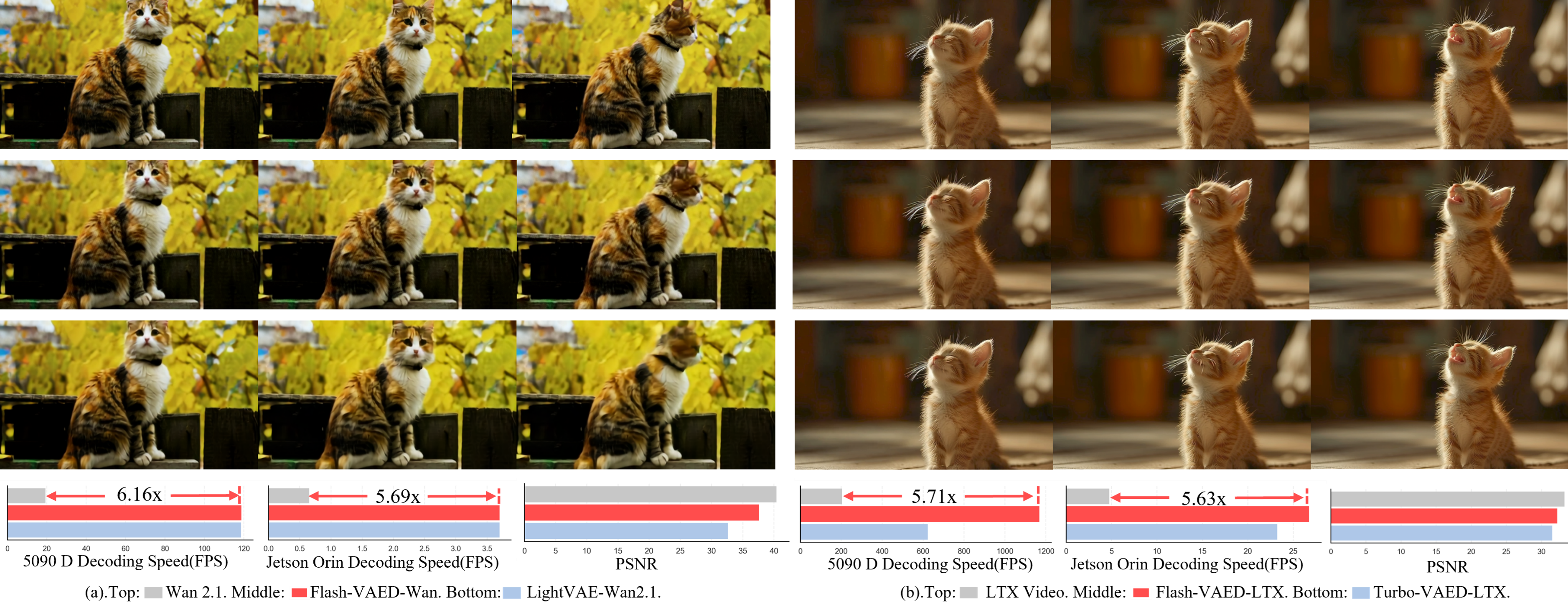
Qualitative and quantitative comparisons of video reconstruction. Flash-VAED (bottom) offers the fastest decoding speed with minimal fidelity loss vs. the original VAE decoder (top) and prior baselines (middle).
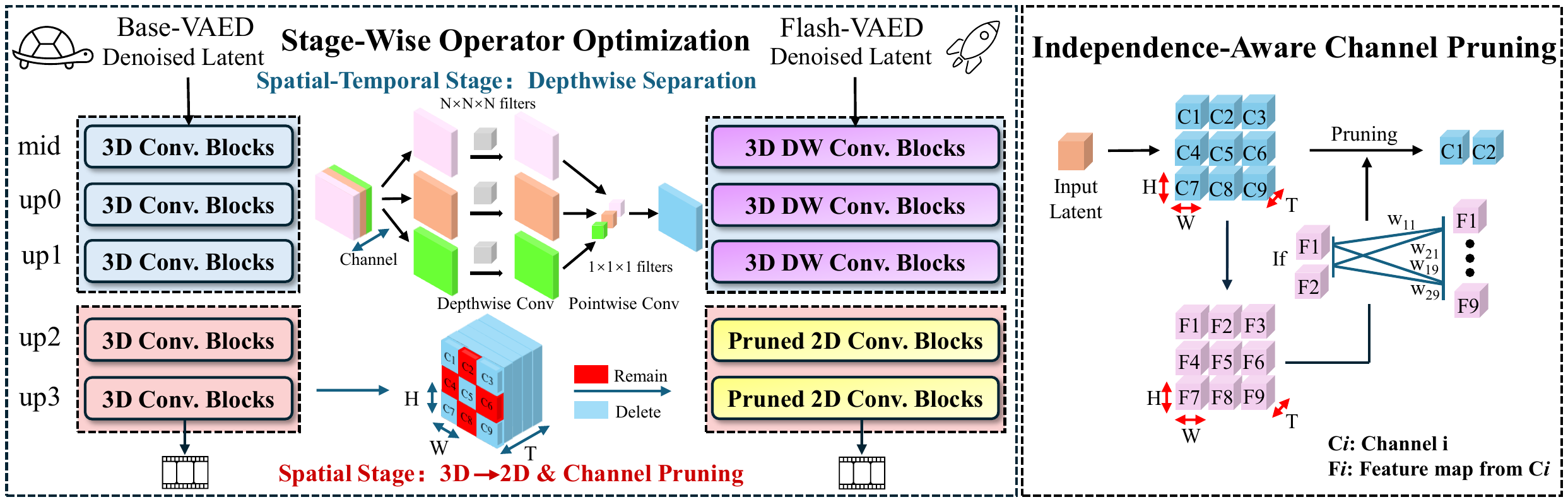
Overview of the Flash-VAED architecture. Stage-wise dominant operator optimization (left) substitutes CausalConv3D with stage-specific efficient operators; independence-aware channel pruning (right) reduces channels to 12.5%–25% of the original with minimal quality loss.
Weights are hosted on Hugging Face: Aoko955/Flash-VAED.
| Variant | Student checkpoint | Teacher |
|---|---|---|
| Wan 2.1 | models/wan/Flash_VAED_Wan.pth | models/wan/Wan_VAE_Teacher.pth |
| LTX-Video | models/ltx/Flash_VAED_LTX.pth | models/ltx/teacher/ |
Download:
pip install -U "huggingface_hub[cli]"
huggingface-cli download Aoko955/Flash-VAED \
  --local-dir . \
  --include "models/wan/*.pth" \
  --include "models/ltx/*.pth" \
  --include "models/ltx/teacher/*"
Expected files after download:
models/wan/Flash_VAED_Wan.pth
models/wan/Wan_VAE_Teacher.pth
models/ltx/Flash_VAED_LTX.pth
models/ltx/teacher/config.json
models/ltx/teacher/diffusion_pytorch_model.safetensors
conda create -n flashvaed python=3.10 -y
conda activate flashvaed
pip install -r requirements.txt
python infer.py --model wan --input demo.mp4 --output outs/wan
python infer.py --model ltx --input demo.mp4 --output outs/ltx
With more options:
python infer.py --model wan --input demo.mp4 --output outs/wan \
  --num_frames 81 --img_h 480 --img_w 832 --fps 8 --device cuda:0
Outputs: frames/*.png and optional recon.mp4 (disable with --no_mp4).
python infer.py --model wan --mode decode --latent z.pt --output outs/decode
z.pt should be a torch.Tensor, or a dict with key latent / latents / z.
Flash-VAED vs. original VAE decoders and competitive baselines on RTX 5090D / Jetson Orin.
| Model | $(d_T, d_H, d_W)$ | FPS (5090D) ↑ | FPS (Orin) ↑ | PSNR ↑ | SSIM ↑ | LPIPS ↓ |
|---|---|---|---|---|---|---|
| Wan 2.1 | (4, 8, 8) | 19.27 | 0.65 | 40.40 | 0.9733 | 0.0190 |
| LightVAE-Wan 2.1 | (4, 8, 8) | 118.60 | 3.70 | 32.61 | 0.9416 | 0.0892 |
| Flash-VAED-Wan 2.1 (Ours) | (4, 8, 8) | 118.77 | 3.70 | 37.61 | 0.9614 | 0.0285 |
| LTX-Video | (8, 32, 32) | 204.55 | 4.75 | 33.28 | 0.9253 | 0.0497 |
| Turbo-VAED-LTX | (8, 32, 32) | 623.08 | 23.24 | 31.52 | 0.9275 | 0.0555 |
| Flash-VAED-LTX (Ours) | (8, 32, 32) | 1167.99 | 26.74 | 32.24 | 0.9293 | 0.0551 |
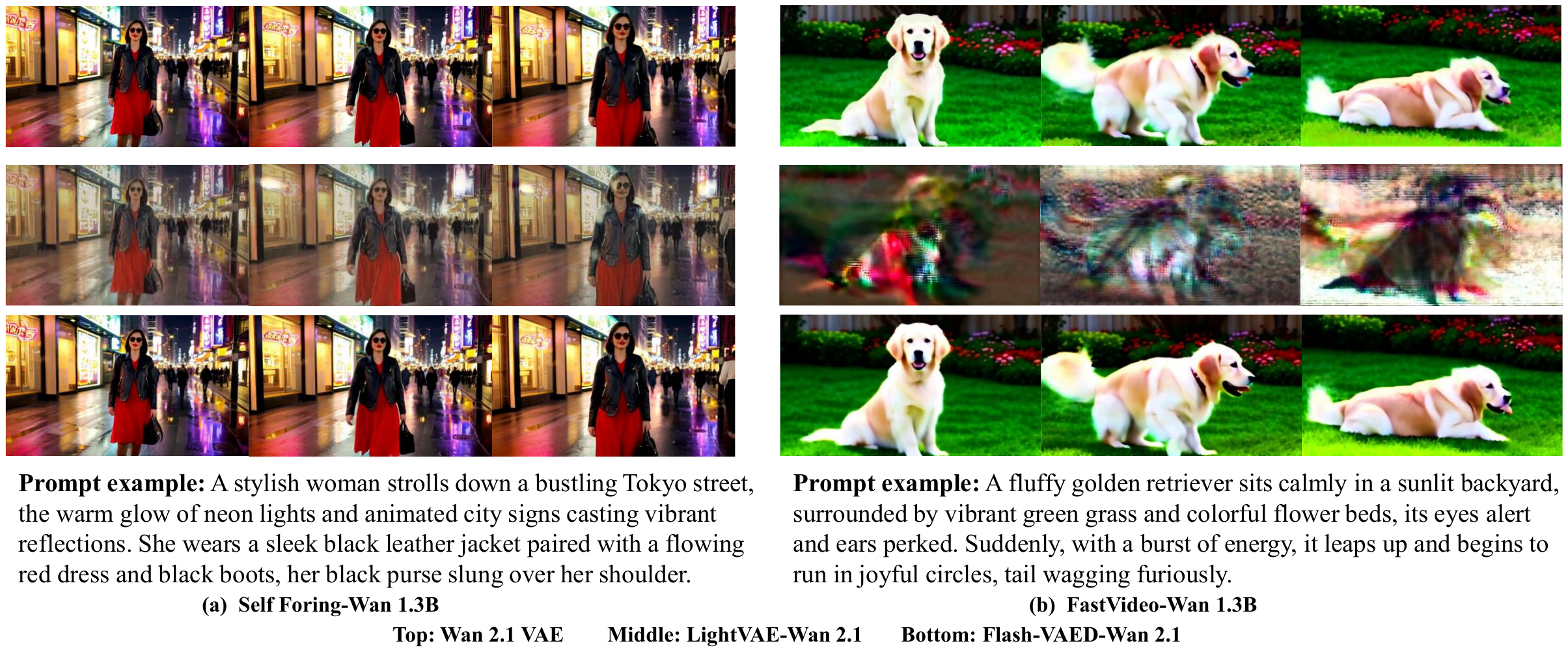
Visual comparison of video generation results. Flash-VAED (bottom) matches the original Wan 2.1 VAE (top) in fidelity and texture, while LightVAE (middle) shows severe artifacts.
Flash-VAED/
  infer.py
  requirements.txt
  assets/
  models/
    wan/
      model_hybrid_aggressive.py   # Wan student
      model_original.py            # Wan teacher (encode)
    ltx/
      ltx_prune_1_4.py              # LTX student
      vendor/                       # minimal local helpers (no pip diffusers)
      teacher/config.json           # LTX teacher config (weights on HF)
If you find this work useful, please cite:
@inproceedings{zhu2026flashvaed,
  title={Flash-{VAED}: Plug-and-Play {VAE} Decoders for Efficient Video Generation},
  author={Lunjie Zhu and Yushi Huang and Xingtong Ge and Yufei Xue and Zhening Liu and Yumeng Zhang and Zehong Lin and Jun Zhang},
  booktitle={Forty-third International Conference on Machine Learning},
  year={2026},
  url={https://openreview.net/forum?id=PDBLtVDb0d}
}
This work builds on:
Please respect upstream Wan / LTX licenses when redistributing weights.
442 followers · starred Jul 2026
[ICML 2026] Official codebase for "Flash-VAED: Plug-and-Play VAE Decoders for Efficient Video Generation"
Python
46
13 commits
updated Aug 5, 2026
Lunjie Zhu1, Yushi Huang1, Xingtong Ge1, Yufei Xue1, Zhening Liu1, Yumeng Zhang1, Zehong Lin2, Jun Zhang1*
1iComAI Lab, The Hong Kong University of Science and Technology 2School of Data Science, Lingnan University
The Forty-Third International Conference on Machine Learning (ICML), 2026
* Corresponding author: [email protected]
Latent diffusion models have enabled high-quality video synthesis, yet their inference remains costly and time-consuming. As diffusion transformers become increasingly efficient, the latency bottleneck inevitably shifts to VAE decoders. To reduce their latency while maintaining quality, we propose a universal acceleration framework for VAE decoders that preserves full alignment with the original latent distribution. Specifically, we propose (1) an independence-aware channel pruning method to effectively mitigate severe channel redundancy, and (2) a stage-wise dominant operator optimization strategy to address the high inference cost of the widely used causal 3D convolutions in VAE decoders. Based on these innovations, we construct a Flash-VAED family. Moreover, we design a three-phase dynamic distillation framework that efficiently transfers the capabilities of the original VAE decoder to Flash-VAED. Extensive experiments on Wan and LTX-Video VAE decoders demonstrate that our method outperforms baselines in both quality and speed, achieving approximately a 6× speedup while maintaining the reconstruction performance up to 96.9%. Notably, Flash-VAED accelerates the end-to-end generation pipeline by up to 36% with negligible quality drops on VBench-2.0.
Qualitative and quantitative comparisons of video reconstruction. Flash-VAED (bottom) offers the fastest decoding speed with minimal fidelity loss vs. the original VAE decoder (top) and prior baselines (middle).
Overview of the Flash-VAED architecture. Stage-wise dominant operator optimization (left) substitutes CausalConv3D with stage-specific efficient operators; independence-aware channel pruning (right) reduces channels to 12.5%–25% of the original with minimal quality loss.
Weights are hosted on Hugging Face: Aoko955/Flash-VAED.
| Variant | Student checkpoint | Teacher |
|---|---|---|
| Wan 2.1 | models/wan/Flash_VAED_Wan.pth | models/wan/Wan_VAE_Teacher.pth |
| LTX-Video | models/ltx/Flash_VAED_LTX.pth | models/ltx/teacher/ |
Download:
pip install -U "huggingface_hub[cli]"
huggingface-cli download Aoko955/Flash-VAED \
  --local-dir . \
  --include "models/wan/*.pth" \
  --include "models/ltx/*.pth" \
  --include "models/ltx/teacher/*"
Expected files after download:
models/wan/Flash_VAED_Wan.pth
models/wan/Wan_VAE_Teacher.pth
models/ltx/Flash_VAED_LTX.pth
models/ltx/teacher/config.json
models/ltx/teacher/diffusion_pytorch_model.safetensors
conda create -n flashvaed python=3.10 -y
conda activate flashvaed
pip install -r requirements.txt
python infer.py --model wan --input demo.mp4 --output outs/wan
python infer.py --model ltx --input demo.mp4 --output outs/ltx
With more options:
python infer.py --model wan --input demo.mp4 --output outs/wan \
  --num_frames 81 --img_h 480 --img_w 832 --fps 8 --device cuda:0
Outputs: frames/*.png and optional recon.mp4 (disable with --no_mp4).
python infer.py --model wan --mode decode --latent z.pt --output outs/decode
z.pt should be a torch.Tensor, or a dict with key latent / latents / z.
Flash-VAED vs. original VAE decoders and competitive baselines on RTX 5090D / Jetson Orin.
| Model | $(d_T, d_H, d_W)$ | FPS (5090D) ↑ | FPS (Orin) ↑ | PSNR ↑ | SSIM ↑ | LPIPS ↓ |
|---|---|---|---|---|---|---|
| Wan 2.1 | (4, 8, 8) | 19.27 | 0.65 | 40.40 | 0.9733 | 0.0190 |
| LightVAE-Wan 2.1 | (4, 8, 8) | 118.60 | 3.70 | 32.61 | 0.9416 | 0.0892 |
| Flash-VAED-Wan 2.1 (Ours) | (4, 8, 8) | 118.77 | 3.70 | 37.61 | 0.9614 | 0.0285 |
| LTX-Video | (8, 32, 32) | 204.55 | 4.75 | 33.28 | 0.9253 | 0.0497 |
| Turbo-VAED-LTX | (8, 32, 32) | 623.08 | 23.24 | 31.52 | 0.9275 | 0.0555 |
| Flash-VAED-LTX (Ours) | (8, 32, 32) | 1167.99 | 26.74 | 32.24 | 0.9293 | 0.0551 |
Visual comparison of video generation results. Flash-VAED (bottom) matches the original Wan 2.1 VAE (top) in fidelity and texture, while LightVAE (middle) shows severe artifacts.
Flash-VAED/
  infer.py
  requirements.txt
  assets/
  models/
    wan/
      model_hybrid_aggressive.py   # Wan student
      model_original.py            # Wan teacher (encode)
    ltx/
      ltx_prune_1_4.py              # LTX student
      vendor/                       # minimal local helpers (no pip diffusers)
      teacher/config.json           # LTX teacher config (weights on HF)
If you find this work useful, please cite:
@inproceedings{zhu2026flashvaed,
  title={Flash-{VAED}: Plug-and-Play {VAE} Decoders for Efficient Video Generation},
  author={Lunjie Zhu and Yushi Huang and Xingtong Ge and Yufei Xue and Zhening Liu and Yumeng Zhang and Zehong Lin and Jun Zhang},
  booktitle={Forty-third International Conference on Machine Learning},
  year={2026},
  url={https://openreview.net/forum?id=PDBLtVDb0d}
}
This work builds on:
Please respect upstream Wan / LTX licenses when redistributing weights.
442 followers · starred Jul 2026



