Generating Molecules with the Mamba architecture
Jupyter Notebook
7
74 commits
updated Oct 4, 2026
Generate drug-like molecules with Mamba state space models trained on the SAFE molecular string representation.
This is the research code behind Molecular Generation with State Space Sequence Models (NeurIPS 2024 Workshop on AI for New Drug Modalities) and the UCT project report Comparing Transformer, MAMBA, and Hybrid Architectures for Molecular Generation using the SAFE Representation. It compares decoder architectures at roughly 20M and 100M parameters on the same task: a GPT-2 transformer (the SAFE-GPT baseline), a pure Mamba-2 SSM, and (at 20M) a hybrid that interleaves attention layers into the Mamba stack.
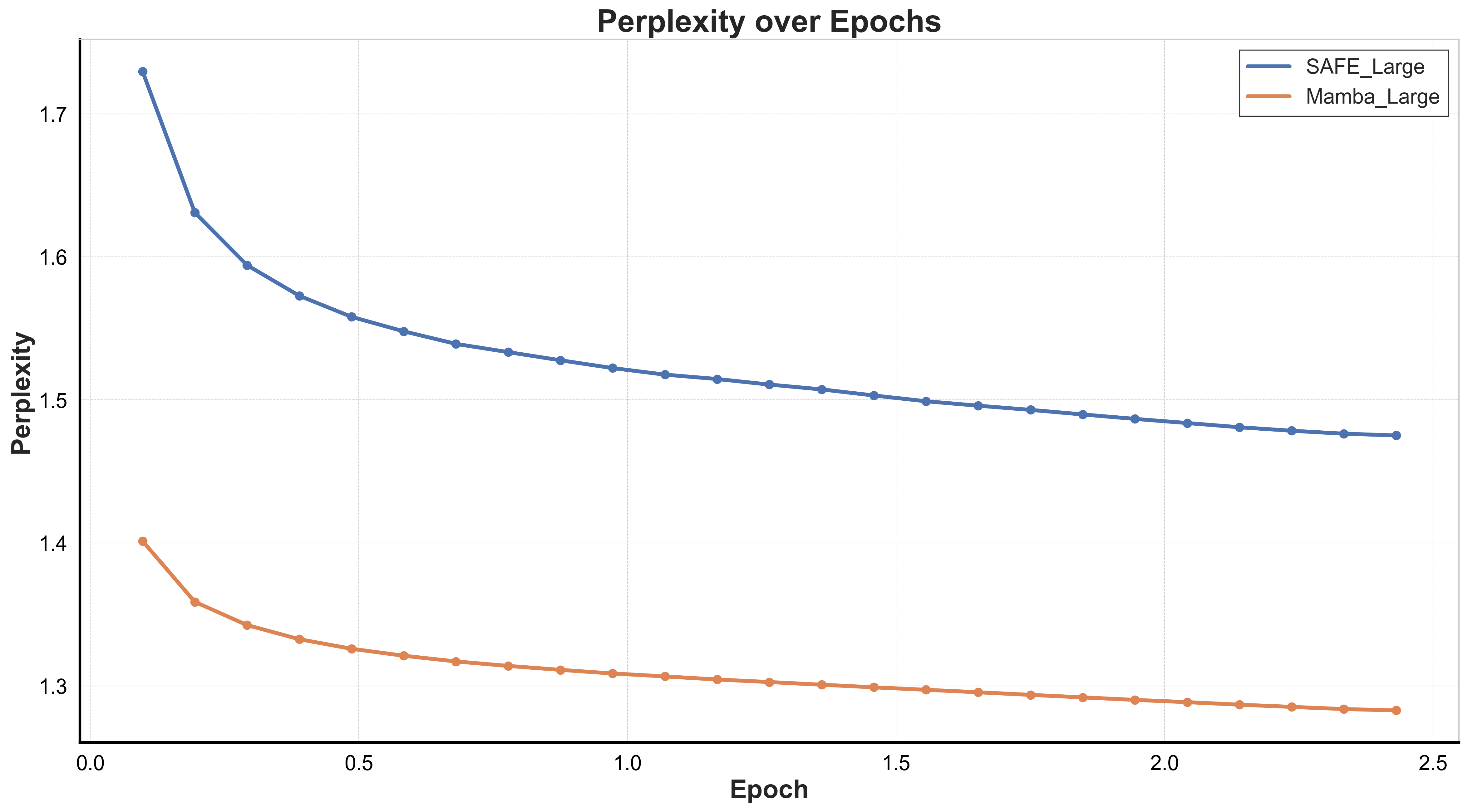
Evaluation perplexity during training, 100M models on ZINC (from Results/loss/*.json, plotted in Results/plots.ipynb).
SAFE (Sequential Attachment-based Fragment Embedding) rewrites a SMILES string as an unordered sequence of molecular fragments joined by attachment points, while staying a valid SMILES string. That makes fragment-level tasks such as scaffold decoration, linker design and motif extension plain sequence completion. See Noutahi et al., Gotta be SAFE: a new framework for molecular design (Digital Discovery, 2024) and the datamol-io/safe library (docs).
Mamba (Gu & Dao, 2023; state-spaces/mamba) is a selective state space model that scales linearly with sequence length. This repo uses the Mamba-2 layer from mamba-ssm, optionally mixed with multi-head attention layers (attn_layer_idx in the model config).
The mamba_safe package is a fork of the SAFE library's tokenizer, converter, sampler and trainer, with the GPT-2 model swapped for a Mamba language model.
| Path | What it is |
|---|---|
mamba_safe/converter.py | SMILES to SAFE encoding and decoding (from the SAFE library) |
mamba_safe/tokenizer.py | SAFETokenizer, a Hugging Face compatible tokenizer for SAFE strings |
mamba_safe/sample.py | SAFEDesign, de novo generation and fragment-constrained sampling with a Mamba model |
mamba_safe/utils.py, viz.py, _exception.py | Fragmentation helpers, molecule drawing, SAFE error types |
mamba_safe/check_libraries.py | Sanity check that torch, CUDA, transformers and mamba-ssm load |
mamba_safe/trainer/mamba_model.py | MAMBAConfig and MAMBAModel: the language model, plus from_pretrained/save_pretrained |
mamba_safe/trainer/mixer_seq_simple.py | Mamba/attention block stack, adapted from mamba_ssm with dropout |
mamba_safe/trainer/cli.py | Training entry point (Hugging Face Trainer + HfArgumentParser) |
mamba_safe/trainer/collator.py, data_utils.py, trainer_utils.py | Batching, dataset loading/tokenisation, causal-LM loss |
scripts_and_configs/example_config.json | Model config for a 12-layer, d_model 768 Mamba-2 model (the 100M setup) |
scripts_and_configs/tokenizer.json | SAFE tokenizer (1880 tokens), identical to the one shipped with the released models |
scripts_and_configs/example.sh | SLURM training script template |
evaluation/simplified_molecule_generator.py | Sample N molecules from a trained model and write SMILES to a file |
evaluation/generation_evaluation_hpc.sh | SLURM job used to sample 10,000 molecules on the UCT cluster |
Results/ | Training-loss logs, evaluation notebooks, property-distribution plots and sample grids |
Papers/ | Project proposal, literature review and final research paper (PDF) |
All checkpoints are public on the Hugging Face Hub. Architecture details are read from each repo's config.json; training data is from each model card.
| Model | Architecture | Layers / width | Training data | Load with |
|---|---|---|---|---|
| anrilombard/ssm-20m | Mamba-2 SSM | 6 / 512 | MOSES | this repo |
| anrilombard/hybrid-20m | Mamba-2 + attention at layers 2 and 5 (8 heads) | 6 / 512 | MOSES | this repo |
| anrilombard/ssm-100m | Mamba-2 SSM | 12 / 768 | ZINC | this repo |
| anrilombard/safe-20m | GPT-2 transformer baseline | 6 / 512, 8 heads | MOSES | safe-mol |
| anrilombard/safe-100m | GPT-2 transformer baseline | 12 / 768, 12 heads | ZINC | safe-mol |
"20M" and "100M" are the parameter budgets the models are named for. The SSM and hybrid repos contain config.json, pytorch_model.bin and tokenizer.json in the format MAMBAModel.from_pretrained expects.
mamba-ssm and causal-conv1d compile CUDA kernels, so you need Linux with an NVIDIA GPU and a CUDA toolkit. Neither installs on macOS or CPU-only machines.
git clone https://github.com/Anri-Lombard/Mamba-SAFE.git
cd Mamba-SAFE
# install a CUDA build of PyTorch first: https://pytorch.org/get-started/locally/
pip install -r requirements.txt
pip install -e .
python mamba_safe/check_libraries.py   # confirms torch sees CUDA and mamba-ssm imports
Keep safe-mol (needed for the GPT-2 safe-* checkpoints) in a separate environment from mamba-safe to avoid dependency conflicts.
import torch
from huggingface_hub import snapshot_download
from mamba_safe import SAFEDesign, SAFETokenizer
from mamba_safe.trainer.mamba_model import MAMBAModel

snapshot_download("anrilombard/ssm-20m", local_dir="ssm-20m")

model = MAMBAModel.from_pretrained("ssm-20m", device=torch.device("cuda"))
tokenizer = SAFETokenizer.from_pretrained("ssm-20m")

designer = SAFEDesign(model=model, tokenizer=tokenizer, verbose=True)
smiles = designer.de_novo_generation(
    n_samples_per_trial=100,
    max_length=100,
    sanitize=True,
    top_k=50,
    top_p=0.9,
    temperature=1.0,
    n_trials=10,
)
print(smiles[:10])
Or from the command line, with the sampling settings used in evaluation/generation_evaluation_hpc.sh (100 trials of 100 samples):
cd evaluation
python simplified_molecule_generator.py \
    --model_dir ../ssm-20m \
    --tokenizer_path ../ssm-20m \
    --num_samples 100 --n_trials 100 \
    --max_length 100 --top_k 50 --top_p 0.9 --temperature 1.0 \
    --output_file ssm_20m_samples.txt
Training expects a Hugging Face datasets dataset (on disk or on the Hub) with a safe text column, a train split and optionally a validation split. To convert SMILES datasets to SAFE, see the SAFE docs. From the repo root:
python -m mamba_safe.trainer.cli \
    --config_path scripts_and_configs/example_config.json \
    --tokenizer_path scripts_and_configs/tokenizer.json \
    --dataset_path /path/to/safe_dataset \
    --text_column safe \
    --output_dir runs/ssm-100m \
    --do_train True --do_eval True \
    --learning_rate 1e-4 --weight_decay 0.1 --max_grad_norm 1.0 \
    --per_device_train_batch_size 100 --gradient_accumulation_steps 2 \
    --warmup_steps 10000 --max_steps 250000 \
    --eval_strategy steps --eval_steps 10000 --save_steps 10000 \
    --gradient_checkpointing True --save_safetensors True
Training logs to Weights & Biases by default (--wandb_project, default MAMBA_small); set WANDB_API_KEY or WANDB_MODE=offline. For the 20M setup, use "n_layer": 6, "d_model": 512 in the config. For the hybrid, add attn_layer_idx and attn_cfg as in hybrid-20m's config.json. scripts_and_configs/example.sh wraps the full command for SLURM.
The numbers below are copied from Results/statistics.ipynb. Each model generated 10,000 molecules in a single sampling run. Validity = valid molecules / 10,000; uniqueness = unique canonical SMILES / generated; diversity = mean pairwise Tanimoto distance (Morgan, radius 2); QED and SA score are means over valid molecules (lower SA = easier to synthesise). The generated-molecule files themselves aren't in the repo.
100M models, trained on ZINC (notebook cell output):
| Model | Validity | Uniqueness | Diversity | QED | SA score |
|---|---|---|---|---|---|
| SAFE-GPT 100M (transformer) | 0.98 | 1.0 | 0.880 | 0.718 | 3.208 |
| SSM 100M (Mamba) | 1.00 | 1.0 | 0.873 | 0.751 | 3.015 |
20M models, trained on MOSES (recorded in a markdown cell of the same notebook):
| Model | Validity | Uniqueness | Diversity | QED | SA score |
|---|---|---|---|---|---|
| SAFE-GPT 20M (transformer) | 0.994 | 1.000 | 0.866 | 0.801 | 2.500 |
| SSM 20M (Mamba) | 1.000 | 0.996 | 0.855 | 0.820 | 2.357 |
| Hybrid 20M | 1.000 | 0.997 | 0.856 | 0.816 | 2.357 |
Property distributions (molecular weight, LogP, TPSA, QED and others) against the training set are in Results/small_plots/ and Results/large_plots/ (Results/property_distributions.ipynb), and grids of sampled molecules are in Results/*_molecules.png. See the research paper for the full analysis.
@inproceedings{lombard2024molecular,
  title     = {Molecular Generation with State Space Sequence Models},
  author    = {Anri Lombard and Shane Acton and Ulrich Armel Mbou Sob and Jan Buys},
  booktitle = {NeurIPS 2024 Workshop on AI for New Drug Modalities},
  year      = {2024},
  url       = {https://openreview.net/forum?id=1ib5oyTQIb}
}
Please also cite SAFE and Mamba:
@article{noutahi2024gotta,
  title     = {Gotta be SAFE: a new framework for molecular design},
  author    = {Noutahi, Emmanuel and Gabellini, Cristian and Craig, Michael and Lim, Jonathan SC and Tossou, Prudencio},
  journal   = {Digital Discovery},
  volume    = {3},
  number    = {4},
  pages     = {796--804},
  year      = {2024},
  publisher = {Royal Society of Chemistry}
}

@article{gu2023mamba,
  title   = {Mamba: Linear-time sequence modeling with selective state spaces},
  author  = {Gu, Albert and Dao, Tri},
  journal = {arXiv preprint arXiv:2312.00752},
  year    = {2023}
}
The tokenizer, converter, sampler and trainer are adapted from datamol-io/safe (Apache-2.0), and the model stack from state-spaces/mamba (Apache-2.0).
Generating Molecules with the Mamba architecture
Jupyter Notebook
7
74 commits
updated Oct 4, 2026
Generate drug-like molecules with Mamba state space models trained on the SAFE molecular string representation.
This is the research code behind Molecular Generation with State Space Sequence Models (NeurIPS 2024 Workshop on AI for New Drug Modalities) and the UCT project report Comparing Transformer, MAMBA, and Hybrid Architectures for Molecular Generation using the SAFE Representation. It compares decoder architectures at roughly 20M and 100M parameters on the same task: a GPT-2 transformer (the SAFE-GPT baseline), a pure Mamba-2 SSM, and (at 20M) a hybrid that interleaves attention layers into the Mamba stack.
Evaluation perplexity during training, 100M models on ZINC (from Results/loss/*.json, plotted in Results/plots.ipynb).
SAFE (Sequential Attachment-based Fragment Embedding) rewrites a SMILES string as an unordered sequence of molecular fragments joined by attachment points, while staying a valid SMILES string. That makes fragment-level tasks such as scaffold decoration, linker design and motif extension plain sequence completion. See Noutahi et al., Gotta be SAFE: a new framework for molecular design (Digital Discovery, 2024) and the datamol-io/safe library (docs).
Mamba (Gu & Dao, 2023; state-spaces/mamba) is a selective state space model that scales linearly with sequence length. This repo uses the Mamba-2 layer from mamba-ssm, optionally mixed with multi-head attention layers (attn_layer_idx in the model config).
The mamba_safe package is a fork of the SAFE library's tokenizer, converter, sampler and trainer, with the GPT-2 model swapped for a Mamba language model.
| Path | What it is |
|---|---|
mamba_safe/converter.py | SMILES to SAFE encoding and decoding (from the SAFE library) |
mamba_safe/tokenizer.py | SAFETokenizer, a Hugging Face compatible tokenizer for SAFE strings |
mamba_safe/sample.py | SAFEDesign, de novo generation and fragment-constrained sampling with a Mamba model |
mamba_safe/utils.py, viz.py, _exception.py | Fragmentation helpers, molecule drawing, SAFE error types |
mamba_safe/check_libraries.py | Sanity check that torch, CUDA, transformers and mamba-ssm load |
mamba_safe/trainer/mamba_model.py | MAMBAConfig and MAMBAModel: the language model, plus from_pretrained/save_pretrained |
mamba_safe/trainer/mixer_seq_simple.py | Mamba/attention block stack, adapted from mamba_ssm with dropout |
mamba_safe/trainer/cli.py | Training entry point (Hugging Face Trainer + HfArgumentParser) |
mamba_safe/trainer/collator.py, data_utils.py, trainer_utils.py | Batching, dataset loading/tokenisation, causal-LM loss |
scripts_and_configs/example_config.json | Model config for a 12-layer, d_model 768 Mamba-2 model (the 100M setup) |
scripts_and_configs/tokenizer.json | SAFE tokenizer (1880 tokens), identical to the one shipped with the released models |
scripts_and_configs/example.sh | SLURM training script template |
evaluation/simplified_molecule_generator.py | Sample N molecules from a trained model and write SMILES to a file |
evaluation/generation_evaluation_hpc.sh | SLURM job used to sample 10,000 molecules on the UCT cluster |
Results/ | Training-loss logs, evaluation notebooks, property-distribution plots and sample grids |
Papers/ | Project proposal, literature review and final research paper (PDF) |
All checkpoints are public on the Hugging Face Hub. Architecture details are read from each repo's config.json; training data is from each model card.
| Model | Architecture | Layers / width | Training data | Load with |
|---|---|---|---|---|
| anrilombard/ssm-20m | Mamba-2 SSM | 6 / 512 | MOSES | this repo |
| anrilombard/hybrid-20m | Mamba-2 + attention at layers 2 and 5 (8 heads) | 6 / 512 | MOSES | this repo |
| anrilombard/ssm-100m | Mamba-2 SSM | 12 / 768 | ZINC | this repo |
| anrilombard/safe-20m | GPT-2 transformer baseline | 6 / 512, 8 heads | MOSES | safe-mol |
| anrilombard/safe-100m | GPT-2 transformer baseline | 12 / 768, 12 heads | ZINC | safe-mol |
"20M" and "100M" are the parameter budgets the models are named for. The SSM and hybrid repos contain config.json, pytorch_model.bin and tokenizer.json in the format MAMBAModel.from_pretrained expects.
mamba-ssm and causal-conv1d compile CUDA kernels, so you need Linux with an NVIDIA GPU and a CUDA toolkit. Neither installs on macOS or CPU-only machines.
git clone https://github.com/Anri-Lombard/Mamba-SAFE.git
cd Mamba-SAFE
# install a CUDA build of PyTorch first: https://pytorch.org/get-started/locally/
pip install -r requirements.txt
pip install -e .
python mamba_safe/check_libraries.py   # confirms torch sees CUDA and mamba-ssm imports
Keep safe-mol (needed for the GPT-2 safe-* checkpoints) in a separate environment from mamba-safe to avoid dependency conflicts.
import torch
from huggingface_hub import snapshot_download
from mamba_safe import SAFEDesign, SAFETokenizer
from mamba_safe.trainer.mamba_model import MAMBAModel

snapshot_download("anrilombard/ssm-20m", local_dir="ssm-20m")

model = MAMBAModel.from_pretrained("ssm-20m", device=torch.device("cuda"))
tokenizer = SAFETokenizer.from_pretrained("ssm-20m")

designer = SAFEDesign(model=model, tokenizer=tokenizer, verbose=True)
smiles = designer.de_novo_generation(
    n_samples_per_trial=100,
    max_length=100,
    sanitize=True,
    top_k=50,
    top_p=0.9,
    temperature=1.0,
    n_trials=10,
)
print(smiles[:10])
Or from the command line, with the sampling settings used in evaluation/generation_evaluation_hpc.sh (100 trials of 100 samples):
cd evaluation
python simplified_molecule_generator.py \
    --model_dir ../ssm-20m \
    --tokenizer_path ../ssm-20m \
    --num_samples 100 --n_trials 100 \
    --max_length 100 --top_k 50 --top_p 0.9 --temperature 1.0 \
    --output_file ssm_20m_samples.txt
Training expects a Hugging Face datasets dataset (on disk or on the Hub) with a safe text column, a train split and optionally a validation split. To convert SMILES datasets to SAFE, see the SAFE docs. From the repo root:
python -m mamba_safe.trainer.cli \
    --config_path scripts_and_configs/example_config.json \
    --tokenizer_path scripts_and_configs/tokenizer.json \
    --dataset_path /path/to/safe_dataset \
    --text_column safe \
    --output_dir runs/ssm-100m \
    --do_train True --do_eval True \
    --learning_rate 1e-4 --weight_decay 0.1 --max_grad_norm 1.0 \
    --per_device_train_batch_size 100 --gradient_accumulation_steps 2 \
    --warmup_steps 10000 --max_steps 250000 \
    --eval_strategy steps --eval_steps 10000 --save_steps 10000 \
    --gradient_checkpointing True --save_safetensors True
Training logs to Weights & Biases by default (--wandb_project, default MAMBA_small); set WANDB_API_KEY or WANDB_MODE=offline. For the 20M setup, use "n_layer": 6, "d_model": 512 in the config. For the hybrid, add attn_layer_idx and attn_cfg as in hybrid-20m's config.json. scripts_and_configs/example.sh wraps the full command for SLURM.
The numbers below are copied from Results/statistics.ipynb. Each model generated 10,000 molecules in a single sampling run. Validity = valid molecules / 10,000; uniqueness = unique canonical SMILES / generated; diversity = mean pairwise Tanimoto distance (Morgan, radius 2); QED and SA score are means over valid molecules (lower SA = easier to synthesise). The generated-molecule files themselves aren't in the repo.
100M models, trained on ZINC (notebook cell output):
| Model | Validity | Uniqueness | Diversity | QED | SA score |
|---|---|---|---|---|---|
| SAFE-GPT 100M (transformer) | 0.98 | 1.0 | 0.880 | 0.718 | 3.208 |
| SSM 100M (Mamba) | 1.00 | 1.0 | 0.873 | 0.751 | 3.015 |
20M models, trained on MOSES (recorded in a markdown cell of the same notebook):
| Model | Validity | Uniqueness | Diversity | QED | SA score |
|---|---|---|---|---|---|
| SAFE-GPT 20M (transformer) | 0.994 | 1.000 | 0.866 | 0.801 | 2.500 |
| SSM 20M (Mamba) | 1.000 | 0.996 | 0.855 | 0.820 | 2.357 |
| Hybrid 20M | 1.000 | 0.997 | 0.856 | 0.816 | 2.357 |
Property distributions (molecular weight, LogP, TPSA, QED and others) against the training set are in Results/small_plots/ and Results/large_plots/ (Results/property_distributions.ipynb), and grids of sampled molecules are in Results/*_molecules.png. See the research paper for the full analysis.
@inproceedings{lombard2024molecular,
  title     = {Molecular Generation with State Space Sequence Models},
  author    = {Anri Lombard and Shane Acton and Ulrich Armel Mbou Sob and Jan Buys},
  booktitle = {NeurIPS 2024 Workshop on AI for New Drug Modalities},
  year      = {2024},
  url       = {https://openreview.net/forum?id=1ib5oyTQIb}
}
Please also cite SAFE and Mamba:
@article{noutahi2024gotta,
  title     = {Gotta be SAFE: a new framework for molecular design},
  author    = {Noutahi, Emmanuel and Gabellini, Cristian and Craig, Michael and Lim, Jonathan SC and Tossou, Prudencio},
  journal   = {Digital Discovery},
  volume    = {3},
  number    = {4},
  pages     = {796--804},
  year      = {2024},
  publisher = {Royal Society of Chemistry}
}

@article{gu2023mamba,
  title   = {Mamba: Linear-time sequence modeling with selective state spaces},
  author  = {Gu, Albert and Dao, Tri},
  journal = {arXiv preprint arXiv:2312.00752},
  year    = {2023}
}
The tokenizer, converter, sampler and trainer are adapted from datamol-io/safe (Apache-2.0), and the model stack from state-spaces/mamba (Apache-2.0).



