Ask a natural-language question about a satellite or aerial image and get a confidence-scored answer. A router dispatches to six specialists - VQA, captioning, visual grounding, bi-temporal change detection, change-VQA and optical-SAR fusion - over frozen backbones on CPU.
See the codeSatellite imagery question answering, remote-sensing change detection, visual grounding and optical-SAR fusion in one open, CPU-runnable system.
Ask a natural-language question about a satellite or aerial image — or a pair of images — and SatQuery AI routes it to the right specialist model, collects evidence, and returns a single confidence-scored result envelope. It is a remote-sensing vision-language system built as a router plus specialists pipeline: satellite image captioning, visual question answering, text-guided visual grounding, bi-temporal satellite image change detection, change-VQA, and Sentinel-1 / Sentinel-2 optical-SAR fusion. It runs on CPU, is served from a static frontend, and is live at https://satquery.pages.dev.




Status: research prototype, pre-1.0. The architecture is frozen. This repository is the documented public release of the system, its trained artifacts, and its measured results — including the negative ones.
This README is the front door to a long-form documentation set. It is written to the same standard as the rest of the release: every number, path, run identifier and status is taken from a file that was actually read, and where something was never run, that is stated rather than implied.
This system spans several searchable areas. If you are looking for a remote-sensing vision-language model, a satellite image change-detection baseline, a text-guided visual grounding implementation for Earth observation, Sentinel-1/Sentinel-2 optical-SAR fusion, or a router-and-specialists design that runs on CPU, this repository covers that ground.
| Area | What is here |
|---|---|
| Satellite imagery question answering | six task specialists behind one typed ResultEnvelope |
| Remote-sensing VQA & captioning | SmolVLM-500M over frozen backbones, with a trained LoRA adapter |
| Visual grounding (text → box) | RemoteCLIP ViT-B/32 + a trained grounding head; VRSBench protocol |
| Change detection (bi-temporal) | STANet-style Siamese detector on LEVIR-CD-256 |
| Change-VQA | natural-language questions over a temporal pair |
| Optical-SAR fusion | CROMA-base, 19-class BigEarthNet CLC head |
| Multimodal / vision-language | evidence aggregation, calibrated confidence, execution traces |
| Deployment | static frontend + gateway + outbound-tunnel inference on CPU |
Search terms this project is described by: satellite imagery question answering ·
remote sensing vision language model · satellite image change detection · visual grounding remote sensing · optical SAR fusion · Sentinel-1 Sentinel-2 fusion · satellite image captioning ·
LEVIR-CD · VRSBench · BigEarthNet · router and specialists architecture · vision-language model on CPU.
Remote-sensing analysis is fragmented. Detecting change between two acquisitions, localising an object, captioning a scene, answering a question about it, and fusing optical with SAR each live in a different model, a different preprocessing convention, and a different output schema. Assembling them into one answer means re-solving the same problems — tiling, band handling, coordinate systems, confidence — every time.
SatQuery AI explores a single hypothesis: a small deterministic router plus a shared evidence contract can make a heterogeneous specialist ensemble behave like one system, without a large language model in the control path. The router understands the query. A deterministic policy decides which specialists run. The specialists compute. The evidence engine proves the answer.
Two design rules follow from that, and they are non-negotiable in the codebase:
The design is a router plus specialists, not a single model that "does satellite QA". Each layer has exactly one verb, assigned in the architecture freeze:
router understands; policy engine decides; specialists compute; VLM explains; evidence engine proves.
That division is not decoration — it resolves real ambiguities about where a decision belongs. The
Intent type makes the first row explicit in code:
class Intent(BaseModel):
    """Output of the learned router. Advisory only — the controller decides."""
The four constraints that force the modular design:
| Constraint | Consequence |
|---|---|
| The system must run on CPU | End-to-end VLM inference at usable quality needs a GPU; small per-task modules do not. |
| Different tasks have incompatible outputs | change returns a spatial change map; caption returns prose; optical_sar returns a class distribution. One head cannot emit all three. |
| Tasks have different data and metrics | Each specialist is trained and evaluated on its own split with its own protocol. |
| Truthfulness | Per-task metrics are auditable. A single end-to-end number would hide which component failed. |
The cost of this design is that there is no system-level accuracy number — because there is no single model to measure. That absence is stated rather than papered over; see Known limitations item 1.
| Absent | Why |
|---|---|
| Database, authentication, users, job queue | the gateway is stateless by design; inference is synchronous |
| GPU requirement | device is selected via SATQUERY_DEVICE; all placement is .to(device), never .cuda() |
| Gradio GUI | the frontend is a separate static tier; app/space_app.py serves JSON only |
| Chain-of-thought in traces | traces carry observable facts only — states, timings, counts, config hash, model refs |
| Backbone redistribution | backbones are fetched from the Hugging Face Hub, pinned by revision |
| System-level end-to-end benchmark | NOT RUN — none exists |
| Router test-split evaluation | NOT RUN |
Six specialist tasks. All six are reported available: true by the live capability contract
(GET /api/capabilities, probed 2026-09-25, schema_version 1.0).
| Task | What it answers | Assets | requires_pair | max_assets |
|---|---|---|---|---|
vqa | A free-form question about a single scene | 1 | false | 1 |
caption | A description of a single scene | 1 | false | 1 |
grounding | Where is a described object or region — returns boxes | 1 | false | 1 |
change | What changed between two co-registered acquisitions — returns change regions | 2 | true | 2 |
change_vqa | A yes/no or short question about a detected change | 2 | true | 2 |
optical_sar | Joint scene classification from an optical + SAR pair | 2 | true | 2 |
The live contract also carries per-task notes — vqa/caption fetch SmolVLM weights from the Hub on
first use, grounding fetches the RemoteCLIP encoder on first use, and optical_sar declares
modalities: ["optical", "sar"].
There are two related vocabularies, and they are not the same six:
core/schemas.py::Task carries seven values: vqa, caption, grounding, change,
optical_sar, change_vqa, unsupported.router/label_space.py::TASK_CLASSES) is six classes:
vqa, caption, grounding, change, optical_sar, unsupported.GET /api/capabilities lists six tasks — the same six as the router's minus unsupported,
plus change_vqa.This asymmetry is intentional. unsupported is a routing outcome ("this is not a satellite-imagery
question"), not a servable capability. change_vqa is reached through the change family rather than
being a separate router class, and it is servable. The three sets are reconciled in one place — the
frontend's ROUTER_TASK_TO_SERVER map (frontend/assets/js/mission.js) — because AnalysisRequest is
extra="forbid" and any string outside the Task enum is a 422.
Confirmed by the implementation, not assumed:
| Modality | Task(s) | Format |
|---|---|---|
| Optical, single image | vqa, caption, grounding | JPEG, PNG, TIFF |
| Temporal optical pair | change, change_vqa | Two images of identical dimensions |
| Optical + SAR pair | optical_sar | GeoTIFF/TIFF preferred |
Modality is inferred server-side from band count, not from the file extension: {1, 2} bands ⇒
SAR, {3, 4, 8, 11, 12, 13} bands ⇒ optical. The browser cannot read band count, so the console warns
when a submitted pair looks like two ordinary photographs rather than an optical/SAR pair.
Per-file upload limit: 4,194,304 bytes (4 MiB). Larger files are refused with HTTP 413 — imagery must be downscaled first.
The cap is not a literal in two places; both the gateway and the inference service read
SATQUERY_MAX_FILE_BYTES, and the default is 4 * 1024 * 1024 in both. The inference service's
_asset_max_file_bytes() (app/space_app.py) is deliberately strict about it:
ValueError (not silently defaulted);ValueError (a cap of 0 refuses every upload, which is a configuration
error rather than a limit).The reason is recorded in the source: a silent default would let a deployment whose operator typed a malformed cap keep accepting uploads against a limit nobody chose, while the gateway refused to boot for the same value — the two layers disagreeing about what "too large" means, which is exactly the failure the shared variable exists to prevent.
The accepted content types mirror the gateway's allowlist (defence in depth — the Space validates independently rather than trusting the gateway to be its only caller):
image/tiff, image/geotiff, image/png, image/jpeg, application/octet-stream
POST /v1/assets accepts one file and returns an opaque ephemeral handle. The store lives on the
inference host, not the gateway, because the inference host is where inspect_raster reads the bytes
and where cache_max_models: 1 serialises their consumption — a gateway-side store would put the bytes
on a different machine from the reader. The upload endpoint is off by default and enabled only when
SATQUERY_ASSET_ENABLED and SATQUERY_ASSET_DIR are both set; otherwise it answers a named
model_unavailable envelope explaining the switch. Handle capacity defaults to 32 and the handle
TTL to 900.0 s, both overridable by environment (and read from the environment rather than
configs/base.yaml on purpose — adding a key there would move the frozen config hash).
Downstream of the format check, input handling is governed by the frozen registry
(configs/base.yaml):
| Key | Value | Meaning |
|---|---|---|
image.max_pixels | 25,000,000 | hard ceiling on decoded pixels |
image.tile_size | 512 | tile edge |
image.tile_overlap | 128 | tile stride overlap |
image.max_tiles | 64 | hard ceiling on tiles examined |
image.top_k_tiles | 4 | tiles actually sent through a specialist |
optical.normalization | percentile | 2nd–98th percentile stretch |
optical.lower_percentile / upper_percentile | 2 / 98 | stretch bounds |
optical.canonical_channels | 12 | CROMA expects exactly 12 optical channels |
sar.representation | db | SAR is converted to decibels |
sar.clip_min_db / clip_max_db | −30 / 5 | dB clip window |
sar.canonical_channels | 2 | CROMA expects exactly 2 SAR channels (VV, VH) |
The tile policy follows the plan's section 9.1: whole-image thumbnail first, then top-K tiles. max_tiles
is the hard ceiling on tiles examined; top_k_tiles is how many are actually dispatched — and the loader
rejects a config where top_k_tiles > max_tiles.
This is the actually deployed topology. An older direct-client-to-inference design is superseded.
flowchart TD
  B["Browser<br/>(static console)"] -->|HTTPS| CF["Cloudflare Pages<br/>satquery.pages.dev"]
  CF -->|"HTTPS JSON · /api/*"| R["Render<br/>satquery-orchestrator"]
  R -->|"outbound long-poll<br/>POST /tunnel/agent"| T{{"outbound tunnel"}}
  T --> C["GitHub Codespace<br/>FastAPI inference · CPU · :8000"]
  C --> S["Specialists"]
  S --> M["SmolVLM · RemoteCLIP · STANet-change<br/>CROMA-fusion · MiniLM router"]
  M --> E["Evidence engine<br/>+ temperature scaling"]
  E --> RE["ResultEnvelope"]
  RE -->|"tunnel → Render"| B
The inference host runs in a GitHub Codespace. The forwarded-port path is not reachable for a private
repo (it returns HTTP 302), so the orchestrator keeps a long-poll tunnel: the Codespace dials out
to POST /tunnel/agent and holds the connection; Render queues work onto it. transport_mode is
auto, and the tunnel is the live transport. There is no SATQUERY_UPSTREAM_URL and no
HF_TOKEN in the live configuration — the transport is the outbound tunnel, not a forwarded port.
The live health payload (GET /api/health, probed 2026-09-25) records the tunnel's state directly:
{"status":"ok","service":"satquery-orchestrator",
 "tunnel":{"agent_connected":true,"agent_id":"codespaces-fd1038","pending":0,"completed":97},
 "config":{"codespace_name":"potential-space-trout-r4ppw969w45j2pvvw\n","codespace_port":8000,
           "transport_mode":"auto","tunnel_timeout_s":150.0,"wake_timeout_s":120.0,
           "upstream_timeout_s":90.0,"device":"cpu","has_github_token":true}}
Note codespace_name still carries a trailing \n — that is item B-02, cosmetic, and
still open.
The inference host is a FastAPI service built by build_space_app(). Behind the transport sits a
deterministic controller with a nine-state finite state machine (core/schemas.py::ControllerState,
mirrored in configs/base.yaml §agent.states):
RECEIVE → PARSE → VALIDATE → PLAN → PREPROCESS → EXECUTE → AGGREGATE → VERIFY → RESPOND
The controller is the only component that dispatches. agent.max_specialists is 4,
agent.timeout_seconds is 120, and agent.unload_after_workflow is true — the controller unloads
models after a workflow so that cache_max_models: 1 is honoured rather than thrashing the cache.
Four backbones are pinned by repo_id + revision and fetched from the Hub on first use. Nothing is
fine-tuned end-to-end.
| Role | Repository | Revision | Size / notes |
|---|---|---|---|
| Router encoder | sentence-transformers/all-MiniLM-L6-v2 | 1110a243fdf4 | 90.9 MB, 22,713,216 params, 384-dim embeddings |
| VLM | HuggingFaceTB/SmolVLM-500M-Instruct | a7da5b986cb5 | ~1015 MB safetensors |
| Grounding | chendelong/RemoteCLIP (RemoteCLIP-ViT-B-32.pt) | bf1d8a3ccf2d | 605.2 MB; width 768, projected dim 512 |
| Optical-SAR | antofuller/CROMA (CROMA_base.pt) | 0dd28e3d633b | 777.6 MB; encoder_dim 768, image_resolution 120 |
Two consequences follow: the system is small (the six trained artifacts total ~125 MiB; everything else is public weights), and no backbone weights are redistributed by this release.
Specialists each emit Evidence for what they computed. The EvidenceEngine
(evidence/engine.py) does not re-derive any of it; it aggregates:
collect across specialists → deduplicate → order → renumber → cap
The pipeline is pure and deterministic — no clock, no RNG, no I/O — and its purity is a test assertion, not a hope. Three details matter:
Evidence.evidence_id defaults to a random uuid, which is useless across runs.
The engine renumbers to evidence_001, evidence_002, … (zero-padded to three digits, well past the
evidence.max_items bound of 32) so a downstream artefact can cite one item deterministically.(type, source_specialist, score DESC, coordinates). The
coordinate tie-breaker is what makes the order total; without it, two items sharing type,
specialist and score would fall back to Python's stable-sort insertion order, reintroducing
input-order dependence.(type, source_specialist, coordinate_system, rounded coordinates, rounded score) — payload,
artifact_ref and evidence_id are deliberately excluded. Two items that agree on the same
geolocation, one carrying a crs and one not, have made the same claim about the world; the surviving
item's payload is merged with the discarded one's so the crs is not lost. Two items that share a type
and score but disagree on coordinates are two different claims and are both kept — suppressing a
spatial disagreement would be the silent contradiction the freeze forbids.The engine records dropped_duplicates (non-zero is normal and healthy — it means two specialists
agreed), dropped_over_limit (non-zero is a warning — a specialist's evidence did not survive), and
truncated. evidence_digest() exists so that reproducibility is an assertion:
aggregate(inputs_a) is reproducible iff digest(a) == digest(b)
The confidence stage is evidence/confidence.py, and it exists to enforce one rule: a calibration that
claims to be fitted when it is not is a false claim of reliability. So when no fitted artifact is
available it passes the raw score through unchanged, sets method="uncalibrated", and leaves
calibrated=None — which is what makes it honest, because ConfidenceBreakdown.value then returns
raw, and any consumer can distinguish "we calibrated this" from "we did not". The temperature scaling
itself is calibrated = sigmoid(logit(z) / T), with two stated failure modes handled explicitly: a
fitted T of exactly 1.0 is the identity map and is reported as uncalibrated rather than silently
pretending to have done something, and z = 0.0 (whose log-odds diverge) is clamped at the boundary so
a hard zero cannot become a NaN.
Scope of this repository. It contains the documentation and the source code only. It deliberately does not contain: datasets, the
artifacts/tree (trained weights, checkpoints, evaluation outputs), Jupyter notebooks, the static frontend, logs, or any credential. The six trained artifacts are published on the Hugging Face Hub; the frozen backbones are fetched from the Hub at run time. Some documents cite the source repository's internal phase reports by filename as provenance — those files are not part of this release.
| Path | Contents |
|---|---|
app/ | FastAPI inference service and its composition root (build_space_app(), serving.py) |
core/ | The typed contracts, config registry + loader, nine-state controller, planner, registry, errors |
router/ | The MiniLM intent router: encoder, five-head adapter, classifier, lexical fallback, label space, dataset, training |
specialists/ | One module per specialist: vqa/, grounding/, change/, optical_sar/, plus base.py |
evidence/ | The evidence engine (aggregation) and the confidence/calibration module |
preprocessing/, geospatial/ | Raster handling, tiling, normalisation, sensor adapters |
gateway/ | The orchestrator / gateway (/api/*, CORS, wake flow, error translation) |
deploy/ | Deployment entrypoints: Codespace serve.py + tunnel_agent.py, Render blueprint |
training/, evaluation/ | Training entry points and evaluation harnesses |
scripts/ | Repository scripts (data prep, calibration fitting, packaging) |
tests/ | The test suite |
configs/base.yaml | The frozen configuration registry — the single source of truth for every tunable |
docs/ | Architecture, models, benchmarks, datasets, training, evaluation, deployment, security, testing, operations, performance, glossary, limitations |
models/ | The generated artifact manifest and checksums (identities, not the weights) |
tools/ | Verification tooling (metric verification, manifest generation, archive tools) |
screenshots/ | Real live-run captures referenced by the documentation |
Not in this repository: artifacts/, data/, notebooks/, frontend/, logs/, reports/.
The component inventory in full (every path is the authoritative location):
| Layer | Module | Responsibility |
|---|---|---|
| Contracts | core/schemas.py | the binding typed contract: Task, Intent, Evidence, SpecialistResult, ResultEnvelope, ExecutionTrace, … |
| Config | core/config.py | load, deep-merge, validate, hash the registry; get_config() singleton |
| Errors | core/errors.py | the error taxonomy (ConfigError, ModelLoadError, RoutingError, WorkflowPlanError, …) |
| Planning | core/planner.py | turn an Intent into a concrete, ordered ExecutionPlan |
| Registry | core/registry.py | specialist registration / lookup |
| Controller | core/controller.py | the nine-state FSM; the only thing that dispatches |
| Router | router/encoder.py | frozen MiniLM embedding, cached |
router/adapter.py | the five-head IntentAdapter (the only trainable router part) | |
router/classifier.py | learned classification + confidence gate + fallback selection | |
router/fallback.py | deterministic lexical fallback (lexical_route) | |
router/label_space.py | the ontology, single source of truth | |
router/dataset.py, router/train.py | dataset generation and training | |
| Specialists | specialists/base.py | the specialist interface |
specialists/vqa/{model,inference,prompts}.py | SmolVLM VQA | |
specialists/grounding/{remoteclip,head,inference,specialist}.py | RemoteCLIP + head | |
specialists/change/{stanet,specialist,postprocess,vqa_specialist}.py | change detection + change-VQA | |
specialists/optical_sar/{croma,fusion_head,inference,specialist,sensor_adapter,radiometry,prompts}.py | CROMA fusion | |
| Evidence | evidence/engine.py | aggregation: dedup → sort → renumber → cap |
evidence/confidence.py | temperature scaling, honest pass-through | |
| Inference app | app/space_app.py | build_space_app(); the four-endpoint JSON contract |
app/serving.py | the composition root (build_serving_controller()) | |
app/deployment.py | capability / health payload builders | |
| Gateway | gateway/ | the Render orchestrator, asset store, policy/error translation |
| Frontend | frontend/ | the static site |
The inference service serves exactly four JSON endpoints (app/space_app.py). No Gradio GUI exists
in code; the file serves JSON only, by design, so it cannot compete with the static frontend's contract.
| Endpoint | Method | Purpose |
|---|---|---|
/v1/health | GET | liveness + capability states; loads no model |
/v1/capabilities | GET | the six servable tasks with requires_pair / max_assets |
/v1/assets | POST | accept one uploaded file, return an opaque ephemeral handle |
/v1/analyze | POST | run one analysis; returns a ResultEnvelope |
The gateway in front of it exposes the same functionality under /api/* and holds the request-side
security boundary. Two details are worth recording because they cost real debugging time:
routing_error, recoverable: false) rather than FastAPI's default {"detail": …}. An unhandled
exception answers with satquery_error and a fixed, operator-safe message; the exception's own text is
logged server-side only, so a traceback cannot disclose internal paths to an unauthenticated caller.POST /v1/assets uses read_body_bounded(request, cap) rather
than await request.body(), so the cap is applied while reading rather than after the whole body has
been buffered. The measured defect this fixed: with the cap at 1 MiB, a 64 MiB body produced a peak
allocation of 128 MiB, tracking body size linearly with no ceiling, and the 413 came only after
everything had been held.The architecture reference is a hub plus ten deep sub-documents. Every one of them is written at long-form depth, with real signatures, schemas, numbers and file paths.
| # | Document | What it covers |
|---|---|---|
| — | docs/architecture/README.md | the architecture hub: thesis, sub-document index, cross-cutting principles, what is deliberately absent |
| 01 | docs/architecture/01-system-overview.md | the thesis, the component inventory, the frozen-backbone strategy, what is deliberately absent |
| 02 | docs/architecture/02-deployment-topology.md | the four tiers, the gateway, the outbound tunnel, wake flow, cold start, transport_mode |
| 03 | docs/architecture/03-request-lifecycle.md | the nine-state controller, validation rules, modality inference, tiling |
| 04 | docs/architecture/04-router.md | frozen MiniLM, the five-head adapter, interpret() vs chooseTask(), the lexical fallback, the label space |
| 05 | docs/architecture/05-specialists.md | all six tasks: entry points, preprocessing, postprocessing, outputs |
| 06 | docs/architecture/06-evidence-and-confidence.md | the evidence schema, the aggregation pipeline, temperature scaling, the eight execution events |
| 07 | docs/architecture/07-configuration-freeze.md | the registry, the enforced invariants, the config hash, why it is frozen |
| 08 | docs/architecture/08-api-contract.md | the four endpoints, the envelopes, error codes, transport headers |
| 09 | docs/architecture/09-frontend.md | the static pages, the Analyze console, real-vs-preview, platform traps |
| 10 | docs/architecture/10-observability-and-ops.md | health, counters, traces, what is and is not observed |
Companion references, all in this repository:
| Document | Contents |
|---|---|
docs/MODELS.md | the six artifacts in detail, backbone pinning, rejected model decisions |
MODEL_CARD.md | the Hugging Face model card (intended use, out-of-scope use, measured performance) |
models/manifest.json | machine-generated byte counts and sha256, one entry per artifact |
docs/BENCHMARKS.md | the headline metric table and the rules it follows |
docs/EVALUATION.md | how each number was produced; evaluation-honesty rules; behavioural validation |
docs/DATASETS.md | LEVIR-CD-256, VRSBench, BigEarthNet, CDVQA/SECOND — measured corpus figures |
docs/TRAINING.md | per-artifact hyperparameters and where each was trained |
docs/DEPLOYMENT.md | live revisions, env vars, deploy mechanics, platform traps |
docs/REPRODUCIBILITY.md | what a third party can and cannot reproduce |
docs/RESEARCH_NOTES.md | findings that changed the code; the router defect; negative results |
docs/LIMITATIONS.md | the honest catalogue of everything not done or done poorly |
docs/CHANGELOG.md | versioned record of what changed and what was verified |
Routing is deliberately two-stage, and the split matters:
interpret() — the reading. A lexical pass over the query produces a reading: task intent,
modality, temporal requirement, spatial scope, and expected evidence kind. It is
asset-count-blind.chooseTask() — the dispatch. The reading is combined with the number of attached assets to
decide the task actually dispatched. This is why a reading of change with one asset dispatches
change_vqa — the documented quantifier upgrade.The server-side router has the same two-part shape in Python: router/classifier.py::IntentRouter.route()
produces an Intent, and core/planner.py turns that Intent into an ordered ExecutionPlan. The
planner's docstring states the rule it exists to enforce: the planner is the only component permitted
to choose what runs; its input is a router prediction, its output is a plan, and the router's Intent is
an input to a decision, never the decision. A design where intent.task selects a specialist in one
step has collapsed understand into decide, and three things break: the router can never be overruled,
a query needing two specialists can never get both, and there is no auditable record of the decision.
The learned router is a small adapter over frozen MiniLM embeddings. router/label_space.py is the single
source of truth for its output ontology — both the dataset generator and the training script import from
it, so a class added in one place cannot silently desynchronise the other.
| Head | Classes / kind | Loss |
|---|---|---|
task | 6 classes: vqa, caption, grounding, change, optical_sar, unsupported | softmax cross-entropy |
modality | 4 classes: optical, sar, optical_sar, unknown | softmax cross-entropy |
temporal | binary | single logit + BCEWithLogitsLoss |
spatial_output | binary | single logit + BCEWithLogitsLoss |
language_output | binary | single logit + BCEWithLogitsLoss |
The three binary heads use a single logit rather than a two-way softmax: a 2-way softmax would waste a parameter and make the loss harder to weight. Because the heads are independent by construction, a confident task label with an incoherent binary head is possible; the classifier resolves that in favour of the task label (the controller keys off the task), and records that it did so.
Router configuration (configs/base.yaml §router):
| Key | Value |
|---|---|
model | sentence-transformers/all-MiniLM-L6-v2 |
revision | 1110a243fdf4 |
max_length | 128 |
embedding_dim | 384 |
hidden_dim | 128 |
dropout | 0.10 |
confidence_threshold | 0.70 |
num_tasks | 6 |
training.epochs / batch_size / learning_rate | 60 / 64 / 0.001 |
training.weight_decay | 0.01 |
training.task_loss_weight / modality_loss_weight / binary_loss_weight | 1.0 / 0.3 / 0.5 |
training.val_ratio | 0.15 |
training.hard_negatives_to_test | true |
Finding F4-1 — the tokenizer ceiling. The MiniLM tokenizer's own ceiling is 256 (verified by
probe). The project truncates to 128 — a deliberate truncation well inside the ceiling, not the
model limit. Satellite queries are short; halving the sequence halves attention cost for no measurable
accuracy loss. The encoder asserts max_length ≤ 256, because truncating above the ceiling is a
silent no-op.
Finding F4-2 — the router needs no GPU. The encoder is frozen, so embeddings are cached and the 50,822-parameter adapter trains on cached vectors. Measured on CPU: 20 epochs / 4,096 vectors in 0.28 s.
Finding F4-3 — splits must be by group. Splits are by group (template / hard-negative family), never by example. Hard-negative families are placed in the test split so their accuracy measures generalisation rather than memorisation; splitting by example would leak template variants across the boundary.
IntentRouter.route() runs the learned router first, and falls back to the lexical rules only when the
learned router is below the confidence gate (or when the encoder cannot be loaded at all):
query
  → encoder.encode          (frozen MiniLM, 384-d)
  → adapter                 (5 heads, softmax / sigmoid)
  → confidence gate         (router.confidence_threshold = 0.70)
  → lexical fallback        (only if below the gate)
  → Intent                  (validated pydantic model)
The router never refuses to answer; above_threshold carries the uncertainty, and the planner — not
the router — decides what to do about it. The fallback is purely lexical: no model, no embeddings, no
randomness, ordered rules with the highest specificity first, and it never invents capability — if
nothing matches it returns unsupported with low confidence rather than guessing a task. Its precedence
is explicit, and it matters because the phrasings overlap:
dual_modality > temporal > spatial > caption > vqa > unsupported
Two examples of why precedence is load-bearing, both from the source:
change +
spatial_output=True.optical_sar
(spatial does not apply to the joint workflow, whose output is a classification).The fallback's confidence band (0.72–0.92) overlaps and can exceed the trained model's — on the spec's
own examples the fallback returns 0.850–0.920 against the trained model's 0.780–1.000. So the planner
applies a provenance discount to its own reading of the confidence and never edits
Intent.confidence itself: a lexical fallback at 0.9 is not the same evidence as a learned model at 0.9,
and treating them identically would let a matched keyword outrank the model it fell back from.
IntentRouter.adapter_source returns 'trained' or 'lexical_fallback' so a caller can check this in
one place instead of inferring it from a confidence band — because from_config defaults adapter_path
to None, meaning the default router runs the fallback, not the trained adapter.
An earlier revision evaluated the temporal rule before the location rule, so "Where are the built-up
areas in this image?" matched \bbuilt\b as a change marker and area inside "areas" as a
quantifier. With one asset it collapsed to vqa and answered "River". Fixed on 2026-09-25 in
frontend/assets/js/mission.js; the fix is covered by regression tests and verified live. The same defect
existed on a second surface (SQ.policy in core.js) and was fixed the same day.
The fix is four lexical changes, each documented in the source because each was a real failure:
| Change | Why |
|---|---|
built removed from the temporal term set entirely | "built-up areas" is land-cover vocabulary, not a change marker. While it sat in the temporal set, the location question "Where are the built-up areas in this image?" was read as a change request and answered with the degenerate one-word "River". Measured live, 2026-09-25. |
\barea\b instead of bare area | Without the boundary the substring matched inside "areas", so the already-mis-read change question was upgraded again to change_vqa. The boundary keeps the quantifier reading for a real "how much area changed" while refusing the plural land-cover noun. |
new counts as a change marker only when the query is not a where question | The repo ships eo/new-airport.jpg, so "Where is the new airport?" is a real question, and new is a place descriptor as often as a change marker. |
the change stem is matched without a trailing \b | \bchang\b cannot match "changed", "changes" or "changing" — there is no word boundary between the stem and its inflection. With the boundary, the page's own default question ("What changed here?") fell through to the vqa branch, so the change path was unreachable from the UI that exists to reach it. |
Both defect queries now dispatch to grounding and are captured in the screenshot set below.
The console renders an execution trace built from eight events, emitted by the frontend around
real network calls (SQ.EVENT_NAMES in frontend/assets/js/core.js):
| # | Event | Emitted when |
|---|---|---|
| 1 | QUERY_RECEIVED | The query and assets are accepted |
| 2 | QUERY_UNDERSTOOD | interpret() has produced the reading |
| 3 | ROUTE_SELECTED | chooseTask() has selected the dispatched task |
| 4 | SPECIALIST_STARTED | The inference request has been issued |
| 5 | SPECIALIST_COMPLETED | The specialist has returned |
| 6 | EVIDENCE_GENERATED | Evidence items are available |
| 7 | CONFIDENCE_COMPUTED | The calibrated confidence is available |
| 8 | RESULT_ASSEMBLED | The ResultEnvelope is complete |
These are a frontend vocabulary driven by observable events — not a backend protocol and not a model's reasoning trace. The run engine is deliberately dumb: it renders whatever events it receives, and swapping the mock driver for a websocket/SSE feed of the same event names is the entire integration surface. On live runs the trace bar reaches 94.4444 % (17/18) and every node is marked live; the preview path is the only source of mock-marked nodes.
The trace is deliberately not chain-of-thought. ExecutionTrace (core/schemas.py) carries
run_id, schema_version, task, query, inputs, modalities, intent, validation, workflow,
steps, selected_models, parameters, outputs, confidence, timings, fallbacks, errors,
contradiction, config_hash, started_at, finished_at — observable facts, with no field for model
reasoning and no LLM-generated confidence. The router's own trace projection is the model of this: it
emits the task, modality, the three booleans, the rounded confidence, the source, above_threshold,
used_fallback and fallback_rule — and nothing else.
POST /api/infer on the Render orchestrator. Every run returns a real run_* identifier from the
inference service. Live validation recorded 0 mock nodes across 24 live runs.is-mock
and never appear in a live run.The distinction is observable, not asserted: a live run shows live · N evidence · transport … and
zero .trace__node.is-mock elements.
Two related traps are worth stating because they are the kind of thing a reader will otherwise misdiagnose:
change answers invalid_request ("change requires exactly 2 assets (T1 and T2); got 1") and
the whole envelope comes back degraded: true. Measured live, 2026-09-25. The console's job is to
avoid asking for a pair-requiring task when only one asset exists; it does so in chooseTask(), and it
names the substitution rather than hiding it.vqa, grounding and caption accept a single image, while
change, change_vqa and optical_sar require a pair. Sending the optional earlier frame to a
single-image task makes the backend reject the whole request — measured live when a pair was uploaded
and a VQA question asked. The fix isolates the file set so the pair is only ever sent to the tasks that
declared it.Six trained artifacts are released. Four are task heads and two are adapters — none is a complete
standalone model, and each documents its backbone dependency. Full detail: docs/MODELS.md,
MODEL_CARD.md, and the generated models/manifest.json.
| Task | Backbone (pinned) | Custom component | Artifact | Size | Eval data | Metric | Status |
|---|---|---|---|---|---|---|---|
change | STANet-style, ResNet-18 encoder, PAM | change head | head.pt | 63,231,009 B | LEVIR-CD-256, test n=2048 | pooled IoU 0.8122 · macro IoU 0.8457 · pooled F1 0.8964 | VERIFIED |
grounding | chendelong/RemoteCLIP ViT-B/32 @ bf1d8a3ccf2d (frozen) | trainable head (2048→512) | head.pt | 12,639,041 B | VRSBench, n=16159 | mean_best_IoU 0.2838 · [email protected] 0.2198 (canonical) | measured — two protocols |
optical_sar | antofuller/CROMA base @ 0dd28e3d633b | fusion head (2318→512→19) | head.pt | 14,427,457 B | BigEarthNet, 19 CLC classes, test n=4000 | accuracy 0.931 · macro_F1 0.434161 | measured — ruling OPEN |
change_vqa | as change | change-VQA head | head.pt | 5,822,809 B | test n=39686 | accuracy 0.697626 · macro_F1 0.378373 | measured — ruling OPEN |
router | sentence-transformers/all-MiniLM-L6-v2 @ 1110a243fdf4 | intent adapter | adapter.pt | 211,961 B | val n=86 | accuracy 0.965116 | TEST NOT RUN |
vqa / caption | HuggingFaceTB/SmolVLM-500M-Instruct @ a7da5b986cb5 | LoRA (r=16, α=32, dropout 0.05) | adapter_model.safetensors | 34,798,048 B | frozen 1000-Q subset | exact_match 0.963 · F1 0.96432 | ACCEPTANCE-REJECTED |
Backbones are third-party and pinned by repo_id + revision in configs/base.yaml; they are
fetched from the Hugging Face Hub, not redistributed here.
models/manifest.json is generated by reading the files — no byte count or hash is typed by hand. Its
schema is satquery_model_manifest_v1, generated 2026-09-25T18:15:38+00:00, artifact_count: 6, and
every entry carries the frozen config_hash 78f1e3700da15aa1.
| # | id | Task | Kind | Local path | HF path | Bytes | sha256 (first 16) |
|---|---|---|---|---|---|---|---|
| 1 | change_head | change | trained head | artifacts/change/levir_change_v001/head.pt | change/head.pt | 63,231,009 | c5ef31277b67aa01 |
| 2 | change_vqa_head | change_vqa | trained head | artifacts/change_vqa/run/head.pt | change_vqa/head.pt | 5,822,809 | cfae5e43b97ca930 |
| 3 | optical_sar_fusion_head | optical_sar | trained head | artifacts/optical_sar/fusion_head_production_v001/head.pt | optical_sar/head.pt | 14,427,457 | 785815729a3a39fc |
| 4 | grounding_head | grounding | trained head | artifacts/grounding/remoteclip_grounding_v001/head.pt | grounding/head.pt | 12,639,041 | 93432f7034be91a8 |
| 5 | router_adapter | router | trained adapter | artifacts/router/router_adapter_v001/adapter.pt | router/adapter.pt | 211,961 | 8527c3ed28a293e1 |
| 6 | vlm_lora_adapter | vlm | LoRA adapter | .scratch/phase6_real_adapter/phase6_adapter/adapter_model.safetensors | vlm/adapter_model.safetensors | 34,798,048 | 07c76a75fa046248 |
Total released weight payload: 131,130,325 bytes (~125 MiB). Two of the six hashes are cross-checked
against values recorded independently elsewhere in the project — change_vqa_head against
artifacts/change_vqa/run/PROMOTION.json, and vlm_lora_adapter against the adapter's own provenance
manifest — and both agree. That is an external cross-check, not a self-consistency claim.
The manifest also records each artifact's architecture and the metric artifact it came from:
id | Architecture | Source metric artifact |
|---|---|---|
change_head | STANet-style Siamese change detector (ResNet-18 + PAM) | artifacts/change/eval_test/eval_result.json |
change_vqa_head | change_vqa_head_v1 (1,453,912 parameters) | artifacts/change_vqa/run/PROMOTION.json |
optical_sar_fusion_head | CROMA-base fusion head (input 2318 → hidden 512 → 19 classes) | artifacts/optical_sar/fusion_head_production_v001/pre_registered_115_metric.json |
grounding_head | RemoteCLIP ViT-B/32 grounding head (feature 2048, hidden 512) | artifacts/grounding/remoteclip_grounding_v001/eval_result_canonical.json |
router_adapter | task/modality adapter over frozen MiniLM embeddings (~50,822 params) | artifacts/router/threshold_sweep_val.json |
vlm_lora_adapter | PEFT LoRA (r=16, α=32, dropout 0.05) on text-model projections | artifacts/vlm/phase6_closure.json |
Training checkpoints also exist (checkpoint_last.pt at 189,291,829 B for change; checkpoint_last.pt at
12,640,331 B for grounding; checkpoint-1500 / checkpoint-2000 for the LoRA adapter) and are
not the released artifacts — they are archived as provenance.
The six artifacts are published at https://huggingface.co/thundercode/SatQuery (public,
private: false, gated: false), HEAD 55681e0cddb91a4a5655da98a49bc025e537b657, 22 files, last
modified 2026-09-25T18:21:52Z.
The release was verified by re-downloading each artifact over direct HTTPS and hashing the bytes
received, rather than trusting the upload step: 6/6 MATCH, 0 failed, and the four support files
(README.md, MODEL_CARD.md, models/manifest.json, models/checksums.sha256) confirmed present. The
pre-existing content was a 25-byte stub README (literally ---\nlicense: unknown\n---) which was
replaced, and the standard HF LFS routing .gitattributes, which was left untouched.
A verification method that was itself wrong (recorded). The first verification attempt reported all six artifacts
DIFFER, with every remote hash equal toe3b0c44298fc1c149afbf4c8996fb92427ae41e4649b934ca495991b7852b855— the sha256 of empty content. The cause was not the upload:hf_hub_downloadreturned an empty file in this environment, so the verifier hashed nothing. It was caught by a second, independent method (a directcurldownload), which produced the correct hash forrouter/adapter.ptand confirmed it to be a real PyTorch zip (PK\x03\x04). The verifier was then rewritten to use direct HTTPS with proxies disabled. The failed first attempt is recorded because a verifier that silently hashes an empty file would have produced a false failure — and, with a different bug, could just as easily have produced a false pass.
No secret was uploaded. The uploaded set is the model card, the manifest, the checksums, the docs, and the six weight files; no tokens, keys, environment files or credentials exist in any uploaded file, and the token used for the upload is not written into any released file.
Every number below traces to an artifact, a test, or a live run. Nothing here is a system-level benchmark — no such benchmark exists (see Known limitations).
| Metric | Value | Split / protocol | Source key | Status |
|---|---|---|---|---|
| Change pooled IoU | 0.8122 | LEVIR-CD-256 test, n=2048, thr 0.50 | metrics.pooled.iou | VERIFIED |
| Change macro IoU | 0.8457 | same | metrics.macro.miou | VERIFIED |
| Change pooled F1 | 0.8964 | same | metrics.pooled.f1 | VERIFIED |
Grounding mean_best_IoU (canonical, head_threshold) | 0.2838 | VRSBench, n=16159 | results.head_threshold.mean_best_iou | measured |
Grounding [email protected] (canonical, head_threshold) | 0.2198 | same | results.head_threshold.recall.0.50 | measured |
Grounding mean_best_IoU (matched6, head_threshold) | 0.2566 | VRSBench, n=16159 | results.head_threshold.mean_best_iou | measured |
Grounding [email protected] (matched6, head_threshold) | 0.1938 | same | results.head_threshold.recall.0.50 | measured |
Grounding head_argmax decode (both protocols) | 0.1215 | same | results.head_argmax.mean_best_iou | measured — worse |
| Grounding zero-shot baseline | 0.0972 | same | results.zero_shot_matched.mean_best_iou | measured |
| Optical-SAR accuracy | 0.931 | BigEarthNet, held-out test n=4000 | accuracy | measured — ruling OPEN |
| Optical-SAR macro_F1 | 0.434161 | same | macro_f1 | measured — ruling OPEN |
| Change-VQA accuracy (test) | 0.697626 | test n=39686 | verification.test_accuracy | measured — ruling OPEN |
| Change-VQA macro_F1 (test) | 0.378373 | same | verification.test_macro_f1 | measured — ruling OPEN |
| Change-VQA accuracy (test2) | 0.651469 | second test set | verification.test2_accuracy | measured — lower |
| Change-VQA macro_F1 (test2) | 0.372309 | second test set | verification.test2_macro_f1 | measured — lower |
| VLM adapter exact_match | 0.963 | frozen 1000-Q subset | artifacts/vlm/phase6_closure.json | USABLE_VERIFIED — ACCEPTANCE-REJECTED |
| VLM adapter F1 | 0.96432 | same | same | USABLE_VERIFIED — ACCEPTANCE-REJECTED |
| Router overall ungated accuracy | 0.965116 | val, n=86, corpus-limited | overall_ungated_accuracy | TEST NOT RUN |
| System-level end-to-end benchmark | — | — | — | NOT RUN — none exists |
Each metric family has exactly one source artifact:
| Metric family | Artifact |
|---|---|
| change | artifacts/change/eval_test/eval_result.json |
| grounding | artifacts/grounding/remoteclip_grounding_v001/eval_result_canonical.json, …_matched6.json |
| optical-SAR | artifacts/optical_sar/fusion_head_production_v001/pre_registered_115_metric.json |
| change-VQA | artifacts/change_vqa/run/PROMOTION.json |
| router | artifacts/router/threshold_sweep_val.json |
| calibration | artifacts/calibration_v001.json |
| VLM | artifacts/vlm/phase6_closure.json |
All 20 quoted metrics are checked against these files by
release/tools/verify_readme_metrics.py, which resolves
nested artifact keys (including keys that themselves contain dots — the recall dict is keyed
"0.10"/"0.25"/"0.50", so a naive split(".") walk would break) and compares each value at the precision
printed here. It exits non-zero if any claim fails and prints ALL CLAIMS VERIFIED only when everything
matches. The table obeys six rules:
test and test2.There is also no composite or vanity score: no single headline accuracy for the system, and none invented by averaging the per-task numbers.
The grounding head is evaluated under two matching protocols (canonical, matched6) and three decode variants. Quoting a single number would misrepresent the result, so all of them are listed:
| Decode | canonical mean_best_IoU | matched6 mean_best_IoU |
|---|---|---|
head_threshold (the headline number) | 0.2838 | 0.2566 |
head_argmax | 0.1215 | 0.1215 |
zero_shot_matched (baseline, no head) | 0.0972 | 0.0972 |
The head clears the zero-shot baseline, but only the threshold decode is meaningfully above it — the argmax decode (0.1215) is barely better than zero-shot. The absolute level is modest either way: grounding is useful, not solved.
The [email protected] numbers travel with the IoU numbers: canonical 0.2198, matched6 0.1938. The box
convention is a common source of silent error, which is why the project converts VRSBench's 0–100 boxes
to its own 0–1 convention through a declared benchmark_box_scale: 100.0 — so the conversion cannot be
applied twice or forgotten — and reports both protocols.
The head itself is a trainable head over the frozen RemoteCLIP ViT-B/32 encoder. Its per-cell feature is
concat([patch, text, patch·text, global_pool]) = 4 × 512 = 2048 (finding P7-1: the transformer width
is 768, but visual.proj maps to a projected dim of 512). Cells are assigned by ground-truth box
centre (cell_relative decode). The objectness BCE is weighted 20× because only ~1 of 49 cells is
positive; unweighted, the optimum collapses to "no object" everywhere. Image resolution is frozen at
224 — 448 was evaluated and rejected (see below).
Question: should grounding decode at 448 or 224? Answer: 224. 448 was rejected — and the rejection is notable because it was pre-registered and then confirmed by a paired test over identical samples (n = 16,159):
| Comparison (448 vs 224) | Value |
|---|---|
| mean best IoU | −0.0147 |
| [email protected] | −0.0022 |
| [email protected] | −0.0699 |
| [email protected] | −0.0243 |
| latency | 1.59× |
| paired 95 % CI | [−0.0160, −0.0134] |
| paired t | −22.63 |
| 448 better on | 8.5 % of records |
| 448 worse on | 20.9 % of records |
448 lost on every axis. The pre-registered decision rule and the paired test agree on 224. This is
a model of how a resolution decision should be made: declared in advance, then tested. Recorded as
RESOLVED 2026-09-16 in configs/base.yaml and in
docs/RESEARCH_NOTES.md §2.
Optical-SAR fusion reaches 0.931 accuracy on a 19-class held-out set of 4,000 — but only 0.434 macro_F1. Those two numbers describe very different things: the model is accurate on frequent classes and weak on rare ones. The acceptance ruling for this head is OPEN, and the headline accuracy must never be quoted without the macro_F1 beside it.
The metric JSON records why the macro score is low by construction: of the 19 classes in the label space,
14 are present and 5 are absent in the scored split, and the macro-F1 denominator is all 19
(absent classes contribute 0.0). It also records is_deciding_statistic: False — this is a reported
measurement, not a decision statistic. The feature concatenation is the frozen one:
input_dim = 3 × 768 + 12 + 2 = 2318 → hidden 512 → num_classes 19 (BigEarthNet CLC)
and the availability mask is consumed by the fusion head, not by CROMA (finding C-1) — CROMA always sees the canonical channel counts (12 optical, 2 SAR).
Two further caveats on this head, stated rather than hidden:
class_18), not a human-readable label. The modality
accounting in the response confirms the right channels reached the fusion head, but the presentation is
not user-facing.artifacts/change_vqa/run/PROMOTION.json records two test evaluations:
| Split | accuracy | macro_F1 |
|---|---|---|
test | 0.697626 | 0.378373 |
test2 | 0.651469 | 0.372309 |
The test numbers are the higher pair. Both are reported here; quoting only test would overstate
the result. The acceptance ruling is OPEN.
The head was trained outside this repository, on an external GPU (Kaggle), and promoted through a
byte-identity gate: sha256 cfae5e43b97ca930f568dc5b8ae4f36b24e9ff717af226159802206ffd63a82a, 5,822,809
bytes, architecture change_vqa_head_v1, 1,453,912 parameters, 0 non-finite tensors, weights not
modified during promotion, byte-identical to source, hash agreeing across model_metadata.json,
run_record.json and hashes.json. Selection was epoch 8, chosen on val answer accuracy
0.700018, stopped by early stopping; seed 42. It trains on cached change + text features, not on
raw imagery — the raw CDVQA loader loads examples but has no training loop of its own, and the two paths
are not conflated.
The Phase-6 SmolVLM LoRA adapter reaches exact_match 0.963 and F1 0.96432 on a frozen 1,000-question subset. It is marked USABLE_VERIFIED and ACCEPTANCE-REJECTED.
Those two verdicts are not in conflict, and the distinction is the point:
artifacts/vlm/phase6_closure.json under why_acceptance_rejected; the
artifact's status is CLOSED.A model can be a working engineering artifact and a rejected research result at the same time. This release keeps both labels. The deployed caption/VQA path therefore uses the unadapted SmolVLM.
The adapter's own shape is recorded: PEFT 0.19.1, r = 16, alpha = 32, dropout = 0.05, targeting
model.text_model.*.{q,k,v,o,gate,up,down}_proj, precision fp16 (finding C-6: the T4 is compute
capability 7.5, so fp16 — not bf16), batch size 2, gradient accumulation 8, learning rate 0.0002,
1 epoch, gradient checkpointing on, save_every_steps 500.
The change_vqa confidence path applies temperature scaling (T = 0.9773). Measured on the
validation split (n=16441):
| ECE | NLL | |
|---|---|---|
| Before temperature scaling | 0.013755 | 0.689741 |
| After temperature scaling | 0.014929 | 0.689631 |
Calibration did not improve — it moved slightly worse. The fitted temperature is 0.9772732 and
ece_improvement is −0.001174: negative. The scaling is retained because it is part
of the frozen configuration, not because it helped. The reliability curve plotted on the Benchmark page
is explicitly labelled as the pre-scaling diagram so a reader cannot mistake it for the calibrated
result. The calibrated curve is not plotted.
| Benchmark | Status | Note |
|---|---|---|
| System-level end-to-end accuracy | NOT RUN — none exists | There is no measured end-to-end benchmark of the full router → specialist → envelope pipeline. No such number is claimed anywhere. |
| Router test split | NOT RUN | Only the validation split (n = 86) was scored. |
| Benchmark adapters | NOT RUN | Adapter-based benchmark runs were not executed. |
| Efficiency / latency benchmark | not systematically measured | Per-specialist latency is recorded incidentally in artifacts (e.g. grounding latency_ms_per_image 2.205 ms for the head), but there is no end-to-end latency benchmark. |
| Cross-dataset generalisation | NOT RUN | Each specialist is evaluated only on its own training-family test split. |
| Human evaluation | NOT RUN | — |
| Adversarial / robustness evaluation | NOT RUN | — |
Validation drove the production site in a headed browser, one upload per case, with per-case screenshots and recorded run identifiers. It is behavioural evidence — that the pipeline runs and routes correctly — and it is not an accuracy claim; accuracy and behaviour are evaluated separately.
| Property | Result |
|---|---|
| Independent full passes | 3 |
| Cases per pass | 8 (6 regression + 2 defect) |
| Passes at 8/8 | 3 of 3 |
| Live runs executed | 24 |
| Correct dispatches | 24 |
| Mock-node contamination | 0 on every live run |
| Trace fill | 94.4444 % on every live run |
| Frontend regression suite | 106 passed (tests/unit/test_frontend_live_wiring.py) |
Each pass produced fresh run identifiers — no run id is shared between passes. The three passes ran against two frontend revisions:
| Pass | Deployed HEAD | Result |
|---|---|---|
| 1 | ff46eba42b18 + d413d3672311 | 8/8 |
| 2 | 2d7ae53b482d | 8/8 |
| 3 | 2d7ae53b482d | 8/8 |
The harness asserts the form state before dispatch — that the query box really holds the intended
query, that #obsTail reads ready, and that both frames are attached for pair tasks. This matters:
an earlier harness revision typed with synthetic key events that Chrome silently drops when the window
lacks OS focus, so it dispatched the page's default query and still recorded a "result". The
assertions exist because of that failure. The earlier 8/8 run was independently re-examined and confirmed
not to have been infected (its answers were query-specific and the query text was embedded in the
answers), but the failure mode is recorded because it is exactly the kind of silent false-positive an
evaluation harness must never have.
Deployed-artifact integrity was checked separately: 9 files were re-read from the GitHub API and compared byte-for-byte against local copies, and all 9 were sha256 byte-identical; the deployed HEAD was re-read from the API.
One full pass (pass 3 of 3) — the same pass the screenshots below are drawn from. Run identifiers are fresh on every pass; the other two passes recorded different ids.
| Case | Query | Dispatched | Run ID |
|---|---|---|---|
| vqa | What type of terrain dominates this scene? | vqa | run_fef26e91e7e6 |
| caption | Describe the main visual characteristics of this scene. | caption | run_96281bdfcc08 |
| grounding | Where are the visible buildings in this image? | grounding | run_e49adc8d319f |
| change | What changed between the earlier and later image? | change | run_aedc59cbcdc9 |
| change_vqa | Did the coastline advance between the two observations? | change_vqa | run_62ca98d510be |
| optical_sar | …combining the optical and SAR observations? | optical_sar | run_beacf6aa4e21 |
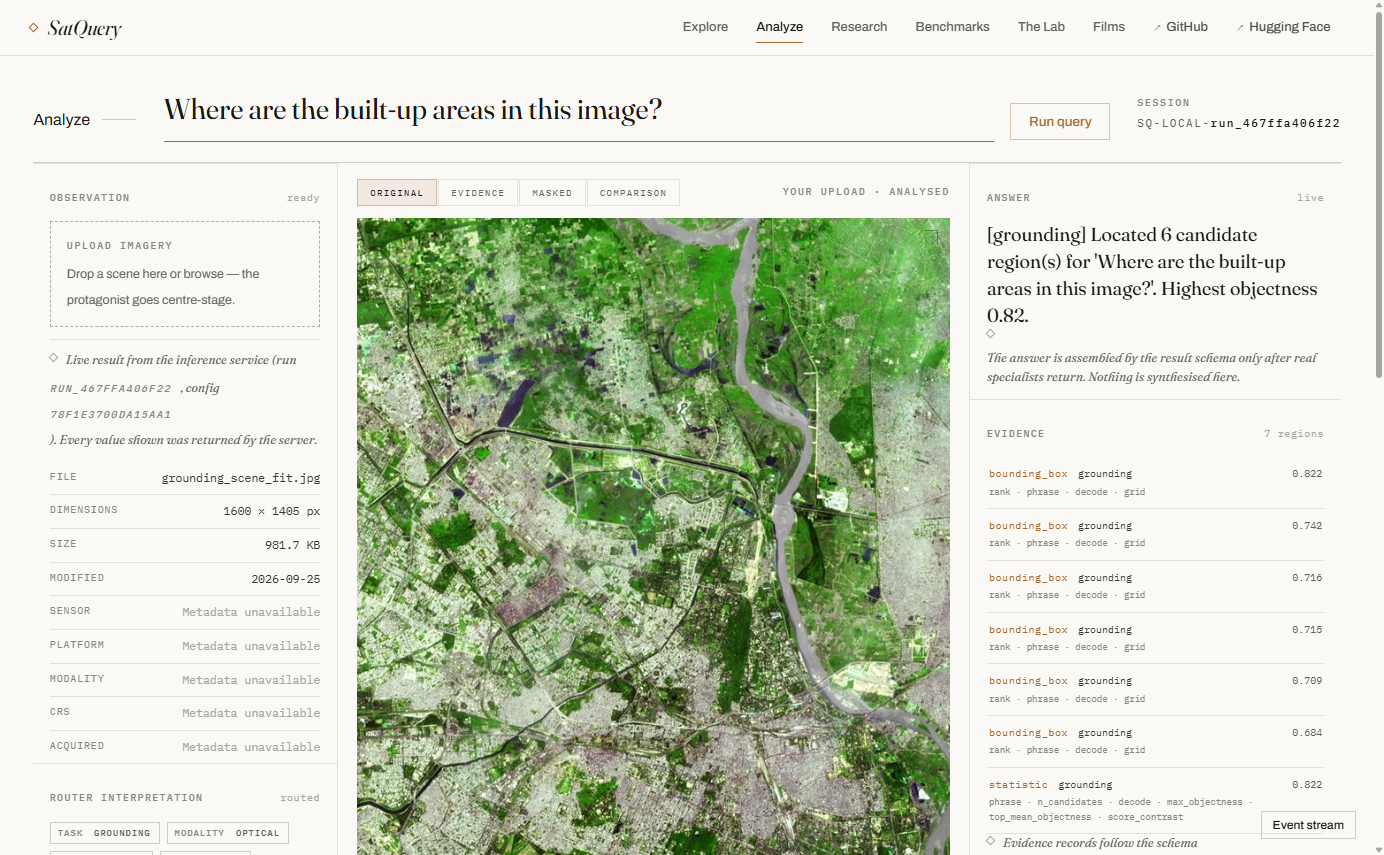
| grounding | Where are the built-up areas in this image? | grounding | run_467ffa406f22 |
| grounding | Where is the new airport? | grounding | run_46980ba55c62 |
The last two are the router-defect queries. Both previously collapsed to vqa and answered "River".
Note the fifth row: "Did the coastline advance between the two observations?" is read as change and
dispatches change_vqa — the documented quantifier upgrade, because the page's Answer block promises
an answer and the server's change returns a spatial map with no language output. With one asset
attached, change would instead be refused outright ("requires exactly 2 assets"); the console avoids
asking for a pair-requiring task when only one asset exists.
Eight captures from the post-fix live run (headed browser, 1384×855, one upload per case). Each
panel shows the run identifier, the frozen config hash 78f1e3700da15aa1, and the evidence list
returned by the specialist — nothing is mocked.
| 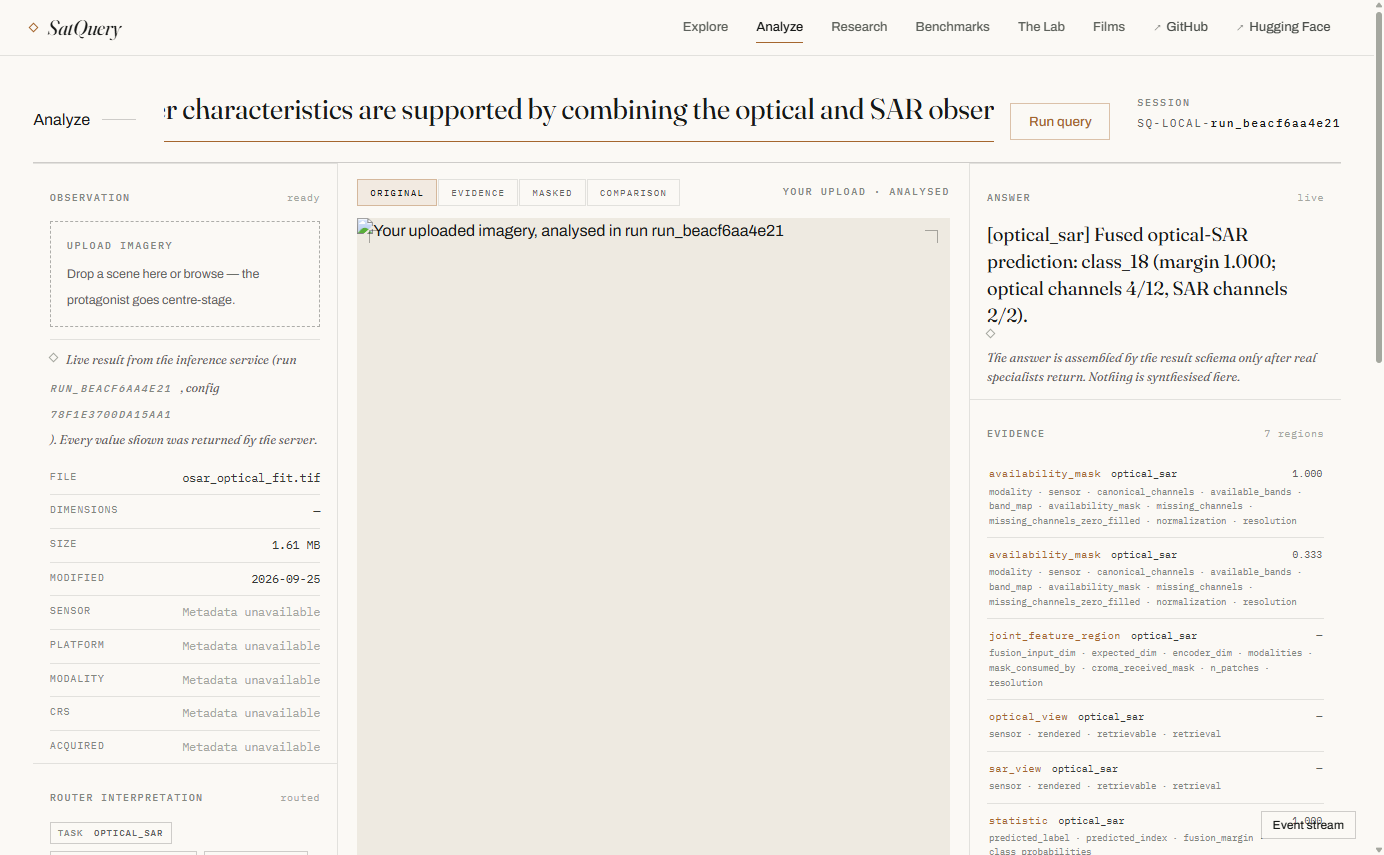 |
Grounding — "Where are the built-up areas in this image?" — the fixed router defect (run_467ffa406f22, dispatched grounding, not vqa) | Optical-SAR fusion on a real optical/SAR GeoTIFF pair (run_beacf6aa4e21, fused class 18) |
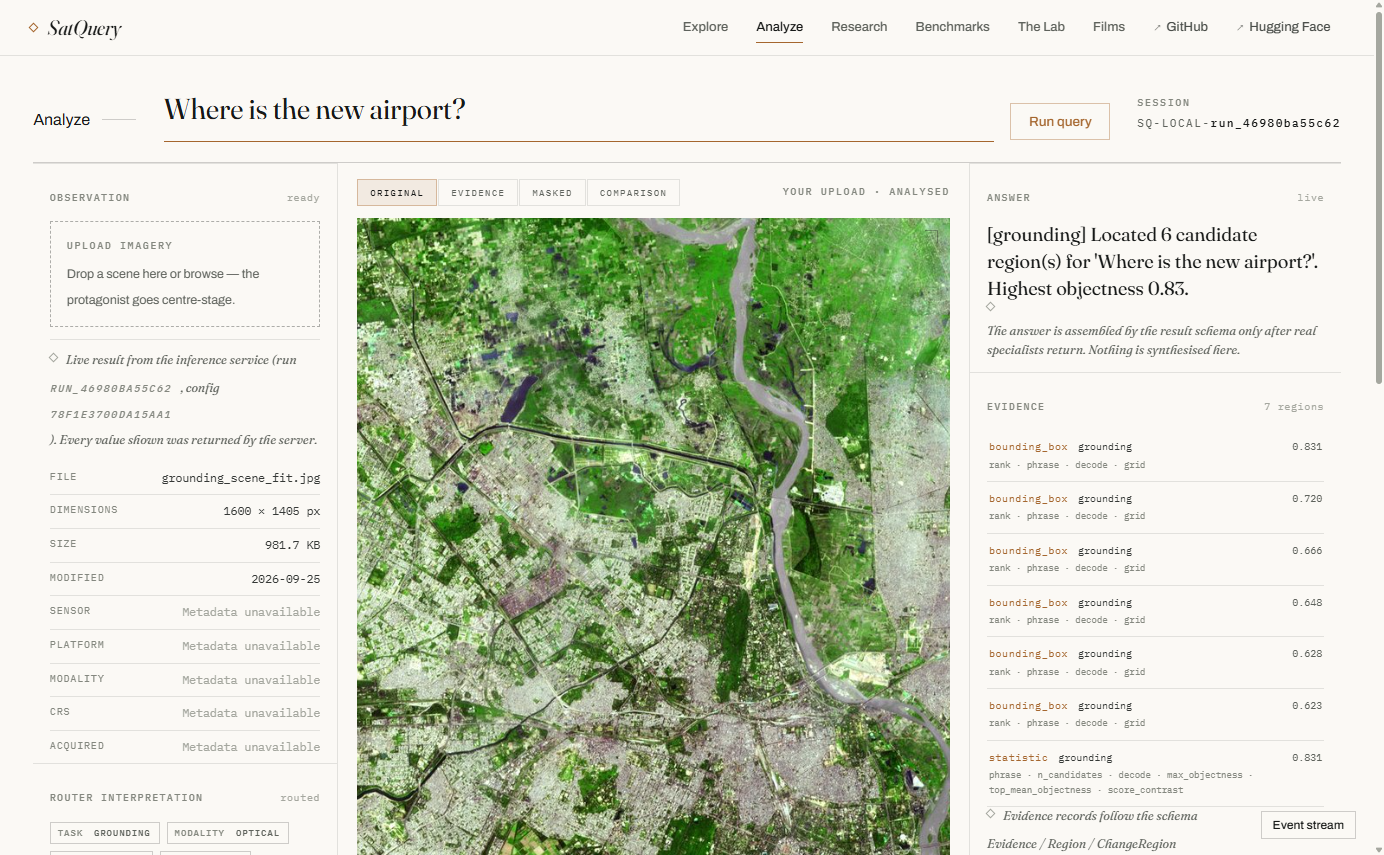 | 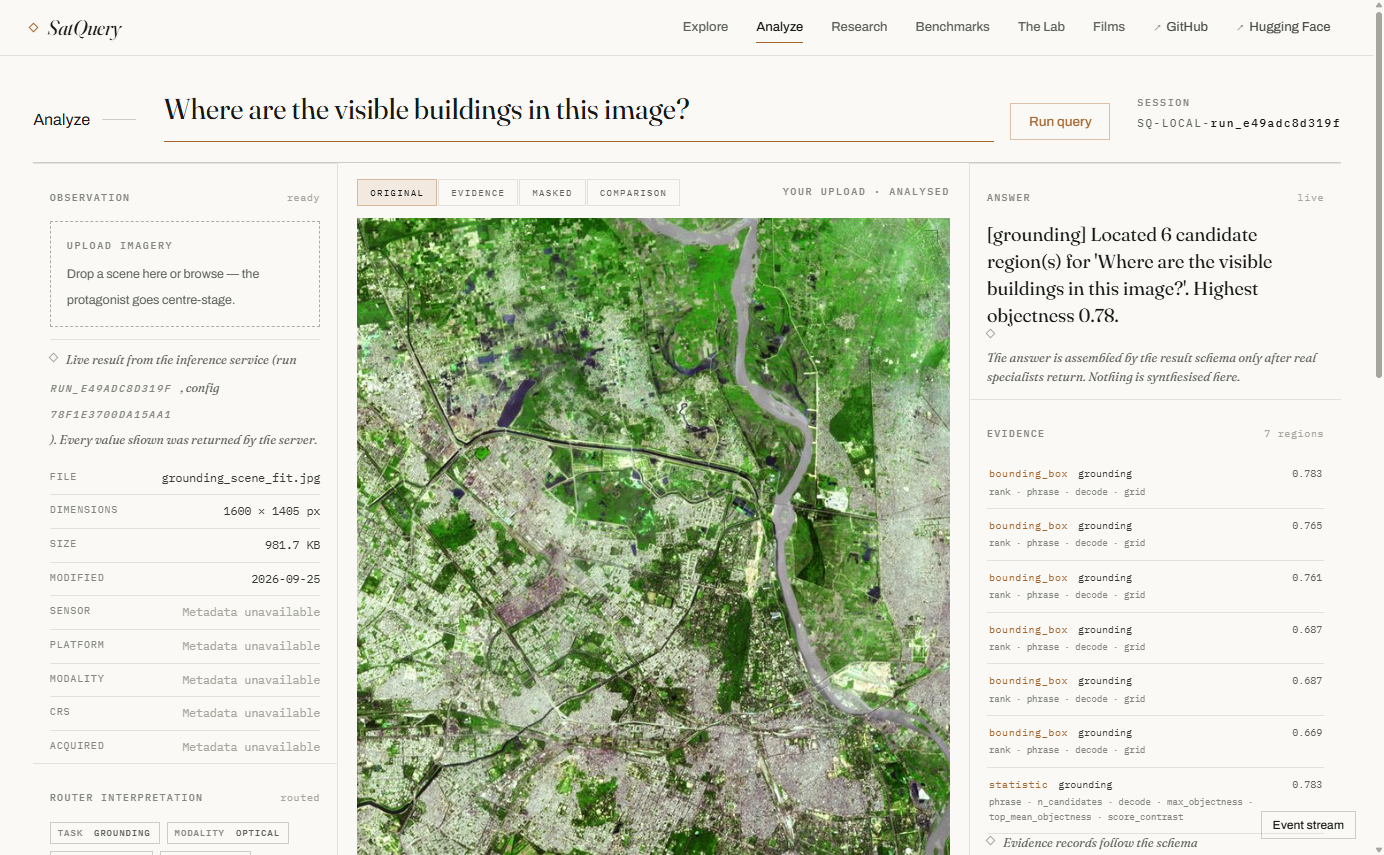 |
Grounding — "Where is the new airport?" — second defect query (run_46980ba55c62, dispatched grounding) | Grounding — "Where are the visible buildings in this image?" (run_e49adc8d319f) |
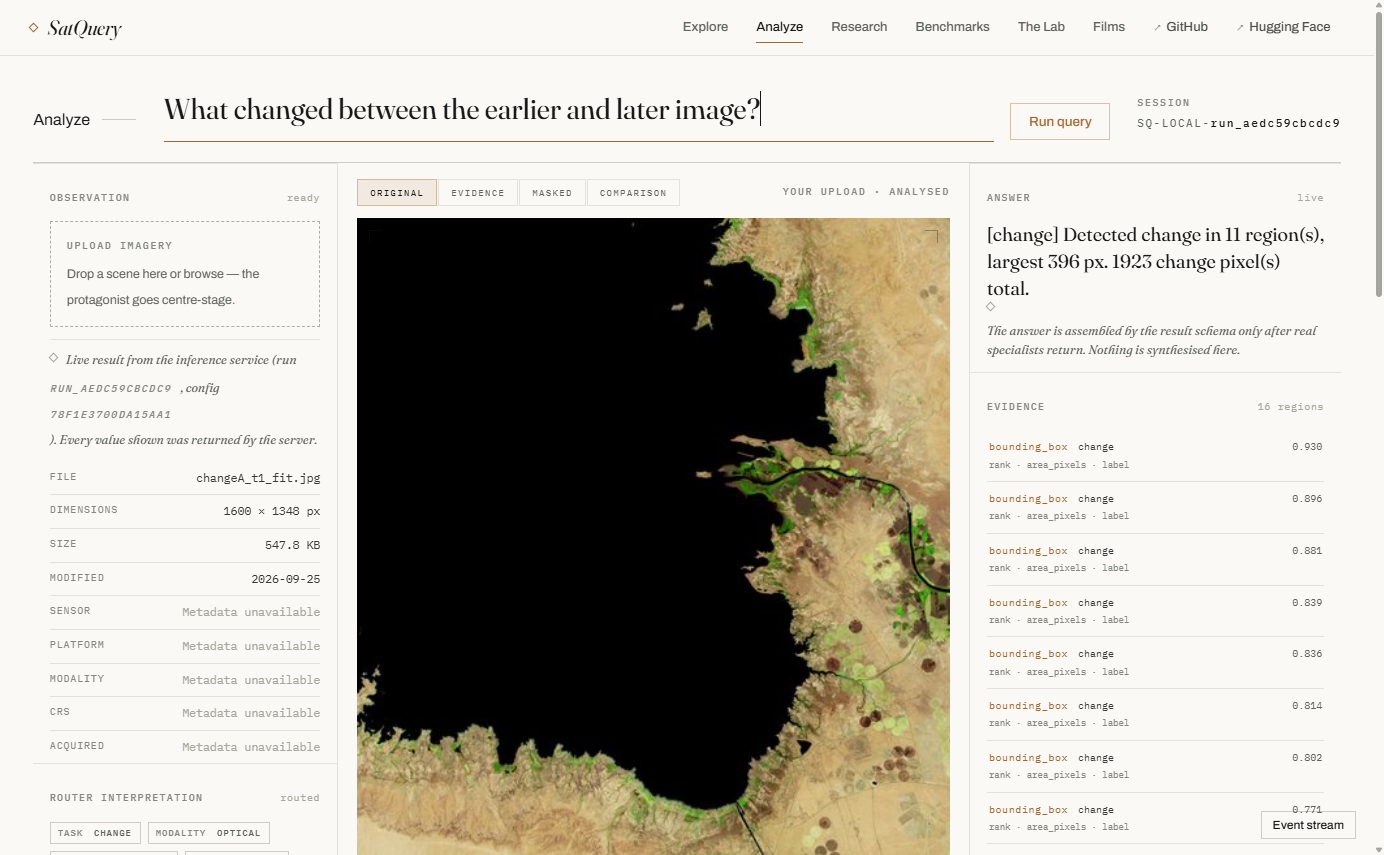 | 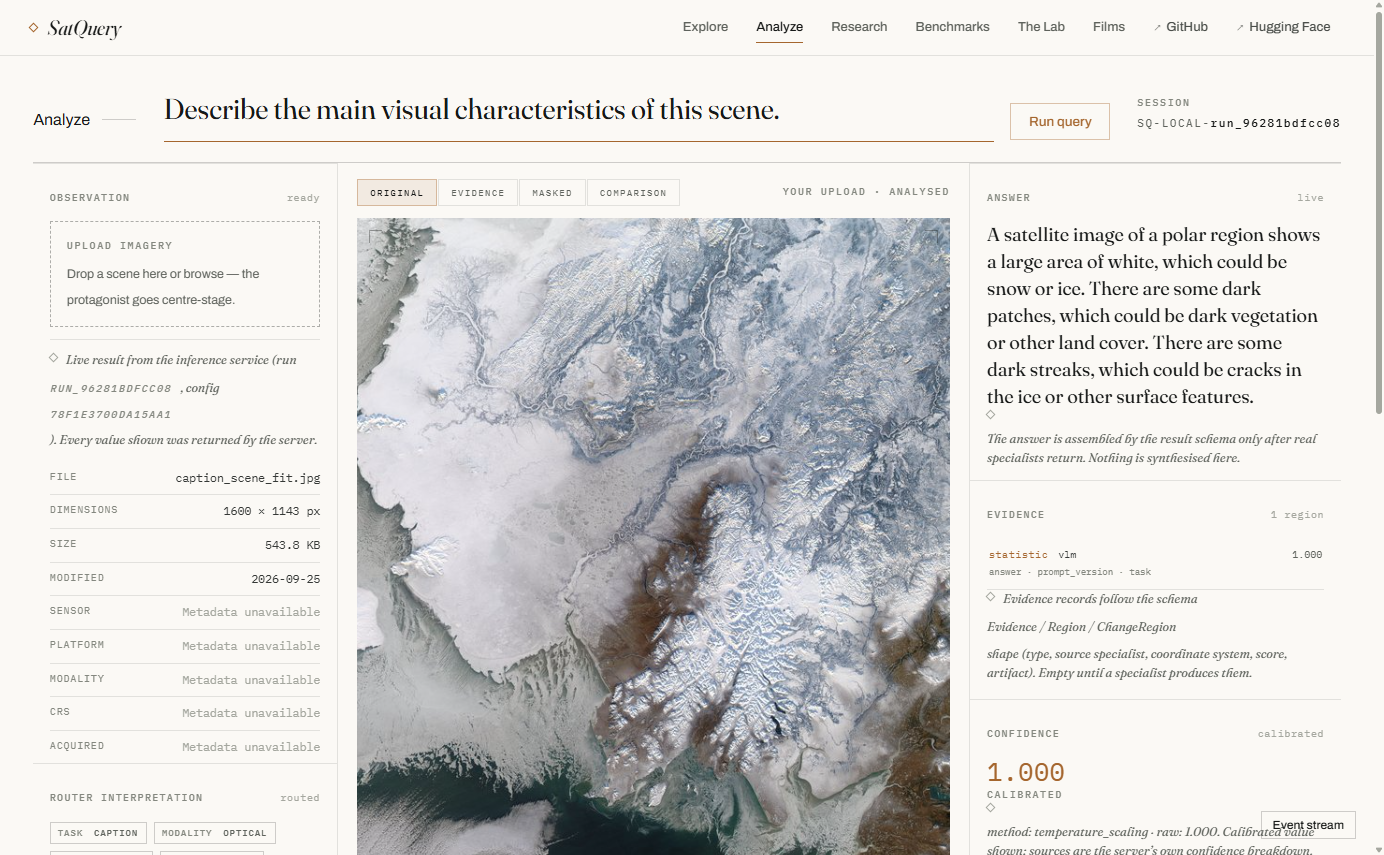 |
| Change detection on a same-shape temporal pair | Caption of a single scene (run_96281bdfcc08, calibrated confidence 1.000) |
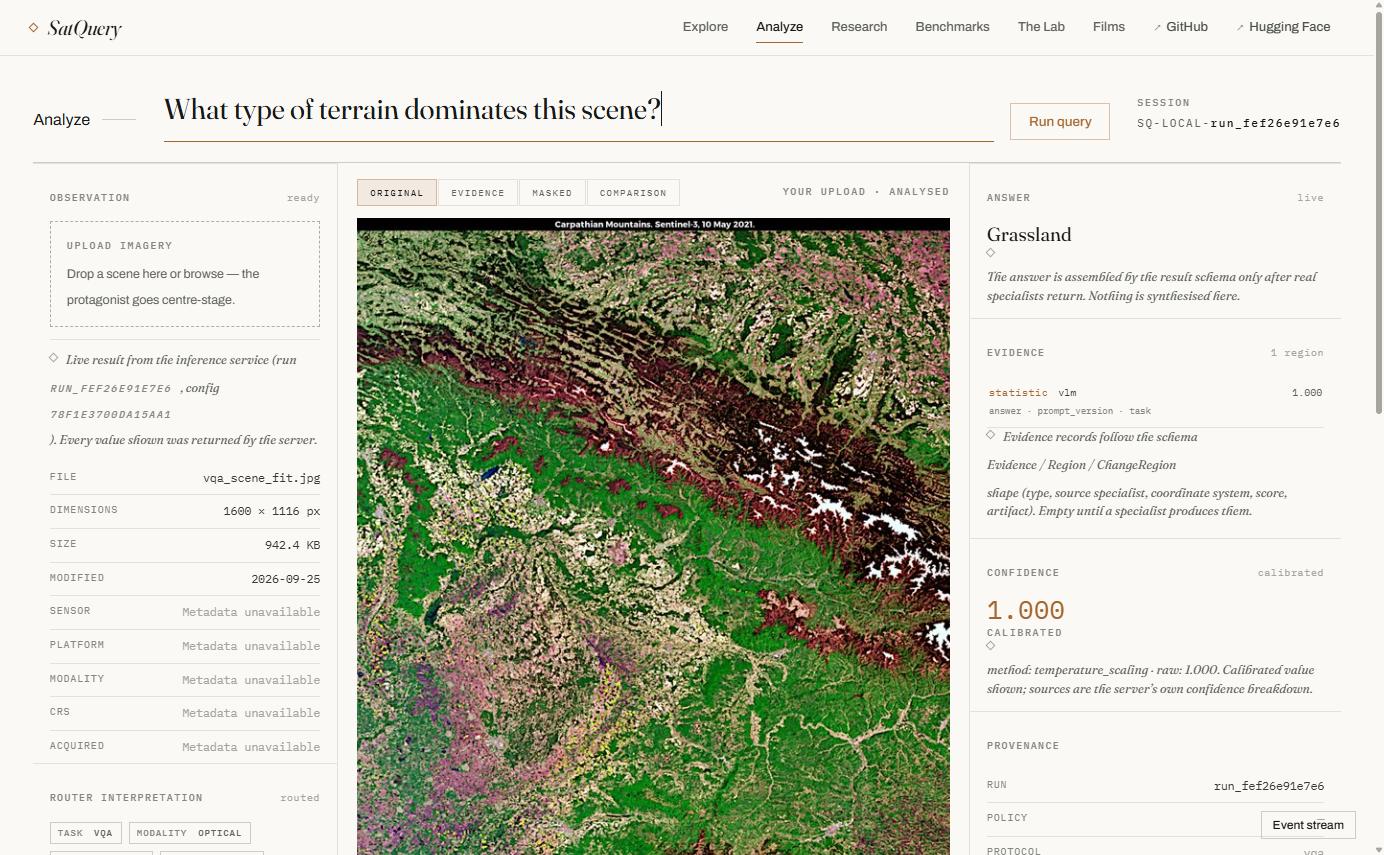 | 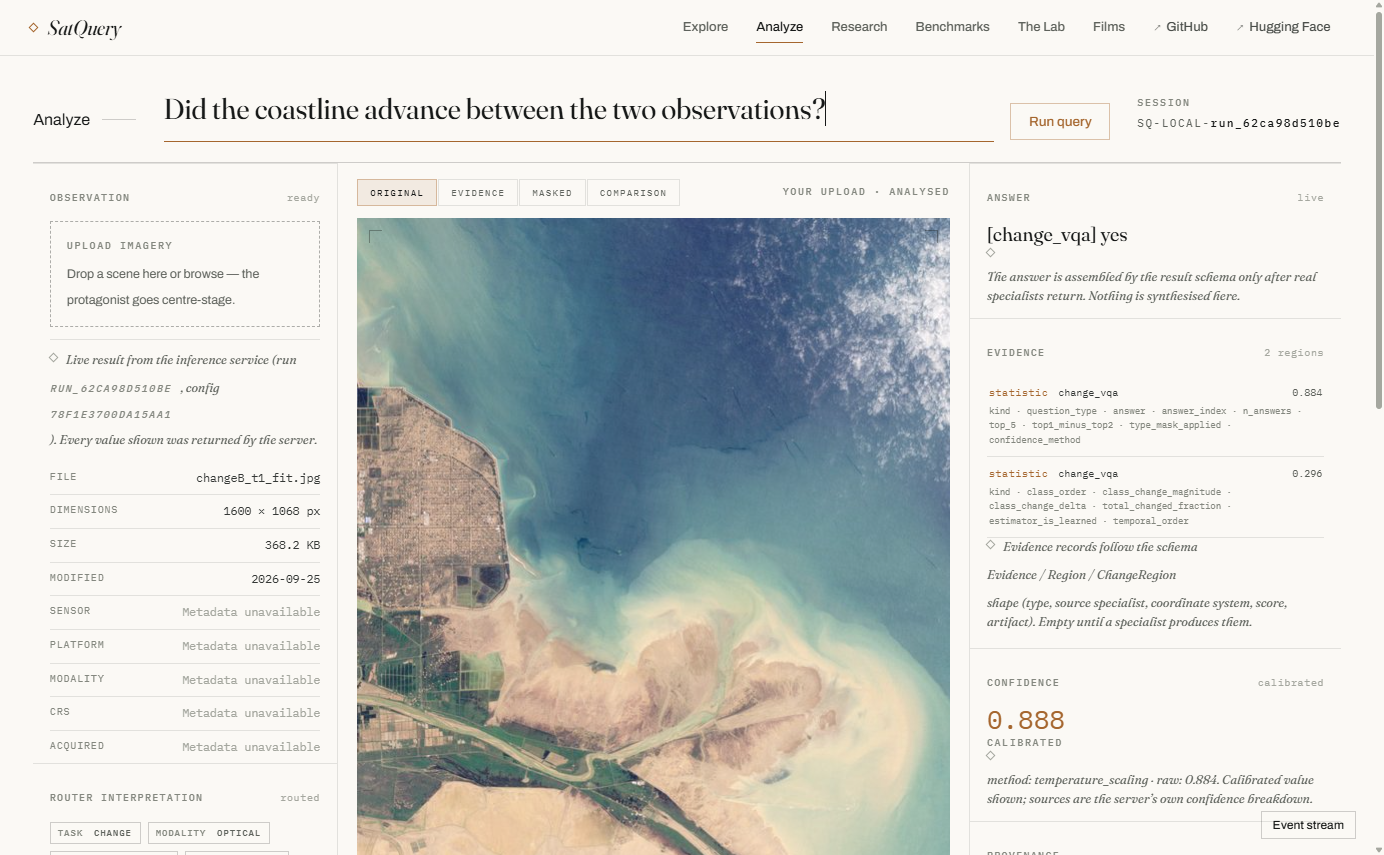 |
| VQA — "What type of terrain dominates this scene?" | Change-VQA — "Did the coastline advance between the two observations?" |
All eight are reproduced byte-for-byte in the evidence archive (Phase 7) with SHA-256 recorded in
RELEASE_MANIFEST.md.
Python 3.11+ and a CPU are sufficient. No CUDA requirement — device is selected via
SATQUERY_DEVICE; all placement is .to(device), never .cuda().
git clone https://github.com/Anish-lab-blip/SatQuery-AI
cd SatQuery-AI
python -m venv .venv
source .venv/Scripts/activate      # Windows git-bash; use .venv/bin/activate on Linux/macOS
pip install -r requirements.txt
Backbones are fetched from the Hugging Face Hub on first use, pinned by revision in
configs/base.yaml. The frozen config hash is 78f1e3700da15aa1 — the loader refuses to run a
config that violates the recorded invariants (for example fusion.input_dim == 3*encoder_dim + 12 + 2).
core/config.py validates the registry at load time and raises ConfigError — naming every violation —
rather than letting a bad value reach runtime. The invariants are not documentation; they are checks:
| Invariant | Why it exists |
|---|---|
croma.image_resolution % 8 == 0 | CROMA asserts this (finding C-7); native 120 → 225 patches |
training.precision ∈ {fp16, bf16, fp32} | the T4 is SM 7.5, so bf16 is unavailable (finding C-6) |
deployment.torch_compile is not true | ZeroGPU does not support torch.compile (finding C-8) |
vlm.processor_longest_edge ≤ image.tile_size | the processor's default longest_edge is 2048, which upscales a 512 px tile 4× and then splits it into 17 sub-images — a ~17× overrun, not the 4× the plan estimated (finding F5-2). Tying the pin to image.tile_size makes it a control, so the processor cannot silently start upscaling again. |
vlm.prompt_must_use_chat_template is true | SmolVLM raises ValueError on prompts lacking one <image> token per image (finding F5-3) |
fusion.input_dim == 3*encoder_dim + optical_channels + sar_channels (= 2318) | CROMA emits optical/SAR/joint GAP vectors; the availability mask is consumed by the head (finding C-1) |
croma.optical_channels == 12 and croma.sar_channels == 2 | CROMA's s2_channels / s1_channels are fixed |
grounding_head.feature_dim == 4 * grounding.encoder_projected_dim (= 2048) | a mismatch is a silent shape error — torch raises only at the similarity step, after patch features are already cached (finding P7-1) |
router.tasks includes unsupported and router.num_tasks == len(router.tasks) | the ontology and its declared size cannot drift apart |
change.sa_mode ∈ {BAM, PAM} and change.encoder is set | the change architecture is not implicit |
image.top_k_tiles ≤ image.max_tiles | the dispatch ceiling cannot exceed the examination ceiling |
Because a config edit moves Config.hash and invalidates every artifact keyed to it, deployment state
that must not move the hash (asset-store capacity, TTL, the per-file cap) is read from the environment
rather than from configs/base.yaml — the same reasoning that keeps the config hash frozen.
# Inference service, CPU (this is the launcher the Codespace runs)
PORT=8000 python deploy/codespace/serve.py

# Health
curl localhost:8000/v1/health
The frontend is fully static and needs no build step to serve locally:
python -m http.server 5500 --directory frontend
Run the frontend regression suite:
python -m pytest tests/unit/test_frontend_live_wiring.py -q
| Suite | Command | Expected |
|---|---|---|
| Frontend live-wiring | pytest tests/unit/test_frontend_live_wiring.py | 106 passed |
| Doc/frontend suite | pytest on the 5 doc/frontend files | 183 passed |
| Full unit suite | pytest tests/unit | 5–6 environmental failures (sandbox delete guard × 4, 1 ordering flake, 1 stale adapter test) |
The full-suite failures are not hidden, and they are not regressions: 4 are the sandbox's bulk-delete
guard (test_safe_delete_shim), 1 is an ordering flake that passes in isolation, and 1 is a stale adapter
test (CROMA is now shipped). Re-running the affected files together gives 137 passed, confirming the
failures are attributable to the sandbox environment and test ordering rather than the code under test.
The deployed stack is reachable. Note the authoring sandbox has a dead proxy, so outbound calls need
--noproxy '*' (curl) or ProxyHandler({}) (Python):
curl --noproxy '*' https://<backend-host>/api/health
curl --noproxy '*' https://<backend-host>/api/capabilities
/api/capabilities returns six tasks, all available: true. A live run requires the tunnel agent to be
connected (agent_connected: true); if the Codespace is stopped, the request parks until the tunnel
timeout. See docs/DEPLOYMENT.md §5–6.
The live topology is Cloudflare Pages → Render → outbound tunnel → GitHub Codespace.
| Layer | Role | Source |
|---|---|---|
| Cloudflare Pages | Static frontend at https://satquery.pages.dev | frontend/ |
| Render | Orchestrator / API gateway, /api/*, CORS, wake flow | gateway/ |
| GitHub Codespace | FastAPI inference host, CPU, port 8000 | app/ |
| Hugging Face | Model cards, released artifacts, checksums | this release |
Deployment sources are separate repositories from this release. The wake flow is: Cloudflare →
Render → start the Codespace if stopped → poll /v1/health → surface "Waking inference engine…" →
POST /infer → result.
| Component | Repository | Visibility | Revision | Host |
|---|---|---|---|---|
| Frontend | Anish-lab-blip/SatQuery-Frontend | private | 2d7ae53b482d | Cloudflare Pages → satquery.pages.dev |
| Backend / orchestrator | Anish-lab-blip/SatQuery-Backend | private | 89d80eaddec5 | Render → <backend-host> |
| Inference | Anish-lab-blip/SatQuery-Inference | private | 5a0936ace491 | Codespace, port 8000, via outbound tunnel |
| Public umbrella | Anish-lab-blip/SatQuery-AI | public | 3dcabd32da41 | this release home |
Trap.
deploy/inside the monorepo is stale and untracked. It is not the deployed source. Edits must go to the three real repositories. Recorded indocs/DEPLOYMENT.md§1.
Render (gateway), measured live:
| Variable | Value (live) |
|---|---|
CODESPACE_NAME | potential-space-trout-r4ppw969w45j2pvvw |
CODESPACE_PORT | 8000 |
SATQUERY_ALLOWED_ORIGINS | https://satquery.pages.dev |
SATQUERY_DEVICE | cpu |
SATQUERY_TRANSPORT | auto |
SATQUERY_TUNNEL_TIMEOUT_S | 150 |
SATQUERY_WAKE_TIMEOUT_S | 120 |
SATQUERY_UPSTREAM_TIMEOUT_S | 90 |
GITHUB_TOKEN | present |
Codespace (inference):
| Variable | Purpose |
|---|---|
PORT | platform-assigned; must be read |
SATQUERY_DEVICE | cpu | cuda | mps | null; read without importing torch |
SATQUERY_MAX_FILE_BYTES | per-file cap (shared with Render) |
SATQUERY_ASSET_ENABLED / SATQUERY_ASSET_DIR | both required for /v1/assets; fails closed otherwise |
SATQUERY_ASSET_MAX_FILES / SATQUERY_ASSET_TTL_S | optional handle capacity / lifetime |
Deploy mechanics: the frontend is staged by scripts/stage_pages.mjs and deployed with
npx wrangler pages deploy; the backend is a render.yaml blueprint whose main.py exposes app; the
inference host runs deploy/codespace/serve.py on $PORT and the devcontainer forwards port 8000 and
starts the tunnel agent on postStartCommand. Repository writes are performed through the GitHub Git
Data API (blob → tree → commit → PATCH ref) with sha256 byte-verification of every uploaded blob,
rather than git push, so each deployed file is verified by content hash.
GET /api/health reports tunnel.agent_connected: true. Cold start is tens of seconds and is
documented rather than papered over.forward_unavailable 503 / upstream_timeout 504 plus a codespace_name fix) exists and is
documented, but it was deliberately not deployed. Root cause: in auto transport mode a tunnel
timeout falls through to the forwarded-port path (main.py:546), which then spends the 120 s wake
timeout on an HTTP 302 — the observed ~249 s failure (150 + 120).codespace_name is still reported with a trailing newline by /api/health (cosmetic; the wake
path strips it).POST /api/infer at the gateway — a retry consumes inference twice._headers rules concatenate
rather than override, and Chromium takes the first max-age it encounters, so a later rule cannot "fix"
an earlier one. Cloudflare 308-redirects X.html → /X, so the extensionless path must be referenced.
A forwarded Codespace port returns 302 for a private repo — which is why the tunnel exists. And the
tunnel agent must be started by the devcontainer's postStartCommand, or a restarted Codespace comes up
with agent_connected: false.The superseded design ran inference on an HF Space with ZeroGPU behind a Railway gateway. The
active design moves to Render + Codespace, CPU-first, with an outbound tunnel. The four-endpoint
contract, the gateway responsibility table, the env-var vocabulary and the config freeze are unchanged —
only host names moved. configs/deploy.yaml still describes the old HF-Space/ZeroGPU target and is left
undisturbed as frozen paperwork (editing it would move the config hash); no Gradio runtime exists in
code. The declared ZeroGPU durations are transcribed, not invented — app/space_app.py carries
GPU_DURATIONS = vqa 20, caption 20, grounding 45, change 30, optical_sar 45, change_vqa 30,
and a task with no declared duration is a programming error rather than a default, because silently
picking one would reserve the wrong amount of the 5 GPU-minute daily budget. The decoration has never
executed here (spaces is not installed in this environment); configs/deploy.yaml sets
cpu_mode_required: true, so a CPU run must work, and it does.
configs/base.yaml is the single registry; no magic numbers in Python. Its hash
is recorded in every execution trace. Frozen hash: 78f1e3700da15aa1. A config edit moves the hash and
invalidates every artifact keyed to it.repo_id + revision, never by floating tag:
HuggingFaceTB/SmolVLM-500M-Instruct@a7da5b986cb5,
chendelong/RemoteCLIP@bf1d8a3ccf2d,
sentence-transformers/all-MiniLM-L6-v2@1110a243fdf4,
antofuller/CROMA@0dd28e3d633b.models/manifest.json and models/checksums.sha256 are generated from
the actual files — never hand-typed. Verify with sha256sum -c models/checksums.sha256.scene_id.The frozen contract, in the registry's own vocabulary:
| Guarantee | How it is enforced |
|---|---|
| Frozen configuration | all tunables live in configs/base.yaml; the loader validates invariants and computes a hash |
| Frozen config hash | 78f1e3700da15aa1; every artifact records the hash it was produced against |
| Pinned backbones | every backbone is pinned by revision; the Hub resolves the exact commit |
| Seed | project.seed: 42 |
| Immutable public test | evaluation.immutable_public_test: true; hidden_data_access: false |
| Byte-verified artifacts | every released artifact ships with a sha256 in models/checksums.sha256 |
| Verified metrics | every quoted number is checked against its artifact by the metric-verification tool |
python release/tools/verify_readme_metrics.py
It reads the artifacts under artifacts/, compares each of the 20 quoted metrics at the precision
printed in this README, and also asserts the statuses (that the VLM headline contains
ACCEPTANCE-REJECTED; the router's corpus_limited / n_val; the calibration temperature and
ece_improvement). It exits 0 and prints ALL CLAIMS VERIFIED only when everything matches.
| Artifact | Where it trains | Reproducible from this release? |
|---|---|---|
| router adapter | local CPU | yes — configs/base.yaml §router.training |
| grounding head | local | yes — configs/base.yaml §grounding_training |
| change head | local | yes — configs/base.yaml §change |
| optical_sar fusion head | local, seed sweep | yes (see docs/TRAINING.md §5) |
| change_vqa head | external GPU (Kaggle) | partly — the promotion gate, evaluation and serving wiring are reproducible; there is no one-command retrain |
| vlm LoRA adapter | external GPU | partly — same |
For the two externally-trained artifacts, the repository reproduces the promotion gate (byte-identity, sha256, zero non-finite tensors), the evaluation, and the serving wiring; it does not ship a one-command retrain. That is stated rather than implied.
| Item | Reason |
|---|---|
| The private deployment repos | they are private; the deployed sources are not in this release |
| System-level end-to-end benchmark | no such benchmark exists |
| Router test-split number | not run |
| CDVQA / SECOND imagery | public but large; the release documents the acquisition + name-verification procedure, not the data |
| BigEarthNet full corpus | not downloaded (only a 28k S2 subset was used) |
| The historical ZeroGPU/Gradio deploy target | frozen paperwork only; no runtime exists in code |
Environment traps worth recording for anyone reproducing: the authoring sandbox has a dead proxy
(outbound calls need --noproxy '*' for curl or ProxyHandler({}) for Python); pytest is installed only
in the repository virtualenv (.venv/Scripts/python.exe); the full-suite run trips the sandbox's
bulk-delete guard; Cloudflare 308-redirects X.html → /X; and Chrome drops synthetic CDP key events
when the window lacks OS focus, which is relevant to any browser-driven reproduction of the live
validation.
class_18), not a human-readable label. The
modality accounting in the response confirms the right channels reached the fusion head, but the
presentation is not user-facing.change rather than vqa (the
new-as-change heuristic fires outside where questions), and "How much built-up area was
added?" reads vqa (under-trigger). A lexical router cannot cleanly separate "the new X" from
"what's new"; a trained intent router exists in artifacts/router/ but is not attached.license: unknown and no reuse rights should be assumed. This is an open owner decision.| Live demo | https://satquery.pages.dev |
| GitHub | https://github.com/Anish-lab-blip/SatQuery-AI |
| Hugging Face | https://huggingface.co/thundercode/SatQuery |
Third-party models this work builds on (pinned, not redistributed):
| Model | Revision | Role |
|---|---|---|
HuggingFaceTB/SmolVLM-500M-Instruct | a7da5b986cb5 | VQA + captioning backbone |
chendelong/RemoteCLIP | bf1d8a3ccf2d | remote-sensing grounding encoder |
sentence-transformers/all-MiniLM-L6-v2 | 1110a243fdf4 | router embedding |
antofuller/CROMA | 0dd28e3d633b | optical/SAR fusion encoder |
Datasets referenced by the evaluations: LEVIR-CD-256 (change), VRSBench (grounding), BigEarthNet (optical-SAR fusion, 19 CLC classes), CDVQA + SECOND (change-VQA). No dataset is redistributed here.
Documentation in this repository:
| Document | Contents |
|---|---|
docs/architecture/README.md | architecture hub + index of the ten sub-documents |
docs/architecture/01-system-overview.md | thesis, component inventory, frozen backbones |
docs/architecture/02-deployment-topology.md | four tiers, tunnel, wake flow, cold start |
docs/architecture/03-request-lifecycle.md | nine-state controller, validation, modality inference, tiling |
docs/architecture/04-router.md | MiniLM, five heads, interpret() vs chooseTask(), the lexical fallback |
docs/architecture/05-specialists.md | all six tasks end to end |
docs/architecture/06-evidence-and-confidence.md | evidence schema, aggregation, temperature scaling, the eight events |
docs/architecture/07-configuration-freeze.md | the registry, invariants, the config hash |
docs/architecture/08-api-contract.md | four endpoints, envelopes, error codes |
docs/architecture/09-frontend.md | static pages, the Analyze console, real-vs-preview |
docs/architecture/10-observability-and-ops.md | health, counters, traces |
docs/MODELS.md | the six artifacts in detail; rejected decisions |
docs/BENCHMARKS.md | headline metrics and the rules they follow |
docs/EVALUATION.md | per-task protocols; evaluation-honesty rules |
docs/DATASETS.md | measured corpus figures and caveats |
docs/TRAINING.md | per-artifact hyperparameters |
docs/DEPLOYMENT.md | live revisions, env vars, traps |
docs/REPRODUCIBILITY.md | what a third party can reproduce |
docs/RESEARCH_NOTES.md | findings, the router defect, negative results |
docs/LIMITATIONS.md | the full limitation catalogue |
docs/CHANGELOG.md | versioned record |
MODEL_CARD.md | the Hugging Face model card |
Supporting and subsystem documentation:
| Document | Contents |
|---|---|
docs/SECURITY.md | trust model, secret custody, CORS allowlist, limits, what is not defended |
docs/TESTING.md | suite inventory, the doc-guard tests, the harness false-positive lesson |
docs/GEOSPATIAL.md | raster contract, CRS, the coordinate-system rule, band inference, normalisation |
docs/DATA_PIPELINE.md | asset → specialist input, cached features, sensor adapter |
docs/OPERATIONS.md | the runbook, warming, incident triage, known operational gaps |
docs/DEVELOPMENT.md | local setup, the config-hash rule, how to add a specialist, dev traps |
docs/PERFORMANCE.md | model footprint, measured component timings, cost traps |
docs/FRONTEND.md | the 11 pages, the Analyze console, the eight events, Cloudflare traps |
docs/SERVING.md | build_space_app(), the four endpoints, lazy loading, the G-1 trap |
docs/GLOSSARY.md | every domain term and status vocabulary, defined |
docs/MASTER_ARCHITECTURE_PLAN.md | the original master plan (historical; superseded in parts) |
HF_RELEASE_VERIFICATION.md | the Hugging Face release verification record |
RELEASE_MANIFEST.md | every released file with its size and sha256 |
tools/ | the verification tooling (verify_readme_metrics.py, manifest generators, archive tools) |
Honesty rule. Every document in this repository uses one status vocabulary —
IMPLEMENTED·VERIFIED·MEASURED·ATTEMPTED·NOT RUN·BLOCKED·DEFERRED·REJECTED·OPEN·RESOLVED·CLOSED— and negative results are recorded rather than omitted. Where evidence was missing, the text saysUNKNOWN — not established from the available evidenceinstead of guessing.
No paper accompanies this release. Until one exists, cite the repository:
@misc{satqueryai2026,
  title  = {SatQuery AI: an interactive vision-language assistant for
            multimodal remote-sensing image analysis},
  author = {SatQuery AI contributors},
  year   = {2026},
  url    = {https://github.com/Anish-lab-blip/SatQuery-AI}
}
Not yet selected. See limitation 10. Backbone models remain under their own upstream licenses.
No LICENSE file exists in this repository. Until one is selected, the released artifacts carry
license: unknown and no reuse rights should be assumed. This is an open owner decision, recorded
as OPEN in docs/LIMITATIONS.md §5 and
docs/CHANGELOG.md. The six trained artifacts are small modules over frozen
backbones; the backbones are not redistributed here and remain under their own upstream licences —
consult each backbone's Hugging Face page.
Ask a natural-language question about a satellite or aerial image and get a confidence-scored answer. A router dispatches to six specialists - VQA, captioning, visual grounding, bi-temporal change detection, change-VQA and optical-SAR fusion - over frozen backbones on CPU.
See the codeSatellite imagery question answering, remote-sensing change detection, visual grounding and optical-SAR fusion in one open, CPU-runnable system.
Ask a natural-language question about a satellite or aerial image — or a pair of images — and SatQuery AI routes it to the right specialist model, collects evidence, and returns a single confidence-scored result envelope. It is a remote-sensing vision-language system built as a router plus specialists pipeline: satellite image captioning, visual question answering, text-guided visual grounding, bi-temporal satellite image change detection, change-VQA, and Sentinel-1 / Sentinel-2 optical-SAR fusion. It runs on CPU, is served from a static frontend, and is live at https://satquery.pages.dev.
Status: research prototype, pre-1.0. The architecture is frozen. This repository is the documented public release of the system, its trained artifacts, and its measured results — including the negative ones.
This README is the front door to a long-form documentation set. It is written to the same standard as the rest of the release: every number, path, run identifier and status is taken from a file that was actually read, and where something was never run, that is stated rather than implied.
This system spans several searchable areas. If you are looking for a remote-sensing vision-language model, a satellite image change-detection baseline, a text-guided visual grounding implementation for Earth observation, Sentinel-1/Sentinel-2 optical-SAR fusion, or a router-and-specialists design that runs on CPU, this repository covers that ground.
| Area | What is here |
|---|---|
| Satellite imagery question answering | six task specialists behind one typed ResultEnvelope |
| Remote-sensing VQA & captioning | SmolVLM-500M over frozen backbones, with a trained LoRA adapter |
| Visual grounding (text → box) | RemoteCLIP ViT-B/32 + a trained grounding head; VRSBench protocol |
| Change detection (bi-temporal) | STANet-style Siamese detector on LEVIR-CD-256 |
| Change-VQA | natural-language questions over a temporal pair |
| Optical-SAR fusion | CROMA-base, 19-class BigEarthNet CLC head |
| Multimodal / vision-language | evidence aggregation, calibrated confidence, execution traces |
| Deployment | static frontend + gateway + outbound-tunnel inference on CPU |
Search terms this project is described by: satellite imagery question answering ·
remote sensing vision language model · satellite image change detection · visual grounding remote sensing · optical SAR fusion · Sentinel-1 Sentinel-2 fusion · satellite image captioning ·
LEVIR-CD · VRSBench · BigEarthNet · router and specialists architecture · vision-language model on CPU.
Remote-sensing analysis is fragmented. Detecting change between two acquisitions, localising an object, captioning a scene, answering a question about it, and fusing optical with SAR each live in a different model, a different preprocessing convention, and a different output schema. Assembling them into one answer means re-solving the same problems — tiling, band handling, coordinate systems, confidence — every time.
SatQuery AI explores a single hypothesis: a small deterministic router plus a shared evidence contract can make a heterogeneous specialist ensemble behave like one system, without a large language model in the control path. The router understands the query. A deterministic policy decides which specialists run. The specialists compute. The evidence engine proves the answer.
Two design rules follow from that, and they are non-negotiable in the codebase:
The design is a router plus specialists, not a single model that "does satellite QA". Each layer has exactly one verb, assigned in the architecture freeze:
router understands; policy engine decides; specialists compute; VLM explains; evidence engine proves.
That division is not decoration — it resolves real ambiguities about where a decision belongs. The
Intent type makes the first row explicit in code:
class Intent(BaseModel):
    """Output of the learned router. Advisory only — the controller decides."""
The four constraints that force the modular design:
| Constraint | Consequence |
|---|---|
| The system must run on CPU | End-to-end VLM inference at usable quality needs a GPU; small per-task modules do not. |
| Different tasks have incompatible outputs | change returns a spatial change map; caption returns prose; optical_sar returns a class distribution. One head cannot emit all three. |
| Tasks have different data and metrics | Each specialist is trained and evaluated on its own split with its own protocol. |
| Truthfulness | Per-task metrics are auditable. A single end-to-end number would hide which component failed. |
The cost of this design is that there is no system-level accuracy number — because there is no single model to measure. That absence is stated rather than papered over; see Known limitations item 1.
| Absent | Why |
|---|---|
| Database, authentication, users, job queue | the gateway is stateless by design; inference is synchronous |
| GPU requirement | device is selected via SATQUERY_DEVICE; all placement is .to(device), never .cuda() |
| Gradio GUI | the frontend is a separate static tier; app/space_app.py serves JSON only |
| Chain-of-thought in traces | traces carry observable facts only — states, timings, counts, config hash, model refs |
| Backbone redistribution | backbones are fetched from the Hugging Face Hub, pinned by revision |
| System-level end-to-end benchmark | NOT RUN — none exists |
| Router test-split evaluation | NOT RUN |
Six specialist tasks. All six are reported available: true by the live capability contract
(GET /api/capabilities, probed 2026-09-25, schema_version 1.0).
| Task | What it answers | Assets | requires_pair | max_assets |
|---|---|---|---|---|
vqa | A free-form question about a single scene | 1 | false | 1 |
caption | A description of a single scene | 1 | false | 1 |
grounding | Where is a described object or region — returns boxes | 1 | false | 1 |
change | What changed between two co-registered acquisitions — returns change regions | 2 | true | 2 |
change_vqa | A yes/no or short question about a detected change | 2 | true | 2 |
optical_sar | Joint scene classification from an optical + SAR pair | 2 | true | 2 |
The live contract also carries per-task notes — vqa/caption fetch SmolVLM weights from the Hub on
first use, grounding fetches the RemoteCLIP encoder on first use, and optical_sar declares
modalities: ["optical", "sar"].
There are two related vocabularies, and they are not the same six:
core/schemas.py::Task carries seven values: vqa, caption, grounding, change,
optical_sar, change_vqa, unsupported.router/label_space.py::TASK_CLASSES) is six classes:
vqa, caption, grounding, change, optical_sar, unsupported.GET /api/capabilities lists six tasks — the same six as the router's minus unsupported,
plus change_vqa.This asymmetry is intentional. unsupported is a routing outcome ("this is not a satellite-imagery
question"), not a servable capability. change_vqa is reached through the change family rather than
being a separate router class, and it is servable. The three sets are reconciled in one place — the
frontend's ROUTER_TASK_TO_SERVER map (frontend/assets/js/mission.js) — because AnalysisRequest is
extra="forbid" and any string outside the Task enum is a 422.
Confirmed by the implementation, not assumed:
| Modality | Task(s) | Format |
|---|---|---|
| Optical, single image | vqa, caption, grounding | JPEG, PNG, TIFF |
| Temporal optical pair | change, change_vqa | Two images of identical dimensions |
| Optical + SAR pair | optical_sar | GeoTIFF/TIFF preferred |
Modality is inferred server-side from band count, not from the file extension: {1, 2} bands ⇒
SAR, {3, 4, 8, 11, 12, 13} bands ⇒ optical. The browser cannot read band count, so the console warns
when a submitted pair looks like two ordinary photographs rather than an optical/SAR pair.
Per-file upload limit: 4,194,304 bytes (4 MiB). Larger files are refused with HTTP 413 — imagery must be downscaled first.
The cap is not a literal in two places; both the gateway and the inference service read
SATQUERY_MAX_FILE_BYTES, and the default is 4 * 1024 * 1024 in both. The inference service's
_asset_max_file_bytes() (app/space_app.py) is deliberately strict about it:
ValueError (not silently defaulted);ValueError (a cap of 0 refuses every upload, which is a configuration
error rather than a limit).The reason is recorded in the source: a silent default would let a deployment whose operator typed a malformed cap keep accepting uploads against a limit nobody chose, while the gateway refused to boot for the same value — the two layers disagreeing about what "too large" means, which is exactly the failure the shared variable exists to prevent.
The accepted content types mirror the gateway's allowlist (defence in depth — the Space validates independently rather than trusting the gateway to be its only caller):
image/tiff, image/geotiff, image/png, image/jpeg, application/octet-stream
POST /v1/assets accepts one file and returns an opaque ephemeral handle. The store lives on the
inference host, not the gateway, because the inference host is where inspect_raster reads the bytes
and where cache_max_models: 1 serialises their consumption — a gateway-side store would put the bytes
on a different machine from the reader. The upload endpoint is off by default and enabled only when
SATQUERY_ASSET_ENABLED and SATQUERY_ASSET_DIR are both set; otherwise it answers a named
model_unavailable envelope explaining the switch. Handle capacity defaults to 32 and the handle
TTL to 900.0 s, both overridable by environment (and read from the environment rather than
configs/base.yaml on purpose — adding a key there would move the frozen config hash).
Downstream of the format check, input handling is governed by the frozen registry
(configs/base.yaml):
| Key | Value | Meaning |
|---|---|---|
image.max_pixels | 25,000,000 | hard ceiling on decoded pixels |
image.tile_size | 512 | tile edge |
image.tile_overlap | 128 | tile stride overlap |
image.max_tiles | 64 | hard ceiling on tiles examined |
image.top_k_tiles | 4 | tiles actually sent through a specialist |
optical.normalization | percentile | 2nd–98th percentile stretch |
optical.lower_percentile / upper_percentile | 2 / 98 | stretch bounds |
optical.canonical_channels | 12 | CROMA expects exactly 12 optical channels |
sar.representation | db | SAR is converted to decibels |
sar.clip_min_db / clip_max_db | −30 / 5 | dB clip window |
sar.canonical_channels | 2 | CROMA expects exactly 2 SAR channels (VV, VH) |
The tile policy follows the plan's section 9.1: whole-image thumbnail first, then top-K tiles. max_tiles
is the hard ceiling on tiles examined; top_k_tiles is how many are actually dispatched — and the loader
rejects a config where top_k_tiles > max_tiles.
This is the actually deployed topology. An older direct-client-to-inference design is superseded.
flowchart TD
  B["Browser<br/>(static console)"] -->|HTTPS| CF["Cloudflare Pages<br/>satquery.pages.dev"]
  CF -->|"HTTPS JSON · /api/*"| R["Render<br/>satquery-orchestrator"]
  R -->|"outbound long-poll<br/>POST /tunnel/agent"| T{{"outbound tunnel"}}
  T --> C["GitHub Codespace<br/>FastAPI inference · CPU · :8000"]
  C --> S["Specialists"]
  S --> M["SmolVLM · RemoteCLIP · STANet-change<br/>CROMA-fusion · MiniLM router"]
  M --> E["Evidence engine<br/>+ temperature scaling"]
  E --> RE["ResultEnvelope"]
  RE -->|"tunnel → Render"| B
The inference host runs in a GitHub Codespace. The forwarded-port path is not reachable for a private
repo (it returns HTTP 302), so the orchestrator keeps a long-poll tunnel: the Codespace dials out
to POST /tunnel/agent and holds the connection; Render queues work onto it. transport_mode is
auto, and the tunnel is the live transport. There is no SATQUERY_UPSTREAM_URL and no
HF_TOKEN in the live configuration — the transport is the outbound tunnel, not a forwarded port.
The live health payload (GET /api/health, probed 2026-09-25) records the tunnel's state directly:
{"status":"ok","service":"satquery-orchestrator",
 "tunnel":{"agent_connected":true,"agent_id":"codespaces-fd1038","pending":0,"completed":97},
 "config":{"codespace_name":"potential-space-trout-r4ppw969w45j2pvvw\n","codespace_port":8000,
           "transport_mode":"auto","tunnel_timeout_s":150.0,"wake_timeout_s":120.0,
           "upstream_timeout_s":90.0,"device":"cpu","has_github_token":true}}
Note codespace_name still carries a trailing \n — that is item B-02, cosmetic, and
still open.
The inference host is a FastAPI service built by build_space_app(). Behind the transport sits a
deterministic controller with a nine-state finite state machine (core/schemas.py::ControllerState,
mirrored in configs/base.yaml §agent.states):
RECEIVE → PARSE → VALIDATE → PLAN → PREPROCESS → EXECUTE → AGGREGATE → VERIFY → RESPOND
The controller is the only component that dispatches. agent.max_specialists is 4,
agent.timeout_seconds is 120, and agent.unload_after_workflow is true — the controller unloads
models after a workflow so that cache_max_models: 1 is honoured rather than thrashing the cache.
Four backbones are pinned by repo_id + revision and fetched from the Hub on first use. Nothing is
fine-tuned end-to-end.
| Role | Repository | Revision | Size / notes |
|---|---|---|---|
| Router encoder | sentence-transformers/all-MiniLM-L6-v2 | 1110a243fdf4 | 90.9 MB, 22,713,216 params, 384-dim embeddings |
| VLM | HuggingFaceTB/SmolVLM-500M-Instruct | a7da5b986cb5 | ~1015 MB safetensors |
| Grounding | chendelong/RemoteCLIP (RemoteCLIP-ViT-B-32.pt) | bf1d8a3ccf2d | 605.2 MB; width 768, projected dim 512 |
| Optical-SAR | antofuller/CROMA (CROMA_base.pt) | 0dd28e3d633b | 777.6 MB; encoder_dim 768, image_resolution 120 |
Two consequences follow: the system is small (the six trained artifacts total ~125 MiB; everything else is public weights), and no backbone weights are redistributed by this release.
Specialists each emit Evidence for what they computed. The EvidenceEngine
(evidence/engine.py) does not re-derive any of it; it aggregates:
collect across specialists → deduplicate → order → renumber → cap
The pipeline is pure and deterministic — no clock, no RNG, no I/O — and its purity is a test assertion, not a hope. Three details matter:
Evidence.evidence_id defaults to a random uuid, which is useless across runs.
The engine renumbers to evidence_001, evidence_002, … (zero-padded to three digits, well past the
evidence.max_items bound of 32) so a downstream artefact can cite one item deterministically.(type, source_specialist, score DESC, coordinates). The
coordinate tie-breaker is what makes the order total; without it, two items sharing type,
specialist and score would fall back to Python's stable-sort insertion order, reintroducing
input-order dependence.(type, source_specialist, coordinate_system, rounded coordinates, rounded score) — payload,
artifact_ref and evidence_id are deliberately excluded. Two items that agree on the same
geolocation, one carrying a crs and one not, have made the same claim about the world; the surviving
item's payload is merged with the discarded one's so the crs is not lost. Two items that share a type
and score but disagree on coordinates are two different claims and are both kept — suppressing a
spatial disagreement would be the silent contradiction the freeze forbids.The engine records dropped_duplicates (non-zero is normal and healthy — it means two specialists
agreed), dropped_over_limit (non-zero is a warning — a specialist's evidence did not survive), and
truncated. evidence_digest() exists so that reproducibility is an assertion:
aggregate(inputs_a) is reproducible iff digest(a) == digest(b)
The confidence stage is evidence/confidence.py, and it exists to enforce one rule: a calibration that
claims to be fitted when it is not is a false claim of reliability. So when no fitted artifact is
available it passes the raw score through unchanged, sets method="uncalibrated", and leaves
calibrated=None — which is what makes it honest, because ConfidenceBreakdown.value then returns
raw, and any consumer can distinguish "we calibrated this" from "we did not". The temperature scaling
itself is calibrated = sigmoid(logit(z) / T), with two stated failure modes handled explicitly: a
fitted T of exactly 1.0 is the identity map and is reported as uncalibrated rather than silently
pretending to have done something, and z = 0.0 (whose log-odds diverge) is clamped at the boundary so
a hard zero cannot become a NaN.
Scope of this repository. It contains the documentation and the source code only. It deliberately does not contain: datasets, the
artifacts/tree (trained weights, checkpoints, evaluation outputs), Jupyter notebooks, the static frontend, logs, or any credential. The six trained artifacts are published on the Hugging Face Hub; the frozen backbones are fetched from the Hub at run time. Some documents cite the source repository's internal phase reports by filename as provenance — those files are not part of this release.
| Path | Contents |
|---|---|
app/ | FastAPI inference service and its composition root (build_space_app(), serving.py) |
core/ | The typed contracts, config registry + loader, nine-state controller, planner, registry, errors |
router/ | The MiniLM intent router: encoder, five-head adapter, classifier, lexical fallback, label space, dataset, training |
specialists/ | One module per specialist: vqa/, grounding/, change/, optical_sar/, plus base.py |
evidence/ | The evidence engine (aggregation) and the confidence/calibration module |
preprocessing/, geospatial/ | Raster handling, tiling, normalisation, sensor adapters |
gateway/ | The orchestrator / gateway (/api/*, CORS, wake flow, error translation) |
deploy/ | Deployment entrypoints: Codespace serve.py + tunnel_agent.py, Render blueprint |
training/, evaluation/ | Training entry points and evaluation harnesses |
scripts/ | Repository scripts (data prep, calibration fitting, packaging) |
tests/ | The test suite |
configs/base.yaml | The frozen configuration registry — the single source of truth for every tunable |
docs/ | Architecture, models, benchmarks, datasets, training, evaluation, deployment, security, testing, operations, performance, glossary, limitations |
models/ | The generated artifact manifest and checksums (identities, not the weights) |
tools/ | Verification tooling (metric verification, manifest generation, archive tools) |
screenshots/ | Real live-run captures referenced by the documentation |
Not in this repository: artifacts/, data/, notebooks/, frontend/, logs/, reports/.
The component inventory in full (every path is the authoritative location):
| Layer | Module | Responsibility |
|---|---|---|
| Contracts | core/schemas.py | the binding typed contract: Task, Intent, Evidence, SpecialistResult, ResultEnvelope, ExecutionTrace, … |
| Config | core/config.py | load, deep-merge, validate, hash the registry; get_config() singleton |
| Errors | core/errors.py | the error taxonomy (ConfigError, ModelLoadError, RoutingError, WorkflowPlanError, …) |
| Planning | core/planner.py | turn an Intent into a concrete, ordered ExecutionPlan |
| Registry | core/registry.py | specialist registration / lookup |
| Controller | core/controller.py | the nine-state FSM; the only thing that dispatches |
| Router | router/encoder.py | frozen MiniLM embedding, cached |
router/adapter.py | the five-head IntentAdapter (the only trainable router part) | |
router/classifier.py | learned classification + confidence gate + fallback selection | |
router/fallback.py | deterministic lexical fallback (lexical_route) | |
router/label_space.py | the ontology, single source of truth | |
router/dataset.py, router/train.py | dataset generation and training | |
| Specialists | specialists/base.py | the specialist interface |
specialists/vqa/{model,inference,prompts}.py | SmolVLM VQA | |
specialists/grounding/{remoteclip,head,inference,specialist}.py | RemoteCLIP + head | |
specialists/change/{stanet,specialist,postprocess,vqa_specialist}.py | change detection + change-VQA | |
specialists/optical_sar/{croma,fusion_head,inference,specialist,sensor_adapter,radiometry,prompts}.py | CROMA fusion | |
| Evidence | evidence/engine.py | aggregation: dedup → sort → renumber → cap |
evidence/confidence.py | temperature scaling, honest pass-through | |
| Inference app | app/space_app.py | build_space_app(); the four-endpoint JSON contract |
app/serving.py | the composition root (build_serving_controller()) | |
app/deployment.py | capability / health payload builders | |
| Gateway | gateway/ | the Render orchestrator, asset store, policy/error translation |
| Frontend | frontend/ | the static site |
The inference service serves exactly four JSON endpoints (app/space_app.py). No Gradio GUI exists
in code; the file serves JSON only, by design, so it cannot compete with the static frontend's contract.
| Endpoint | Method | Purpose |
|---|---|---|
/v1/health | GET | liveness + capability states; loads no model |
/v1/capabilities | GET | the six servable tasks with requires_pair / max_assets |
/v1/assets | POST | accept one uploaded file, return an opaque ephemeral handle |
/v1/analyze | POST | run one analysis; returns a ResultEnvelope |
The gateway in front of it exposes the same functionality under /api/* and holds the request-side
security boundary. Two details are worth recording because they cost real debugging time:
routing_error, recoverable: false) rather than FastAPI's default {"detail": …}. An unhandled
exception answers with satquery_error and a fixed, operator-safe message; the exception's own text is
logged server-side only, so a traceback cannot disclose internal paths to an unauthenticated caller.POST /v1/assets uses read_body_bounded(request, cap) rather
than await request.body(), so the cap is applied while reading rather than after the whole body has
been buffered. The measured defect this fixed: with the cap at 1 MiB, a 64 MiB body produced a peak
allocation of 128 MiB, tracking body size linearly with no ceiling, and the 413 came only after
everything had been held.The architecture reference is a hub plus ten deep sub-documents. Every one of them is written at long-form depth, with real signatures, schemas, numbers and file paths.
| # | Document | What it covers |
|---|---|---|
| — | docs/architecture/README.md | the architecture hub: thesis, sub-document index, cross-cutting principles, what is deliberately absent |
| 01 | docs/architecture/01-system-overview.md | the thesis, the component inventory, the frozen-backbone strategy, what is deliberately absent |
| 02 | docs/architecture/02-deployment-topology.md | the four tiers, the gateway, the outbound tunnel, wake flow, cold start, transport_mode |
| 03 | docs/architecture/03-request-lifecycle.md | the nine-state controller, validation rules, modality inference, tiling |
| 04 | docs/architecture/04-router.md | frozen MiniLM, the five-head adapter, interpret() vs chooseTask(), the lexical fallback, the label space |
| 05 | docs/architecture/05-specialists.md | all six tasks: entry points, preprocessing, postprocessing, outputs |
| 06 | docs/architecture/06-evidence-and-confidence.md | the evidence schema, the aggregation pipeline, temperature scaling, the eight execution events |
| 07 | docs/architecture/07-configuration-freeze.md | the registry, the enforced invariants, the config hash, why it is frozen |
| 08 | docs/architecture/08-api-contract.md | the four endpoints, the envelopes, error codes, transport headers |
| 09 | docs/architecture/09-frontend.md | the static pages, the Analyze console, real-vs-preview, platform traps |
| 10 | docs/architecture/10-observability-and-ops.md | health, counters, traces, what is and is not observed |
Companion references, all in this repository:
| Document | Contents |
|---|---|
docs/MODELS.md | the six artifacts in detail, backbone pinning, rejected model decisions |
MODEL_CARD.md | the Hugging Face model card (intended use, out-of-scope use, measured performance) |
models/manifest.json | machine-generated byte counts and sha256, one entry per artifact |
docs/BENCHMARKS.md | the headline metric table and the rules it follows |
docs/EVALUATION.md | how each number was produced; evaluation-honesty rules; behavioural validation |
docs/DATASETS.md | LEVIR-CD-256, VRSBench, BigEarthNet, CDVQA/SECOND — measured corpus figures |
docs/TRAINING.md | per-artifact hyperparameters and where each was trained |
docs/DEPLOYMENT.md | live revisions, env vars, deploy mechanics, platform traps |
docs/REPRODUCIBILITY.md | what a third party can and cannot reproduce |
docs/RESEARCH_NOTES.md | findings that changed the code; the router defect; negative results |
docs/LIMITATIONS.md | the honest catalogue of everything not done or done poorly |
docs/CHANGELOG.md | versioned record of what changed and what was verified |
Routing is deliberately two-stage, and the split matters:
interpret() — the reading. A lexical pass over the query produces a reading: task intent,
modality, temporal requirement, spatial scope, and expected evidence kind. It is
asset-count-blind.chooseTask() — the dispatch. The reading is combined with the number of attached assets to
decide the task actually dispatched. This is why a reading of change with one asset dispatches
change_vqa — the documented quantifier upgrade.The server-side router has the same two-part shape in Python: router/classifier.py::IntentRouter.route()
produces an Intent, and core/planner.py turns that Intent into an ordered ExecutionPlan. The
planner's docstring states the rule it exists to enforce: the planner is the only component permitted
to choose what runs; its input is a router prediction, its output is a plan, and the router's Intent is
an input to a decision, never the decision. A design where intent.task selects a specialist in one
step has collapsed understand into decide, and three things break: the router can never be overruled,
a query needing two specialists can never get both, and there is no auditable record of the decision.
The learned router is a small adapter over frozen MiniLM embeddings. router/label_space.py is the single
source of truth for its output ontology — both the dataset generator and the training script import from
it, so a class added in one place cannot silently desynchronise the other.
| Head | Classes / kind | Loss |
|---|---|---|
task | 6 classes: vqa, caption, grounding, change, optical_sar, unsupported | softmax cross-entropy |
modality | 4 classes: optical, sar, optical_sar, unknown | softmax cross-entropy |
temporal | binary | single logit + BCEWithLogitsLoss |
spatial_output | binary | single logit + BCEWithLogitsLoss |
language_output | binary | single logit + BCEWithLogitsLoss |
The three binary heads use a single logit rather than a two-way softmax: a 2-way softmax would waste a parameter and make the loss harder to weight. Because the heads are independent by construction, a confident task label with an incoherent binary head is possible; the classifier resolves that in favour of the task label (the controller keys off the task), and records that it did so.
Router configuration (configs/base.yaml §router):
| Key | Value |
|---|---|
model | sentence-transformers/all-MiniLM-L6-v2 |
revision | 1110a243fdf4 |
max_length | 128 |
embedding_dim | 384 |
hidden_dim | 128 |
dropout | 0.10 |
confidence_threshold | 0.70 |
num_tasks | 6 |
training.epochs / batch_size / learning_rate | 60 / 64 / 0.001 |
training.weight_decay | 0.01 |
training.task_loss_weight / modality_loss_weight / binary_loss_weight | 1.0 / 0.3 / 0.5 |
training.val_ratio | 0.15 |
training.hard_negatives_to_test | true |
Finding F4-1 — the tokenizer ceiling. The MiniLM tokenizer's own ceiling is 256 (verified by
probe). The project truncates to 128 — a deliberate truncation well inside the ceiling, not the
model limit. Satellite queries are short; halving the sequence halves attention cost for no measurable
accuracy loss. The encoder asserts max_length ≤ 256, because truncating above the ceiling is a
silent no-op.
Finding F4-2 — the router needs no GPU. The encoder is frozen, so embeddings are cached and the 50,822-parameter adapter trains on cached vectors. Measured on CPU: 20 epochs / 4,096 vectors in 0.28 s.
Finding F4-3 — splits must be by group. Splits are by group (template / hard-negative family), never by example. Hard-negative families are placed in the test split so their accuracy measures generalisation rather than memorisation; splitting by example would leak template variants across the boundary.
IntentRouter.route() runs the learned router first, and falls back to the lexical rules only when the
learned router is below the confidence gate (or when the encoder cannot be loaded at all):
query
  → encoder.encode          (frozen MiniLM, 384-d)
  → adapter                 (5 heads, softmax / sigmoid)
  → confidence gate         (router.confidence_threshold = 0.70)
  → lexical fallback        (only if below the gate)
  → Intent                  (validated pydantic model)
The router never refuses to answer; above_threshold carries the uncertainty, and the planner — not
the router — decides what to do about it. The fallback is purely lexical: no model, no embeddings, no
randomness, ordered rules with the highest specificity first, and it never invents capability — if
nothing matches it returns unsupported with low confidence rather than guessing a task. Its precedence
is explicit, and it matters because the phrasings overlap:
dual_modality > temporal > spatial > caption > vqa > unsupported
Two examples of why precedence is load-bearing, both from the source:
change +
spatial_output=True.optical_sar
(spatial does not apply to the joint workflow, whose output is a classification).The fallback's confidence band (0.72–0.92) overlaps and can exceed the trained model's — on the spec's
own examples the fallback returns 0.850–0.920 against the trained model's 0.780–1.000. So the planner
applies a provenance discount to its own reading of the confidence and never edits
Intent.confidence itself: a lexical fallback at 0.9 is not the same evidence as a learned model at 0.9,
and treating them identically would let a matched keyword outrank the model it fell back from.
IntentRouter.adapter_source returns 'trained' or 'lexical_fallback' so a caller can check this in
one place instead of inferring it from a confidence band — because from_config defaults adapter_path
to None, meaning the default router runs the fallback, not the trained adapter.
An earlier revision evaluated the temporal rule before the location rule, so "Where are the built-up
areas in this image?" matched \bbuilt\b as a change marker and area inside "areas" as a
quantifier. With one asset it collapsed to vqa and answered "River". Fixed on 2026-09-25 in
frontend/assets/js/mission.js; the fix is covered by regression tests and verified live. The same defect
existed on a second surface (SQ.policy in core.js) and was fixed the same day.
The fix is four lexical changes, each documented in the source because each was a real failure:
| Change | Why |
|---|---|
built removed from the temporal term set entirely | "built-up areas" is land-cover vocabulary, not a change marker. While it sat in the temporal set, the location question "Where are the built-up areas in this image?" was read as a change request and answered with the degenerate one-word "River". Measured live, 2026-09-25. |
\barea\b instead of bare area | Without the boundary the substring matched inside "areas", so the already-mis-read change question was upgraded again to change_vqa. The boundary keeps the quantifier reading for a real "how much area changed" while refusing the plural land-cover noun. |
new counts as a change marker only when the query is not a where question | The repo ships eo/new-airport.jpg, so "Where is the new airport?" is a real question, and new is a place descriptor as often as a change marker. |
the change stem is matched without a trailing \b | \bchang\b cannot match "changed", "changes" or "changing" — there is no word boundary between the stem and its inflection. With the boundary, the page's own default question ("What changed here?") fell through to the vqa branch, so the change path was unreachable from the UI that exists to reach it. |
Both defect queries now dispatch to grounding and are captured in the screenshot set below.
The console renders an execution trace built from eight events, emitted by the frontend around
real network calls (SQ.EVENT_NAMES in frontend/assets/js/core.js):
| # | Event | Emitted when |
|---|---|---|
| 1 | QUERY_RECEIVED | The query and assets are accepted |
| 2 | QUERY_UNDERSTOOD | interpret() has produced the reading |
| 3 | ROUTE_SELECTED | chooseTask() has selected the dispatched task |
| 4 | SPECIALIST_STARTED | The inference request has been issued |
| 5 | SPECIALIST_COMPLETED | The specialist has returned |
| 6 | EVIDENCE_GENERATED | Evidence items are available |
| 7 | CONFIDENCE_COMPUTED | The calibrated confidence is available |
| 8 | RESULT_ASSEMBLED | The ResultEnvelope is complete |
These are a frontend vocabulary driven by observable events — not a backend protocol and not a model's reasoning trace. The run engine is deliberately dumb: it renders whatever events it receives, and swapping the mock driver for a websocket/SSE feed of the same event names is the entire integration surface. On live runs the trace bar reaches 94.4444 % (17/18) and every node is marked live; the preview path is the only source of mock-marked nodes.
The trace is deliberately not chain-of-thought. ExecutionTrace (core/schemas.py) carries
run_id, schema_version, task, query, inputs, modalities, intent, validation, workflow,
steps, selected_models, parameters, outputs, confidence, timings, fallbacks, errors,
contradiction, config_hash, started_at, finished_at — observable facts, with no field for model
reasoning and no LLM-generated confidence. The router's own trace projection is the model of this: it
emits the task, modality, the three booleans, the rounded confidence, the source, above_threshold,
used_fallback and fallback_rule — and nothing else.
POST /api/infer on the Render orchestrator. Every run returns a real run_* identifier from the
inference service. Live validation recorded 0 mock nodes across 24 live runs.is-mock
and never appear in a live run.The distinction is observable, not asserted: a live run shows live · N evidence · transport … and
zero .trace__node.is-mock elements.
Two related traps are worth stating because they are the kind of thing a reader will otherwise misdiagnose:
change answers invalid_request ("change requires exactly 2 assets (T1 and T2); got 1") and
the whole envelope comes back degraded: true. Measured live, 2026-09-25. The console's job is to
avoid asking for a pair-requiring task when only one asset exists; it does so in chooseTask(), and it
names the substitution rather than hiding it.vqa, grounding and caption accept a single image, while
change, change_vqa and optical_sar require a pair. Sending the optional earlier frame to a
single-image task makes the backend reject the whole request — measured live when a pair was uploaded
and a VQA question asked. The fix isolates the file set so the pair is only ever sent to the tasks that
declared it.Six trained artifacts are released. Four are task heads and two are adapters — none is a complete
standalone model, and each documents its backbone dependency. Full detail: docs/MODELS.md,
MODEL_CARD.md, and the generated models/manifest.json.
| Task | Backbone (pinned) | Custom component | Artifact | Size | Eval data | Metric | Status |
|---|---|---|---|---|---|---|---|
change | STANet-style, ResNet-18 encoder, PAM | change head | head.pt | 63,231,009 B | LEVIR-CD-256, test n=2048 | pooled IoU 0.8122 · macro IoU 0.8457 · pooled F1 0.8964 | VERIFIED |
grounding | chendelong/RemoteCLIP ViT-B/32 @ bf1d8a3ccf2d (frozen) | trainable head (2048→512) | head.pt | 12,639,041 B | VRSBench, n=16159 | mean_best_IoU 0.2838 · [email protected] 0.2198 (canonical) | measured — two protocols |
optical_sar | antofuller/CROMA base @ 0dd28e3d633b | fusion head (2318→512→19) | head.pt | 14,427,457 B | BigEarthNet, 19 CLC classes, test n=4000 | accuracy 0.931 · macro_F1 0.434161 | measured — ruling OPEN |
change_vqa | as change | change-VQA head | head.pt | 5,822,809 B | test n=39686 | accuracy 0.697626 · macro_F1 0.378373 | measured — ruling OPEN |
router | sentence-transformers/all-MiniLM-L6-v2 @ 1110a243fdf4 | intent adapter | adapter.pt | 211,961 B | val n=86 | accuracy 0.965116 | TEST NOT RUN |
vqa / caption | HuggingFaceTB/SmolVLM-500M-Instruct @ a7da5b986cb5 | LoRA (r=16, α=32, dropout 0.05) | adapter_model.safetensors | 34,798,048 B | frozen 1000-Q subset | exact_match 0.963 · F1 0.96432 | ACCEPTANCE-REJECTED |
Backbones are third-party and pinned by repo_id + revision in configs/base.yaml; they are
fetched from the Hugging Face Hub, not redistributed here.
models/manifest.json is generated by reading the files — no byte count or hash is typed by hand. Its
schema is satquery_model_manifest_v1, generated 2026-09-25T18:15:38+00:00, artifact_count: 6, and
every entry carries the frozen config_hash 78f1e3700da15aa1.
| # | id | Task | Kind | Local path | HF path | Bytes | sha256 (first 16) |
|---|---|---|---|---|---|---|---|
| 1 | change_head | change | trained head | artifacts/change/levir_change_v001/head.pt | change/head.pt | 63,231,009 | c5ef31277b67aa01 |
| 2 | change_vqa_head | change_vqa | trained head | artifacts/change_vqa/run/head.pt | change_vqa/head.pt | 5,822,809 | cfae5e43b97ca930 |
| 3 | optical_sar_fusion_head | optical_sar | trained head | artifacts/optical_sar/fusion_head_production_v001/head.pt | optical_sar/head.pt | 14,427,457 | 785815729a3a39fc |
| 4 | grounding_head | grounding | trained head | artifacts/grounding/remoteclip_grounding_v001/head.pt | grounding/head.pt | 12,639,041 | 93432f7034be91a8 |
| 5 | router_adapter | router | trained adapter | artifacts/router/router_adapter_v001/adapter.pt | router/adapter.pt | 211,961 | 8527c3ed28a293e1 |
| 6 | vlm_lora_adapter | vlm | LoRA adapter | .scratch/phase6_real_adapter/phase6_adapter/adapter_model.safetensors | vlm/adapter_model.safetensors | 34,798,048 | 07c76a75fa046248 |
Total released weight payload: 131,130,325 bytes (~125 MiB). Two of the six hashes are cross-checked
against values recorded independently elsewhere in the project — change_vqa_head against
artifacts/change_vqa/run/PROMOTION.json, and vlm_lora_adapter against the adapter's own provenance
manifest — and both agree. That is an external cross-check, not a self-consistency claim.
The manifest also records each artifact's architecture and the metric artifact it came from:
id | Architecture | Source metric artifact |
|---|---|---|
change_head | STANet-style Siamese change detector (ResNet-18 + PAM) | artifacts/change/eval_test/eval_result.json |
change_vqa_head | change_vqa_head_v1 (1,453,912 parameters) | artifacts/change_vqa/run/PROMOTION.json |
optical_sar_fusion_head | CROMA-base fusion head (input 2318 → hidden 512 → 19 classes) | artifacts/optical_sar/fusion_head_production_v001/pre_registered_115_metric.json |
grounding_head | RemoteCLIP ViT-B/32 grounding head (feature 2048, hidden 512) | artifacts/grounding/remoteclip_grounding_v001/eval_result_canonical.json |
router_adapter | task/modality adapter over frozen MiniLM embeddings (~50,822 params) | artifacts/router/threshold_sweep_val.json |
vlm_lora_adapter | PEFT LoRA (r=16, α=32, dropout 0.05) on text-model projections | artifacts/vlm/phase6_closure.json |
Training checkpoints also exist (checkpoint_last.pt at 189,291,829 B for change; checkpoint_last.pt at
12,640,331 B for grounding; checkpoint-1500 / checkpoint-2000 for the LoRA adapter) and are
not the released artifacts — they are archived as provenance.
The six artifacts are published at https://huggingface.co/thundercode/SatQuery (public,
private: false, gated: false), HEAD 55681e0cddb91a4a5655da98a49bc025e537b657, 22 files, last
modified 2026-09-25T18:21:52Z.
The release was verified by re-downloading each artifact over direct HTTPS and hashing the bytes
received, rather than trusting the upload step: 6/6 MATCH, 0 failed, and the four support files
(README.md, MODEL_CARD.md, models/manifest.json, models/checksums.sha256) confirmed present. The
pre-existing content was a 25-byte stub README (literally ---\nlicense: unknown\n---) which was
replaced, and the standard HF LFS routing .gitattributes, which was left untouched.
A verification method that was itself wrong (recorded). The first verification attempt reported all six artifacts
DIFFER, with every remote hash equal toe3b0c44298fc1c149afbf4c8996fb92427ae41e4649b934ca495991b7852b855— the sha256 of empty content. The cause was not the upload:hf_hub_downloadreturned an empty file in this environment, so the verifier hashed nothing. It was caught by a second, independent method (a directcurldownload), which produced the correct hash forrouter/adapter.ptand confirmed it to be a real PyTorch zip (PK\x03\x04). The verifier was then rewritten to use direct HTTPS with proxies disabled. The failed first attempt is recorded because a verifier that silently hashes an empty file would have produced a false failure — and, with a different bug, could just as easily have produced a false pass.
No secret was uploaded. The uploaded set is the model card, the manifest, the checksums, the docs, and the six weight files; no tokens, keys, environment files or credentials exist in any uploaded file, and the token used for the upload is not written into any released file.
Every number below traces to an artifact, a test, or a live run. Nothing here is a system-level benchmark — no such benchmark exists (see Known limitations).
| Metric | Value | Split / protocol | Source key | Status |
|---|---|---|---|---|
| Change pooled IoU | 0.8122 | LEVIR-CD-256 test, n=2048, thr 0.50 | metrics.pooled.iou | VERIFIED |
| Change macro IoU | 0.8457 | same | metrics.macro.miou | VERIFIED |
| Change pooled F1 | 0.8964 | same | metrics.pooled.f1 | VERIFIED |
Grounding mean_best_IoU (canonical, head_threshold) | 0.2838 | VRSBench, n=16159 | results.head_threshold.mean_best_iou | measured |
Grounding [email protected] (canonical, head_threshold) | 0.2198 | same | results.head_threshold.recall.0.50 | measured |
Grounding mean_best_IoU (matched6, head_threshold) | 0.2566 | VRSBench, n=16159 | results.head_threshold.mean_best_iou | measured |
Grounding [email protected] (matched6, head_threshold) | 0.1938 | same | results.head_threshold.recall.0.50 | measured |
Grounding head_argmax decode (both protocols) | 0.1215 | same | results.head_argmax.mean_best_iou | measured — worse |
| Grounding zero-shot baseline | 0.0972 | same | results.zero_shot_matched.mean_best_iou | measured |
| Optical-SAR accuracy | 0.931 | BigEarthNet, held-out test n=4000 | accuracy | measured — ruling OPEN |
| Optical-SAR macro_F1 | 0.434161 | same | macro_f1 | measured — ruling OPEN |
| Change-VQA accuracy (test) | 0.697626 | test n=39686 | verification.test_accuracy | measured — ruling OPEN |
| Change-VQA macro_F1 (test) | 0.378373 | same | verification.test_macro_f1 | measured — ruling OPEN |
| Change-VQA accuracy (test2) | 0.651469 | second test set | verification.test2_accuracy | measured — lower |
| Change-VQA macro_F1 (test2) | 0.372309 | second test set | verification.test2_macro_f1 | measured — lower |
| VLM adapter exact_match | 0.963 | frozen 1000-Q subset | artifacts/vlm/phase6_closure.json | USABLE_VERIFIED — ACCEPTANCE-REJECTED |
| VLM adapter F1 | 0.96432 | same | same | USABLE_VERIFIED — ACCEPTANCE-REJECTED |
| Router overall ungated accuracy | 0.965116 | val, n=86, corpus-limited | overall_ungated_accuracy | TEST NOT RUN |
| System-level end-to-end benchmark | — | — | — | NOT RUN — none exists |
Each metric family has exactly one source artifact:
| Metric family | Artifact |
|---|---|
| change | artifacts/change/eval_test/eval_result.json |
| grounding | artifacts/grounding/remoteclip_grounding_v001/eval_result_canonical.json, …_matched6.json |
| optical-SAR | artifacts/optical_sar/fusion_head_production_v001/pre_registered_115_metric.json |
| change-VQA | artifacts/change_vqa/run/PROMOTION.json |
| router | artifacts/router/threshold_sweep_val.json |
| calibration | artifacts/calibration_v001.json |
| VLM | artifacts/vlm/phase6_closure.json |
All 20 quoted metrics are checked against these files by
release/tools/verify_readme_metrics.py, which resolves
nested artifact keys (including keys that themselves contain dots — the recall dict is keyed
"0.10"/"0.25"/"0.50", so a naive split(".") walk would break) and compares each value at the precision
printed here. It exits non-zero if any claim fails and prints ALL CLAIMS VERIFIED only when everything
matches. The table obeys six rules:
test and test2.There is also no composite or vanity score: no single headline accuracy for the system, and none invented by averaging the per-task numbers.
The grounding head is evaluated under two matching protocols (canonical, matched6) and three decode variants. Quoting a single number would misrepresent the result, so all of them are listed:
| Decode | canonical mean_best_IoU | matched6 mean_best_IoU |
|---|---|---|
head_threshold (the headline number) | 0.2838 | 0.2566 |
head_argmax | 0.1215 | 0.1215 |
zero_shot_matched (baseline, no head) | 0.0972 | 0.0972 |
The head clears the zero-shot baseline, but only the threshold decode is meaningfully above it — the argmax decode (0.1215) is barely better than zero-shot. The absolute level is modest either way: grounding is useful, not solved.
The [email protected] numbers travel with the IoU numbers: canonical 0.2198, matched6 0.1938. The box
convention is a common source of silent error, which is why the project converts VRSBench's 0–100 boxes
to its own 0–1 convention through a declared benchmark_box_scale: 100.0 — so the conversion cannot be
applied twice or forgotten — and reports both protocols.
The head itself is a trainable head over the frozen RemoteCLIP ViT-B/32 encoder. Its per-cell feature is
concat([patch, text, patch·text, global_pool]) = 4 × 512 = 2048 (finding P7-1: the transformer width
is 768, but visual.proj maps to a projected dim of 512). Cells are assigned by ground-truth box
centre (cell_relative decode). The objectness BCE is weighted 20× because only ~1 of 49 cells is
positive; unweighted, the optimum collapses to "no object" everywhere. Image resolution is frozen at
224 — 448 was evaluated and rejected (see below).
Question: should grounding decode at 448 or 224? Answer: 224. 448 was rejected — and the rejection is notable because it was pre-registered and then confirmed by a paired test over identical samples (n = 16,159):
| Comparison (448 vs 224) | Value |
|---|---|
| mean best IoU | −0.0147 |
| [email protected] | −0.0022 |
| [email protected] | −0.0699 |
| [email protected] | −0.0243 |
| latency | 1.59× |
| paired 95 % CI | [−0.0160, −0.0134] |
| paired t | −22.63 |
| 448 better on | 8.5 % of records |
| 448 worse on | 20.9 % of records |
448 lost on every axis. The pre-registered decision rule and the paired test agree on 224. This is
a model of how a resolution decision should be made: declared in advance, then tested. Recorded as
RESOLVED 2026-09-16 in configs/base.yaml and in
docs/RESEARCH_NOTES.md §2.
Optical-SAR fusion reaches 0.931 accuracy on a 19-class held-out set of 4,000 — but only 0.434 macro_F1. Those two numbers describe very different things: the model is accurate on frequent classes and weak on rare ones. The acceptance ruling for this head is OPEN, and the headline accuracy must never be quoted without the macro_F1 beside it.
The metric JSON records why the macro score is low by construction: of the 19 classes in the label space,
14 are present and 5 are absent in the scored split, and the macro-F1 denominator is all 19
(absent classes contribute 0.0). It also records is_deciding_statistic: False — this is a reported
measurement, not a decision statistic. The feature concatenation is the frozen one:
input_dim = 3 × 768 + 12 + 2 = 2318 → hidden 512 → num_classes 19 (BigEarthNet CLC)
and the availability mask is consumed by the fusion head, not by CROMA (finding C-1) — CROMA always sees the canonical channel counts (12 optical, 2 SAR).
Two further caveats on this head, stated rather than hidden:
class_18), not a human-readable label. The modality
accounting in the response confirms the right channels reached the fusion head, but the presentation is
not user-facing.artifacts/change_vqa/run/PROMOTION.json records two test evaluations:
| Split | accuracy | macro_F1 |
|---|---|---|
test | 0.697626 | 0.378373 |
test2 | 0.651469 | 0.372309 |
The test numbers are the higher pair. Both are reported here; quoting only test would overstate
the result. The acceptance ruling is OPEN.
The head was trained outside this repository, on an external GPU (Kaggle), and promoted through a
byte-identity gate: sha256 cfae5e43b97ca930f568dc5b8ae4f36b24e9ff717af226159802206ffd63a82a, 5,822,809
bytes, architecture change_vqa_head_v1, 1,453,912 parameters, 0 non-finite tensors, weights not
modified during promotion, byte-identical to source, hash agreeing across model_metadata.json,
run_record.json and hashes.json. Selection was epoch 8, chosen on val answer accuracy
0.700018, stopped by early stopping; seed 42. It trains on cached change + text features, not on
raw imagery — the raw CDVQA loader loads examples but has no training loop of its own, and the two paths
are not conflated.
The Phase-6 SmolVLM LoRA adapter reaches exact_match 0.963 and F1 0.96432 on a frozen 1,000-question subset. It is marked USABLE_VERIFIED and ACCEPTANCE-REJECTED.
Those two verdicts are not in conflict, and the distinction is the point:
artifacts/vlm/phase6_closure.json under why_acceptance_rejected; the
artifact's status is CLOSED.A model can be a working engineering artifact and a rejected research result at the same time. This release keeps both labels. The deployed caption/VQA path therefore uses the unadapted SmolVLM.
The adapter's own shape is recorded: PEFT 0.19.1, r = 16, alpha = 32, dropout = 0.05, targeting
model.text_model.*.{q,k,v,o,gate,up,down}_proj, precision fp16 (finding C-6: the T4 is compute
capability 7.5, so fp16 — not bf16), batch size 2, gradient accumulation 8, learning rate 0.0002,
1 epoch, gradient checkpointing on, save_every_steps 500.
The change_vqa confidence path applies temperature scaling (T = 0.9773). Measured on the
validation split (n=16441):
| ECE | NLL | |
|---|---|---|
| Before temperature scaling | 0.013755 | 0.689741 |
| After temperature scaling | 0.014929 | 0.689631 |
Calibration did not improve — it moved slightly worse. The fitted temperature is 0.9772732 and
ece_improvement is −0.001174: negative. The scaling is retained because it is part
of the frozen configuration, not because it helped. The reliability curve plotted on the Benchmark page
is explicitly labelled as the pre-scaling diagram so a reader cannot mistake it for the calibrated
result. The calibrated curve is not plotted.
| Benchmark | Status | Note |
|---|---|---|
| System-level end-to-end accuracy | NOT RUN — none exists | There is no measured end-to-end benchmark of the full router → specialist → envelope pipeline. No such number is claimed anywhere. |
| Router test split | NOT RUN | Only the validation split (n = 86) was scored. |
| Benchmark adapters | NOT RUN | Adapter-based benchmark runs were not executed. |
| Efficiency / latency benchmark | not systematically measured | Per-specialist latency is recorded incidentally in artifacts (e.g. grounding latency_ms_per_image 2.205 ms for the head), but there is no end-to-end latency benchmark. |
| Cross-dataset generalisation | NOT RUN | Each specialist is evaluated only on its own training-family test split. |
| Human evaluation | NOT RUN | — |
| Adversarial / robustness evaluation | NOT RUN | — |
Validation drove the production site in a headed browser, one upload per case, with per-case screenshots and recorded run identifiers. It is behavioural evidence — that the pipeline runs and routes correctly — and it is not an accuracy claim; accuracy and behaviour are evaluated separately.
| Property | Result |
|---|---|
| Independent full passes | 3 |
| Cases per pass | 8 (6 regression + 2 defect) |
| Passes at 8/8 | 3 of 3 |
| Live runs executed | 24 |
| Correct dispatches | 24 |
| Mock-node contamination | 0 on every live run |
| Trace fill | 94.4444 % on every live run |
| Frontend regression suite | 106 passed (tests/unit/test_frontend_live_wiring.py) |
Each pass produced fresh run identifiers — no run id is shared between passes. The three passes ran against two frontend revisions:
| Pass | Deployed HEAD | Result |
|---|---|---|
| 1 | ff46eba42b18 + d413d3672311 | 8/8 |
| 2 | 2d7ae53b482d | 8/8 |
| 3 | 2d7ae53b482d | 8/8 |
The harness asserts the form state before dispatch — that the query box really holds the intended
query, that #obsTail reads ready, and that both frames are attached for pair tasks. This matters:
an earlier harness revision typed with synthetic key events that Chrome silently drops when the window
lacks OS focus, so it dispatched the page's default query and still recorded a "result". The
assertions exist because of that failure. The earlier 8/8 run was independently re-examined and confirmed
not to have been infected (its answers were query-specific and the query text was embedded in the
answers), but the failure mode is recorded because it is exactly the kind of silent false-positive an
evaluation harness must never have.
Deployed-artifact integrity was checked separately: 9 files were re-read from the GitHub API and compared byte-for-byte against local copies, and all 9 were sha256 byte-identical; the deployed HEAD was re-read from the API.
One full pass (pass 3 of 3) — the same pass the screenshots below are drawn from. Run identifiers are fresh on every pass; the other two passes recorded different ids.
| Case | Query | Dispatched | Run ID |
|---|---|---|---|
| vqa | What type of terrain dominates this scene? | vqa | run_fef26e91e7e6 |
| caption | Describe the main visual characteristics of this scene. | caption | run_96281bdfcc08 |
| grounding | Where are the visible buildings in this image? | grounding | run_e49adc8d319f |
| change | What changed between the earlier and later image? | change | run_aedc59cbcdc9 |
| change_vqa | Did the coastline advance between the two observations? | change_vqa | run_62ca98d510be |
| optical_sar | …combining the optical and SAR observations? | optical_sar | run_beacf6aa4e21 |
| grounding | Where are the built-up areas in this image? | grounding | run_467ffa406f22 |
| grounding | Where is the new airport? | grounding | run_46980ba55c62 |
The last two are the router-defect queries. Both previously collapsed to vqa and answered "River".
Note the fifth row: "Did the coastline advance between the two observations?" is read as change and
dispatches change_vqa — the documented quantifier upgrade, because the page's Answer block promises
an answer and the server's change returns a spatial map with no language output. With one asset
attached, change would instead be refused outright ("requires exactly 2 assets"); the console avoids
asking for a pair-requiring task when only one asset exists.
Eight captures from the post-fix live run (headed browser, 1384×855, one upload per case). Each
panel shows the run identifier, the frozen config hash 78f1e3700da15aa1, and the evidence list
returned by the specialist — nothing is mocked.
| |
Grounding — "Where are the built-up areas in this image?" — the fixed router defect (run_467ffa406f22, dispatched grounding, not vqa) | Optical-SAR fusion on a real optical/SAR GeoTIFF pair (run_beacf6aa4e21, fused class 18) |
| |
Grounding — "Where is the new airport?" — second defect query (run_46980ba55c62, dispatched grounding) | Grounding — "Where are the visible buildings in this image?" (run_e49adc8d319f) |
| |
| Change detection on a same-shape temporal pair | Caption of a single scene (run_96281bdfcc08, calibrated confidence 1.000) |
| |
| VQA — "What type of terrain dominates this scene?" | Change-VQA — "Did the coastline advance between the two observations?" |
All eight are reproduced byte-for-byte in the evidence archive (Phase 7) with SHA-256 recorded in
RELEASE_MANIFEST.md.
Python 3.11+ and a CPU are sufficient. No CUDA requirement — device is selected via
SATQUERY_DEVICE; all placement is .to(device), never .cuda().
git clone https://github.com/Anish-lab-blip/SatQuery-AI
cd SatQuery-AI
python -m venv .venv
source .venv/Scripts/activate      # Windows git-bash; use .venv/bin/activate on Linux/macOS
pip install -r requirements.txt
Backbones are fetched from the Hugging Face Hub on first use, pinned by revision in
configs/base.yaml. The frozen config hash is 78f1e3700da15aa1 — the loader refuses to run a
config that violates the recorded invariants (for example fusion.input_dim == 3*encoder_dim + 12 + 2).
core/config.py validates the registry at load time and raises ConfigError — naming every violation —
rather than letting a bad value reach runtime. The invariants are not documentation; they are checks:
| Invariant | Why it exists |
|---|---|
croma.image_resolution % 8 == 0 | CROMA asserts this (finding C-7); native 120 → 225 patches |
training.precision ∈ {fp16, bf16, fp32} | the T4 is SM 7.5, so bf16 is unavailable (finding C-6) |
deployment.torch_compile is not true | ZeroGPU does not support torch.compile (finding C-8) |
vlm.processor_longest_edge ≤ image.tile_size | the processor's default longest_edge is 2048, which upscales a 512 px tile 4× and then splits it into 17 sub-images — a ~17× overrun, not the 4× the plan estimated (finding F5-2). Tying the pin to image.tile_size makes it a control, so the processor cannot silently start upscaling again. |
vlm.prompt_must_use_chat_template is true | SmolVLM raises ValueError on prompts lacking one <image> token per image (finding F5-3) |
fusion.input_dim == 3*encoder_dim + optical_channels + sar_channels (= 2318) | CROMA emits optical/SAR/joint GAP vectors; the availability mask is consumed by the head (finding C-1) |
croma.optical_channels == 12 and croma.sar_channels == 2 | CROMA's s2_channels / s1_channels are fixed |
grounding_head.feature_dim == 4 * grounding.encoder_projected_dim (= 2048) | a mismatch is a silent shape error — torch raises only at the similarity step, after patch features are already cached (finding P7-1) |
router.tasks includes unsupported and router.num_tasks == len(router.tasks) | the ontology and its declared size cannot drift apart |
change.sa_mode ∈ {BAM, PAM} and change.encoder is set | the change architecture is not implicit |
image.top_k_tiles ≤ image.max_tiles | the dispatch ceiling cannot exceed the examination ceiling |
Because a config edit moves Config.hash and invalidates every artifact keyed to it, deployment state
that must not move the hash (asset-store capacity, TTL, the per-file cap) is read from the environment
rather than from configs/base.yaml — the same reasoning that keeps the config hash frozen.
# Inference service, CPU (this is the launcher the Codespace runs)
PORT=8000 python deploy/codespace/serve.py

# Health
curl localhost:8000/v1/health
The frontend is fully static and needs no build step to serve locally:
python -m http.server 5500 --directory frontend
Run the frontend regression suite:
python -m pytest tests/unit/test_frontend_live_wiring.py -q
| Suite | Command | Expected |
|---|---|---|
| Frontend live-wiring | pytest tests/unit/test_frontend_live_wiring.py | 106 passed |
| Doc/frontend suite | pytest on the 5 doc/frontend files | 183 passed |
| Full unit suite | pytest tests/unit | 5–6 environmental failures (sandbox delete guard × 4, 1 ordering flake, 1 stale adapter test) |
The full-suite failures are not hidden, and they are not regressions: 4 are the sandbox's bulk-delete
guard (test_safe_delete_shim), 1 is an ordering flake that passes in isolation, and 1 is a stale adapter
test (CROMA is now shipped). Re-running the affected files together gives 137 passed, confirming the
failures are attributable to the sandbox environment and test ordering rather than the code under test.
The deployed stack is reachable. Note the authoring sandbox has a dead proxy, so outbound calls need
--noproxy '*' (curl) or ProxyHandler({}) (Python):
curl --noproxy '*' https://<backend-host>/api/health
curl --noproxy '*' https://<backend-host>/api/capabilities
/api/capabilities returns six tasks, all available: true. A live run requires the tunnel agent to be
connected (agent_connected: true); if the Codespace is stopped, the request parks until the tunnel
timeout. See docs/DEPLOYMENT.md §5–6.
The live topology is Cloudflare Pages → Render → outbound tunnel → GitHub Codespace.
| Layer | Role | Source |
|---|---|---|
| Cloudflare Pages | Static frontend at https://satquery.pages.dev | frontend/ |
| Render | Orchestrator / API gateway, /api/*, CORS, wake flow | gateway/ |
| GitHub Codespace | FastAPI inference host, CPU, port 8000 | app/ |
| Hugging Face | Model cards, released artifacts, checksums | this release |
Deployment sources are separate repositories from this release. The wake flow is: Cloudflare →
Render → start the Codespace if stopped → poll /v1/health → surface "Waking inference engine…" →
POST /infer → result.
| Component | Repository | Visibility | Revision | Host |
|---|---|---|---|---|
| Frontend | Anish-lab-blip/SatQuery-Frontend | private | 2d7ae53b482d | Cloudflare Pages → satquery.pages.dev |
| Backend / orchestrator | Anish-lab-blip/SatQuery-Backend | private | 89d80eaddec5 | Render → <backend-host> |
| Inference | Anish-lab-blip/SatQuery-Inference | private | 5a0936ace491 | Codespace, port 8000, via outbound tunnel |
| Public umbrella | Anish-lab-blip/SatQuery-AI | public | 3dcabd32da41 | this release home |
Trap.
deploy/inside the monorepo is stale and untracked. It is not the deployed source. Edits must go to the three real repositories. Recorded indocs/DEPLOYMENT.md§1.
Render (gateway), measured live:
| Variable | Value (live) |
|---|---|
CODESPACE_NAME | potential-space-trout-r4ppw969w45j2pvvw |
CODESPACE_PORT | 8000 |
SATQUERY_ALLOWED_ORIGINS | https://satquery.pages.dev |
SATQUERY_DEVICE | cpu |
SATQUERY_TRANSPORT | auto |
SATQUERY_TUNNEL_TIMEOUT_S | 150 |
SATQUERY_WAKE_TIMEOUT_S | 120 |
SATQUERY_UPSTREAM_TIMEOUT_S | 90 |
GITHUB_TOKEN | present |
Codespace (inference):
| Variable | Purpose |
|---|---|
PORT | platform-assigned; must be read |
SATQUERY_DEVICE | cpu | cuda | mps | null; read without importing torch |
SATQUERY_MAX_FILE_BYTES | per-file cap (shared with Render) |
SATQUERY_ASSET_ENABLED / SATQUERY_ASSET_DIR | both required for /v1/assets; fails closed otherwise |
SATQUERY_ASSET_MAX_FILES / SATQUERY_ASSET_TTL_S | optional handle capacity / lifetime |
Deploy mechanics: the frontend is staged by scripts/stage_pages.mjs and deployed with
npx wrangler pages deploy; the backend is a render.yaml blueprint whose main.py exposes app; the
inference host runs deploy/codespace/serve.py on $PORT and the devcontainer forwards port 8000 and
starts the tunnel agent on postStartCommand. Repository writes are performed through the GitHub Git
Data API (blob → tree → commit → PATCH ref) with sha256 byte-verification of every uploaded blob,
rather than git push, so each deployed file is verified by content hash.
GET /api/health reports tunnel.agent_connected: true. Cold start is tens of seconds and is
documented rather than papered over.forward_unavailable 503 / upstream_timeout 504 plus a codespace_name fix) exists and is
documented, but it was deliberately not deployed. Root cause: in auto transport mode a tunnel
timeout falls through to the forwarded-port path (main.py:546), which then spends the 120 s wake
timeout on an HTTP 302 — the observed ~249 s failure (150 + 120).codespace_name is still reported with a trailing newline by /api/health (cosmetic; the wake
path strips it).POST /api/infer at the gateway — a retry consumes inference twice._headers rules concatenate
rather than override, and Chromium takes the first max-age it encounters, so a later rule cannot "fix"
an earlier one. Cloudflare 308-redirects X.html → /X, so the extensionless path must be referenced.
A forwarded Codespace port returns 302 for a private repo — which is why the tunnel exists. And the
tunnel agent must be started by the devcontainer's postStartCommand, or a restarted Codespace comes up
with agent_connected: false.The superseded design ran inference on an HF Space with ZeroGPU behind a Railway gateway. The
active design moves to Render + Codespace, CPU-first, with an outbound tunnel. The four-endpoint
contract, the gateway responsibility table, the env-var vocabulary and the config freeze are unchanged —
only host names moved. configs/deploy.yaml still describes the old HF-Space/ZeroGPU target and is left
undisturbed as frozen paperwork (editing it would move the config hash); no Gradio runtime exists in
code. The declared ZeroGPU durations are transcribed, not invented — app/space_app.py carries
GPU_DURATIONS = vqa 20, caption 20, grounding 45, change 30, optical_sar 45, change_vqa 30,
and a task with no declared duration is a programming error rather than a default, because silently
picking one would reserve the wrong amount of the 5 GPU-minute daily budget. The decoration has never
executed here (spaces is not installed in this environment); configs/deploy.yaml sets
cpu_mode_required: true, so a CPU run must work, and it does.
configs/base.yaml is the single registry; no magic numbers in Python. Its hash
is recorded in every execution trace. Frozen hash: 78f1e3700da15aa1. A config edit moves the hash and
invalidates every artifact keyed to it.repo_id + revision, never by floating tag:
HuggingFaceTB/SmolVLM-500M-Instruct@a7da5b986cb5,
chendelong/RemoteCLIP@bf1d8a3ccf2d,
sentence-transformers/all-MiniLM-L6-v2@1110a243fdf4,
antofuller/CROMA@0dd28e3d633b.models/manifest.json and models/checksums.sha256 are generated from
the actual files — never hand-typed. Verify with sha256sum -c models/checksums.sha256.scene_id.The frozen contract, in the registry's own vocabulary:
| Guarantee | How it is enforced |
|---|---|
| Frozen configuration | all tunables live in configs/base.yaml; the loader validates invariants and computes a hash |
| Frozen config hash | 78f1e3700da15aa1; every artifact records the hash it was produced against |
| Pinned backbones | every backbone is pinned by revision; the Hub resolves the exact commit |
| Seed | project.seed: 42 |
| Immutable public test | evaluation.immutable_public_test: true; hidden_data_access: false |
| Byte-verified artifacts | every released artifact ships with a sha256 in models/checksums.sha256 |
| Verified metrics | every quoted number is checked against its artifact by the metric-verification tool |
python release/tools/verify_readme_metrics.py
It reads the artifacts under artifacts/, compares each of the 20 quoted metrics at the precision
printed in this README, and also asserts the statuses (that the VLM headline contains
ACCEPTANCE-REJECTED; the router's corpus_limited / n_val; the calibration temperature and
ece_improvement). It exits 0 and prints ALL CLAIMS VERIFIED only when everything matches.
| Artifact | Where it trains | Reproducible from this release? |
|---|---|---|
| router adapter | local CPU | yes — configs/base.yaml §router.training |
| grounding head | local | yes — configs/base.yaml §grounding_training |
| change head | local | yes — configs/base.yaml §change |
| optical_sar fusion head | local, seed sweep | yes (see docs/TRAINING.md §5) |
| change_vqa head | external GPU (Kaggle) | partly — the promotion gate, evaluation and serving wiring are reproducible; there is no one-command retrain |
| vlm LoRA adapter | external GPU | partly — same |
For the two externally-trained artifacts, the repository reproduces the promotion gate (byte-identity, sha256, zero non-finite tensors), the evaluation, and the serving wiring; it does not ship a one-command retrain. That is stated rather than implied.
| Item | Reason |
|---|---|
| The private deployment repos | they are private; the deployed sources are not in this release |
| System-level end-to-end benchmark | no such benchmark exists |
| Router test-split number | not run |
| CDVQA / SECOND imagery | public but large; the release documents the acquisition + name-verification procedure, not the data |
| BigEarthNet full corpus | not downloaded (only a 28k S2 subset was used) |
| The historical ZeroGPU/Gradio deploy target | frozen paperwork only; no runtime exists in code |
Environment traps worth recording for anyone reproducing: the authoring sandbox has a dead proxy
(outbound calls need --noproxy '*' for curl or ProxyHandler({}) for Python); pytest is installed only
in the repository virtualenv (.venv/Scripts/python.exe); the full-suite run trips the sandbox's
bulk-delete guard; Cloudflare 308-redirects X.html → /X; and Chrome drops synthetic CDP key events
when the window lacks OS focus, which is relevant to any browser-driven reproduction of the live
validation.
class_18), not a human-readable label. The
modality accounting in the response confirms the right channels reached the fusion head, but the
presentation is not user-facing.change rather than vqa (the
new-as-change heuristic fires outside where questions), and "How much built-up area was
added?" reads vqa (under-trigger). A lexical router cannot cleanly separate "the new X" from
"what's new"; a trained intent router exists in artifacts/router/ but is not attached.license: unknown and no reuse rights should be assumed. This is an open owner decision.| Live demo | https://satquery.pages.dev |
| GitHub | https://github.com/Anish-lab-blip/SatQuery-AI |
| Hugging Face | https://huggingface.co/thundercode/SatQuery |
Third-party models this work builds on (pinned, not redistributed):
| Model | Revision | Role |
|---|---|---|
HuggingFaceTB/SmolVLM-500M-Instruct | a7da5b986cb5 | VQA + captioning backbone |
chendelong/RemoteCLIP | bf1d8a3ccf2d | remote-sensing grounding encoder |
sentence-transformers/all-MiniLM-L6-v2 | 1110a243fdf4 | router embedding |
antofuller/CROMA | 0dd28e3d633b | optical/SAR fusion encoder |
Datasets referenced by the evaluations: LEVIR-CD-256 (change), VRSBench (grounding), BigEarthNet (optical-SAR fusion, 19 CLC classes), CDVQA + SECOND (change-VQA). No dataset is redistributed here.
Documentation in this repository:
| Document | Contents |
|---|---|
docs/architecture/README.md | architecture hub + index of the ten sub-documents |
docs/architecture/01-system-overview.md | thesis, component inventory, frozen backbones |
docs/architecture/02-deployment-topology.md | four tiers, tunnel, wake flow, cold start |
docs/architecture/03-request-lifecycle.md | nine-state controller, validation, modality inference, tiling |
docs/architecture/04-router.md | MiniLM, five heads, interpret() vs chooseTask(), the lexical fallback |
docs/architecture/05-specialists.md | all six tasks end to end |
docs/architecture/06-evidence-and-confidence.md | evidence schema, aggregation, temperature scaling, the eight events |
docs/architecture/07-configuration-freeze.md | the registry, invariants, the config hash |
docs/architecture/08-api-contract.md | four endpoints, envelopes, error codes |
docs/architecture/09-frontend.md | static pages, the Analyze console, real-vs-preview |
docs/architecture/10-observability-and-ops.md | health, counters, traces |
docs/MODELS.md | the six artifacts in detail; rejected decisions |
docs/BENCHMARKS.md | headline metrics and the rules they follow |
docs/EVALUATION.md | per-task protocols; evaluation-honesty rules |
docs/DATASETS.md | measured corpus figures and caveats |
docs/TRAINING.md | per-artifact hyperparameters |
docs/DEPLOYMENT.md | live revisions, env vars, traps |
docs/REPRODUCIBILITY.md | what a third party can reproduce |
docs/RESEARCH_NOTES.md | findings, the router defect, negative results |
docs/LIMITATIONS.md | the full limitation catalogue |
docs/CHANGELOG.md | versioned record |
MODEL_CARD.md | the Hugging Face model card |
Supporting and subsystem documentation:
| Document | Contents |
|---|---|
docs/SECURITY.md | trust model, secret custody, CORS allowlist, limits, what is not defended |
docs/TESTING.md | suite inventory, the doc-guard tests, the harness false-positive lesson |
docs/GEOSPATIAL.md | raster contract, CRS, the coordinate-system rule, band inference, normalisation |
docs/DATA_PIPELINE.md | asset → specialist input, cached features, sensor adapter |
docs/OPERATIONS.md | the runbook, warming, incident triage, known operational gaps |
docs/DEVELOPMENT.md | local setup, the config-hash rule, how to add a specialist, dev traps |
docs/PERFORMANCE.md | model footprint, measured component timings, cost traps |
docs/FRONTEND.md | the 11 pages, the Analyze console, the eight events, Cloudflare traps |
docs/SERVING.md | build_space_app(), the four endpoints, lazy loading, the G-1 trap |
docs/GLOSSARY.md | every domain term and status vocabulary, defined |
docs/MASTER_ARCHITECTURE_PLAN.md | the original master plan (historical; superseded in parts) |
HF_RELEASE_VERIFICATION.md | the Hugging Face release verification record |
RELEASE_MANIFEST.md | every released file with its size and sha256 |
tools/ | the verification tooling (verify_readme_metrics.py, manifest generators, archive tools) |
Honesty rule. Every document in this repository uses one status vocabulary —
IMPLEMENTED·VERIFIED·MEASURED·ATTEMPTED·NOT RUN·BLOCKED·DEFERRED·REJECTED·OPEN·RESOLVED·CLOSED— and negative results are recorded rather than omitted. Where evidence was missing, the text saysUNKNOWN — not established from the available evidenceinstead of guessing.
No paper accompanies this release. Until one exists, cite the repository:
@misc{satqueryai2026,
  title  = {SatQuery AI: an interactive vision-language assistant for
            multimodal remote-sensing image analysis},
  author = {SatQuery AI contributors},
  year   = {2026},
  url    = {https://github.com/Anish-lab-blip/SatQuery-AI}
}
Not yet selected. See limitation 10. Backbone models remain under their own upstream licenses.
No LICENSE file exists in this repository. Until one is selected, the released artifacts carry
license: unknown and no reuse rights should be assumed. This is an open owner decision, recorded
as OPEN in docs/LIMITATIONS.md §5 and
docs/CHANGELOG.md. The six trained artifacts are small modules over frozen
backbones; the backbones are not redistributed here and remain under their own upstream licences —
consult each backbone's Hugging Face page.





