Claude Code plugin: find code in large or messy repos with fewer turns and tokens
Python
2
1 commits
updated Oct 15, 2026
A Claude Code skill for finding code in large or messy repositories with fewer turns. When Claude invokes it with a few search words, the skill runs a local lookup inside the invocation itself and returns the best-matching functions with their code. The usual Grep → Read → Read chain shrinks to a call or two.
The lookup runs on a map of the repo, .atlas/, built locally in seconds without any model tokens. The map holds
symbols with line ranges, import-graph ranking, files that change together, copy-pasted duplicates, unreferenced
files and generated noise. These are the things that waste turns in vibe-coded repos.
In short: on vague questions in large open-source apps, Claude Code with the plugin used 21–37% fewer tokens and made 35–60% fewer tool calls. It found the right file about as often as without it. With Haiku it lost 3 of 20 questions, and it does not pay off in small repos. All the numbers, limits and raw data are below.
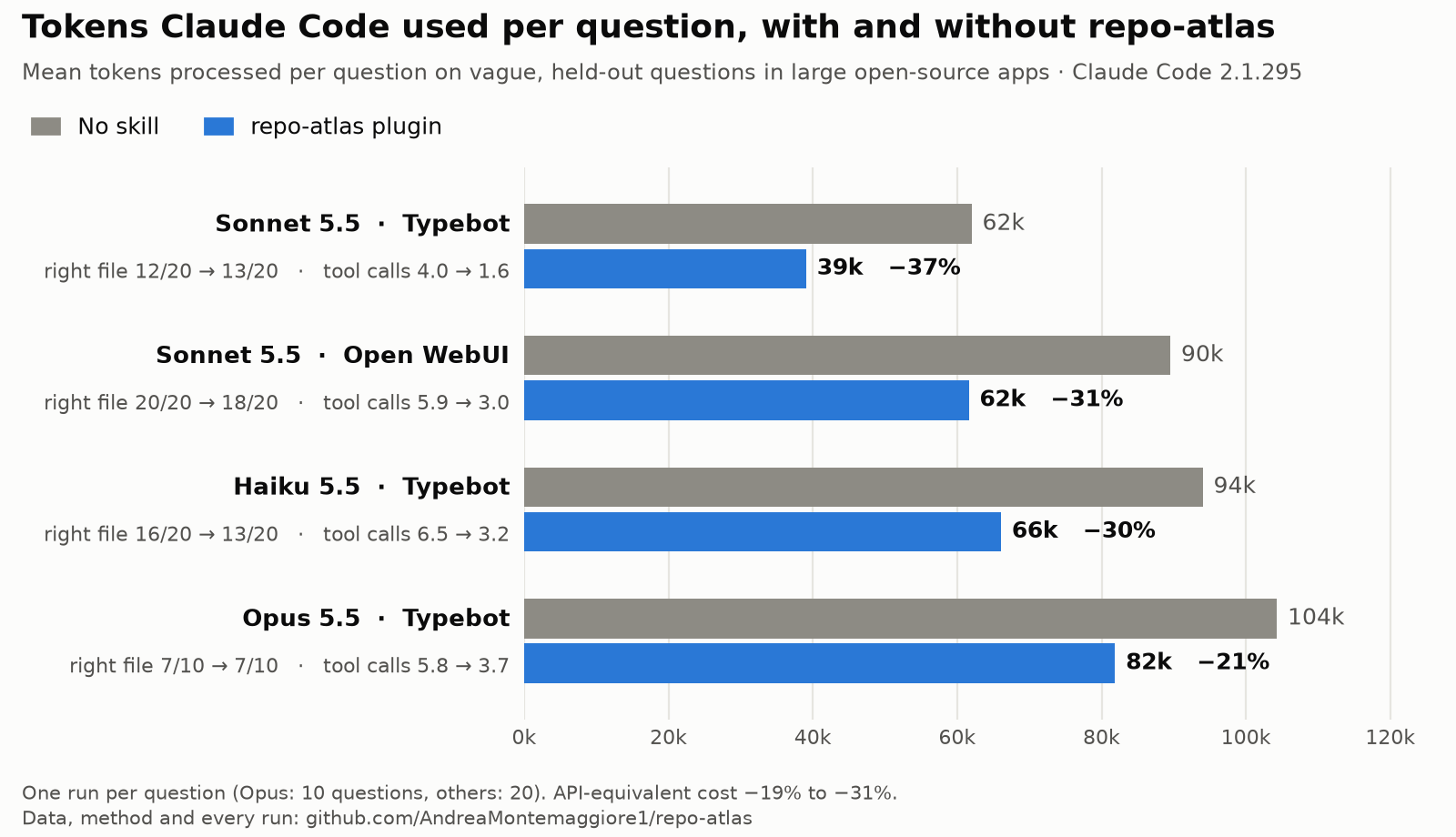
Each tool call sends the whole conversation back to the model. In our measurements one API call carried 13–23k tokens of fixed context, depending on the CLI version, while 100 lines of code cost about 1.5k. A first version of this skill gave Claude a better map but added turns: invoke the skill, read the instructions, run the search, read the results. It cost 1.4–1.7× more than no skill at all. The current version answers in the same turn as the invocation.
The search output (abridged, gPodder):
## resize cover pixbuf keep aspect ratio  (terms: resiz cover pixbuf keep aspect ratio)
1. src/gpodder/gtkui/model.py::PodcastListModel._resize_pixbuf_keep_ratio L662-688 [name+grep]
   662|     def _resize_pixbuf_keep_ratio(self, url, pixbuf):
   663|         """Resizes a GTK Pixbuf but keeps its aspect ratio.
   ...
2. src/gpodder/gtkui/model.py::PodcastListModel._resize_pixbuf L690-694 [grep+name]
   ...
other matching files: src/gpodder/gtkui/services.py, src/gpodder/coverart.py, src/gpodder/gtkui/desktop/channel.py, src/gpodder/gtkui/main.py
When invoked with no search words, it shows the map brief instead:
127 files, 31857 code lines; py:111, sh:9
central files: src/gpodder/__init__.py (L250 in=74), src/gpodder/util.py (L2399 in=50), ...
monolith src/gpodder/gtkui/main.py L4029 (173 syms), biggest: gPodder 73-4029
suspects: 3 duplicate bodies; 6 names defined in several files; 4 unreferenced files? (verify before trusting)
Results marked same body: are copy-pasted code, so change every copy or find the live one. name also in: marks
the same name defined in several files.
As a plugin. This repository is also its own marketplace:
claude plugin marketplace add AndreaMontemaggiore1/repo-atlas
claude plugin install repo-atlas@repo-atlas
The plugin is the recommended install. Besides the skill, it has a SessionStart hook. In a repo that has a map,
or in a git repo with at least 200 tracked code files, the hook tells Claude at the start of each session to use the
skill. That makes Claude use it consistently, starting with the first question in a repo it has never seen, and it
does not touch any file. Elsewhere, in small repos and folders without git, the hook adds nothing. When it fires it
adds about 50 tokens to the session.
Or as a plain skill: copy skills/repo-atlas/ to ~/.claude/skills/repo-atlas/ for every project, or to
<repo>/.claude/skills/repo-atlas/ for one project. Without the plugin's hook, let Claude run
atlas init --claude-md after the first use, or ask it to "set up the repo-atlas pointer". This adds the same
pointer as two lines in the repo's CLAUDE.md, and the skill asks before writing there.
Pick one of the two: with both the plugin and a copied skill, Claude sees the skill twice.
Use: nothing to set up. Ask Claude where something is implemented, or describe a behaviour or a bug. Claude
invokes the skill, and the first lookup in a repo builds the map (seconds; about 20 s for a 13k-file repo). Above
30,000 code files the first map is built in the background, and Claude uses Grep until it is ready. To call it
yourself, run /repo-atlas:repo-atlas where checkout totals are computed with the plugin, or /repo-atlas … with
the plain skill.
Other agents that read Agent Skills can use skills/repo-atlas/ as well. There the model runs the lookup command
itself, because the automatic lookup is a Claude Code feature. This is untested.
Requirements: Python 3.9+ on PATH and bash (Git Bash on Windows). git is optional (it adds churn and
co-change data), and so is ripgrep (faster search). There are no dependencies and no network access, and the
code and the map never leave your machine.
Every run is a real headless Claude Code session on a fresh copy of a public repo, asked one question: "where is
the code I would change for …?". The gold answer is the files the original commit touched. The questions below
are vague: an LLM rewrote each commit subject as a product owner would ask it, with no code names. They are
held out, meaning they were generated and run without being used to tune the skill. Costs are API-equivalent.
The method, the data of every run and the scripts are in bench/.
Arms: A has no skill. S is the skill alone. P is the skill plus the 2-line CLAUDE.md pointer.
H is the plugin as shipped: the skill plus the hook. hit@3 means a gold file is among the first three files
the answer names.
| repo (size) | model | hit@3 out of 20: A / S / P / H | tokens vs A: S / P / H | API cost vs A: S / P / H |
|---|---|---|---|---|
| Open WebUI (278k lines, Python + Svelte) | Sonnet 5.5 | 20 / 20 / 19 / 19 | 0.85 / 0.72 / 0.70 | 0.90 / 0.83 / 0.80 |
| Typebot (167k lines, Next.js) | Sonnet 5.5 | 18 / 16 / 18 / 17 | 0.88 / 0.89 / 0.77 | 0.86 / 0.89 / 0.80 |
| LibreChat (React + Node) | Sonnet 5.5 | 18 / 15 / 16 / – | 0.67 / 1.07¹ / – | 0.75 / 0.92 / – |
| Dify (Python + Next.js, 13k files) | Sonnet 5.5 | 16 / 17 / 17 / – | 0.96 / 0.74 / – | 1.00 / 0.80 / – |
| Typebot | Haiku 5.5 | 16 / 15 / – / 15 | 0.59 / – / 0.54 | 0.66 / – / 0.65 |
| Open WebUI | Haiku 5.5 | 18 / 18 / – / 17 | 0.59 / – / 0.53 | 0.67 / – / 0.67 |
| Typebot, 20 newer questions, CLI 2.1.295 | Sonnet 5.5 | 12 / – / – / 14 | – / – / 0.68 | – / – / 0.82 |
| Typebot, 10 of those questions, CLI 2.1.295 | Opus 5.5 | 7 / – / – / 7 (out of 10) | – / – / 0.90 | – / – / 0.86 |
¹ One question that every arm failed cost P 1.26M tokens. P's median question cost 0.71× A's.
Reports: Open WebUI, Typebot, H, LibreChat and Dify, Haiku, latest CLI and Opus.
Re-check after a Claude Code update (2026-10-14, same CLI number 2.1.295 but a new build, same questions):
| set | model | hit@3: A / H / H0 | tokens vs A: H / H0 | API cost vs A: H / H0 |
|---|---|---|---|---|
| Typebot, newer questions (20) | Sonnet 5.5 | 12 / 13 / 13 | 0.63 / 0.69 | 0.81 / 0.82 |
| Open WebUI (20) | Sonnet 5.5 | 20 / 18 / 20 | 0.69 / 0.78 | 0.81 / 0.87 |
| Typebot, newer questions (20) | Haiku 5.5 | 16 / 13 / – | 0.70 / – | 0.69 / – |
| Typebot, newer questions (10) | Opus 5.5 | 7 / 7 / – | 0.79 / – | 0.79 / – |
H0 is the plugin on a repo it has never seen, with no map yet: the first lookup builds it. Reports: re-check, H0, Haiku, Opus.
What this means:
bench/ before trusting them on a newer one.bash skills/repo-atlas/scripts/atlas find …, which is Python. It
reads the repo's files and runs read-only git commands (ls-files, diff, status, log, rev-parse), plus
ripgrep and ctags if they are installed.atlas session-start. It checks for .atlas/ and runs git ls-files
to count code files, prints at most one line for Claude's context, and writes nothing..atlas/ in your repo: the map (_map.md, _map.json, symbols.json, meta.json),
a .gitignore, notes.md when Claude records notes, and a temporary building lock. atlas init --claude-md
adds two lines to CLAUDE.md, and only when you approve it.atlas map process, which exits when the map is written.Doesn't Anthropic say that grep beats indexing? The Claude Code team has said they replaced a vector-database index with agentic search, where the model drives Grep and Glob, because it worked better and has no stale index or privacy problems. repo-atlas does not bring embeddings or a vector store back. Its lookup is lexical: BM25 over symbol names, paths, matching lines and your notes. The map adds repo structure (imports, git history, duplicates) for the brief and the warnings, and everything runs locally. The model still drives the search: the lookup is one fast first step that returns code, and Claude greps or reads further when the result is only nearby. What it removes are the extra turns, not the agentic search.
Does the map stay up to date when the code changes? Yes, for search. On every lookup, git lists the files that
changed since the map was built: commits, merged PRs, pulls and uncommitted edits. Those files are re-read for that
query, and with more than 50 changed code files the whole map is rebuilt automatically. The repo-wide parts (central
files, duplicates, files that change together, the brief) refresh only on a full rebuild or atlas map. Without
git, changes are not detected, so run atlas map. The map only sees your working copy, so a PR you have not pulled
is not in it.
Where is the map, and can I commit it? In .atlas/ at the repo root. Generated files are git-ignored. Only
notes.md is worth committing, if you use notes.
Does it send my code anywhere? No. The scripts are plain Python and bash with no dependencies and no network access, and the pre-approved command is only the skill's own script.
bench/results/.repo-atlas was developed with Claude Code driven by Claude Opus 5.5, over 13 days and about 50 commits. It went through 5 versions of the skill and 12 benchmark rounds, about 1,570 headless sessions in all. Every number in this README comes from those sessions.
Claude runs these itself. You can also run them from a terminal: bash <skill dir>/scripts/atlas <command>.
| command | what it does |
|---|---|
find "q1" "q2" | ranked symbols with their code, several searches in one call (builds the map on first use) |
find | the map brief |
map | rebuild .atlas/ |
note "path::Symbol | text" | record a fact a search would miss (code in a surprising place, a trap, which duplicate is live). Notes appear with later search results |
check [--fix-lines] | validate notes against the code |
init [--claude-md] | write .atlas/.gitignore (generated files are ignored, notes.md can be committed) and optionally the CLAUDE.md pointer |
gate | optional hook that blocks whole-file reads of big code files (references/enforce.md) |
python -m pytest -q tests
CI runs the tests on Python 3.9–3.13 on Linux, macOS and Windows. The optional tree-sitter parsers in
requirements-dev.txt replace the regex symbol extraction for JS/TS/Go/Java/Rust when installed.
MIT
Claude Code plugin: find code in large or messy repos with fewer turns and tokens
Python
2
1 commits
updated Oct 15, 2026
A Claude Code skill for finding code in large or messy repositories with fewer turns. When Claude invokes it with a few search words, the skill runs a local lookup inside the invocation itself and returns the best-matching functions with their code. The usual Grep → Read → Read chain shrinks to a call or two.
The lookup runs on a map of the repo, .atlas/, built locally in seconds without any model tokens. The map holds
symbols with line ranges, import-graph ranking, files that change together, copy-pasted duplicates, unreferenced
files and generated noise. These are the things that waste turns in vibe-coded repos.
In short: on vague questions in large open-source apps, Claude Code with the plugin used 21–37% fewer tokens and made 35–60% fewer tool calls. It found the right file about as often as without it. With Haiku it lost 3 of 20 questions, and it does not pay off in small repos. All the numbers, limits and raw data are below.
Each tool call sends the whole conversation back to the model. In our measurements one API call carried 13–23k tokens of fixed context, depending on the CLI version, while 100 lines of code cost about 1.5k. A first version of this skill gave Claude a better map but added turns: invoke the skill, read the instructions, run the search, read the results. It cost 1.4–1.7× more than no skill at all. The current version answers in the same turn as the invocation.
The search output (abridged, gPodder):
## resize cover pixbuf keep aspect ratio  (terms: resiz cover pixbuf keep aspect ratio)
1. src/gpodder/gtkui/model.py::PodcastListModel._resize_pixbuf_keep_ratio L662-688 [name+grep]
   662|     def _resize_pixbuf_keep_ratio(self, url, pixbuf):
   663|         """Resizes a GTK Pixbuf but keeps its aspect ratio.
   ...
2. src/gpodder/gtkui/model.py::PodcastListModel._resize_pixbuf L690-694 [grep+name]
   ...
other matching files: src/gpodder/gtkui/services.py, src/gpodder/coverart.py, src/gpodder/gtkui/desktop/channel.py, src/gpodder/gtkui/main.py
When invoked with no search words, it shows the map brief instead:
127 files, 31857 code lines; py:111, sh:9
central files: src/gpodder/__init__.py (L250 in=74), src/gpodder/util.py (L2399 in=50), ...
monolith src/gpodder/gtkui/main.py L4029 (173 syms), biggest: gPodder 73-4029
suspects: 3 duplicate bodies; 6 names defined in several files; 4 unreferenced files? (verify before trusting)
Results marked same body: are copy-pasted code, so change every copy or find the live one. name also in: marks
the same name defined in several files.
As a plugin. This repository is also its own marketplace:
claude plugin marketplace add AndreaMontemaggiore1/repo-atlas
claude plugin install repo-atlas@repo-atlas
The plugin is the recommended install. Besides the skill, it has a SessionStart hook. In a repo that has a map,
or in a git repo with at least 200 tracked code files, the hook tells Claude at the start of each session to use the
skill. That makes Claude use it consistently, starting with the first question in a repo it has never seen, and it
does not touch any file. Elsewhere, in small repos and folders without git, the hook adds nothing. When it fires it
adds about 50 tokens to the session.
Or as a plain skill: copy skills/repo-atlas/ to ~/.claude/skills/repo-atlas/ for every project, or to
<repo>/.claude/skills/repo-atlas/ for one project. Without the plugin's hook, let Claude run
atlas init --claude-md after the first use, or ask it to "set up the repo-atlas pointer". This adds the same
pointer as two lines in the repo's CLAUDE.md, and the skill asks before writing there.
Pick one of the two: with both the plugin and a copied skill, Claude sees the skill twice.
Use: nothing to set up. Ask Claude where something is implemented, or describe a behaviour or a bug. Claude
invokes the skill, and the first lookup in a repo builds the map (seconds; about 20 s for a 13k-file repo). Above
30,000 code files the first map is built in the background, and Claude uses Grep until it is ready. To call it
yourself, run /repo-atlas:repo-atlas where checkout totals are computed with the plugin, or /repo-atlas … with
the plain skill.
Other agents that read Agent Skills can use skills/repo-atlas/ as well. There the model runs the lookup command
itself, because the automatic lookup is a Claude Code feature. This is untested.
Requirements: Python 3.9+ on PATH and bash (Git Bash on Windows). git is optional (it adds churn and
co-change data), and so is ripgrep (faster search). There are no dependencies and no network access, and the
code and the map never leave your machine.
Every run is a real headless Claude Code session on a fresh copy of a public repo, asked one question: "where is
the code I would change for …?". The gold answer is the files the original commit touched. The questions below
are vague: an LLM rewrote each commit subject as a product owner would ask it, with no code names. They are
held out, meaning they were generated and run without being used to tune the skill. Costs are API-equivalent.
The method, the data of every run and the scripts are in bench/.
Arms: A has no skill. S is the skill alone. P is the skill plus the 2-line CLAUDE.md pointer.
H is the plugin as shipped: the skill plus the hook. hit@3 means a gold file is among the first three files
the answer names.
| repo (size) | model | hit@3 out of 20: A / S / P / H | tokens vs A: S / P / H | API cost vs A: S / P / H |
|---|---|---|---|---|
| Open WebUI (278k lines, Python + Svelte) | Sonnet 5.5 | 20 / 20 / 19 / 19 | 0.85 / 0.72 / 0.70 | 0.90 / 0.83 / 0.80 |
| Typebot (167k lines, Next.js) | Sonnet 5.5 | 18 / 16 / 18 / 17 | 0.88 / 0.89 / 0.77 | 0.86 / 0.89 / 0.80 |
| LibreChat (React + Node) | Sonnet 5.5 | 18 / 15 / 16 / – | 0.67 / 1.07¹ / – | 0.75 / 0.92 / – |
| Dify (Python + Next.js, 13k files) | Sonnet 5.5 | 16 / 17 / 17 / – | 0.96 / 0.74 / – | 1.00 / 0.80 / – |
| Typebot | Haiku 5.5 | 16 / 15 / – / 15 | 0.59 / – / 0.54 | 0.66 / – / 0.65 |
| Open WebUI | Haiku 5.5 | 18 / 18 / – / 17 | 0.59 / – / 0.53 | 0.67 / – / 0.67 |
| Typebot, 20 newer questions, CLI 2.1.295 | Sonnet 5.5 | 12 / – / – / 14 | – / – / 0.68 | – / – / 0.82 |
| Typebot, 10 of those questions, CLI 2.1.295 | Opus 5.5 | 7 / – / – / 7 (out of 10) | – / – / 0.90 | – / – / 0.86 |
¹ One question that every arm failed cost P 1.26M tokens. P's median question cost 0.71× A's.
Reports: Open WebUI, Typebot, H, LibreChat and Dify, Haiku, latest CLI and Opus.
Re-check after a Claude Code update (2026-10-14, same CLI number 2.1.295 but a new build, same questions):
| set | model | hit@3: A / H / H0 | tokens vs A: H / H0 | API cost vs A: H / H0 |
|---|---|---|---|---|
| Typebot, newer questions (20) | Sonnet 5.5 | 12 / 13 / 13 | 0.63 / 0.69 | 0.81 / 0.82 |
| Open WebUI (20) | Sonnet 5.5 | 20 / 18 / 20 | 0.69 / 0.78 | 0.81 / 0.87 |
| Typebot, newer questions (20) | Haiku 5.5 | 16 / 13 / – | 0.70 / – | 0.69 / – |
| Typebot, newer questions (10) | Opus 5.5 | 7 / 7 / – | 0.79 / – | 0.79 / – |
H0 is the plugin on a repo it has never seen, with no map yet: the first lookup builds it. Reports: re-check, H0, Haiku, Opus.
What this means:
bench/ before trusting them on a newer one.bash skills/repo-atlas/scripts/atlas find …, which is Python. It
reads the repo's files and runs read-only git commands (ls-files, diff, status, log, rev-parse), plus
ripgrep and ctags if they are installed.atlas session-start. It checks for .atlas/ and runs git ls-files
to count code files, prints at most one line for Claude's context, and writes nothing..atlas/ in your repo: the map (_map.md, _map.json, symbols.json, meta.json),
a .gitignore, notes.md when Claude records notes, and a temporary building lock. atlas init --claude-md
adds two lines to CLAUDE.md, and only when you approve it.atlas map process, which exits when the map is written.Doesn't Anthropic say that grep beats indexing? The Claude Code team has said they replaced a vector-database index with agentic search, where the model drives Grep and Glob, because it worked better and has no stale index or privacy problems. repo-atlas does not bring embeddings or a vector store back. Its lookup is lexical: BM25 over symbol names, paths, matching lines and your notes. The map adds repo structure (imports, git history, duplicates) for the brief and the warnings, and everything runs locally. The model still drives the search: the lookup is one fast first step that returns code, and Claude greps or reads further when the result is only nearby. What it removes are the extra turns, not the agentic search.
Does the map stay up to date when the code changes? Yes, for search. On every lookup, git lists the files that
changed since the map was built: commits, merged PRs, pulls and uncommitted edits. Those files are re-read for that
query, and with more than 50 changed code files the whole map is rebuilt automatically. The repo-wide parts (central
files, duplicates, files that change together, the brief) refresh only on a full rebuild or atlas map. Without
git, changes are not detected, so run atlas map. The map only sees your working copy, so a PR you have not pulled
is not in it.
Where is the map, and can I commit it? In .atlas/ at the repo root. Generated files are git-ignored. Only
notes.md is worth committing, if you use notes.
Does it send my code anywhere? No. The scripts are plain Python and bash with no dependencies and no network access, and the pre-approved command is only the skill's own script.
bench/results/.repo-atlas was developed with Claude Code driven by Claude Opus 5.5, over 13 days and about 50 commits. It went through 5 versions of the skill and 12 benchmark rounds, about 1,570 headless sessions in all. Every number in this README comes from those sessions.
Claude runs these itself. You can also run them from a terminal: bash <skill dir>/scripts/atlas <command>.
| command | what it does |
|---|---|
find "q1" "q2" | ranked symbols with their code, several searches in one call (builds the map on first use) |
find | the map brief |
map | rebuild .atlas/ |
note "path::Symbol | text" | record a fact a search would miss (code in a surprising place, a trap, which duplicate is live). Notes appear with later search results |
check [--fix-lines] | validate notes against the code |
init [--claude-md] | write .atlas/.gitignore (generated files are ignored, notes.md can be committed) and optionally the CLAUDE.md pointer |
gate | optional hook that blocks whole-file reads of big code files (references/enforce.md) |
python -m pytest -q tests
CI runs the tests on Python 3.9–3.13 on Linux, macOS and Windows. The optional tree-sitter parsers in
requirements-dev.txt replace the regex symbol extraction for JS/TS/Go/Java/Rust when installed.
MIT



