
318 Google Cloud GenAI notebooks compiled into a 686-page, source-cited Obsidian second brain. Browsable web view at agricidaniel.github.io/google-genai-brain
TypeScript
22
19 commits
updated Jun 26, 2026
README





Generative AI Google Brain
The entire GoogleCloudPlatform/generative-ai repository compiled into a fully interlinked Obsidian second brain: concept maps, one page per notebook, an entity page for every model and API, and distilled best-practice guides, all cross-linked.
318 Google Cloud GenAI notebooks become 686 navigable, source-cited pages you can browse by concept, trace by relationship, and learn best practices from, without opening a single .ipynb.
Why this brain
- Browse by concept, not by folder. 20 thematic maps (Gemini, Agents and ADK, RAG and Grounding, Vertex AI Search, Evaluation, and more) sit on top of 317 per-notebook pages.
- Every claim is grounded. Each page links back to its source notebook on GitHub with a content hash. Adversarially verified at 95/100, with effectively zero hallucinations.
- Best practices, distilled. One source-cited guide per theme, plus the per-notebook practices that back it.
🌐 Open release. This public mirror lives at
AgriciDaniel/google-genai-brainand is built for the AI Marketing Hub Pro community. It bundles Google's Apache-2.0 sample content (see THIRD_PARTY_NOTICES); our pipeline and synthesis are MIT.
Coverage
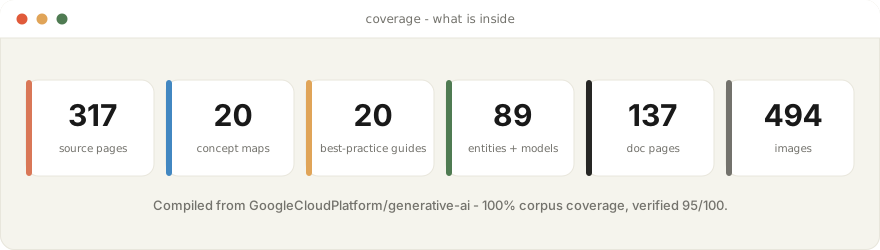
| Pages | Count |
|---|---|
| Source pages (1 per notebook) | 317 |
| Concept maps + best-practice guides | 20 + 20 |
| Entity pages + model pages | 22 + 67 |
| Repository doc pages | 137 |
| Sample-app pages | 74 |
| Area indexes | 12 |
| Total wiki pages | 686 |
| Architecture diagrams and images | 494 |
Quality gate, enforced by lint_vault.py and CI: 0 dead links, 0 dead embeds, 0 orphan pages.
Architecture
Four interlinked grammars in one vault. Open the graph view and they connect.
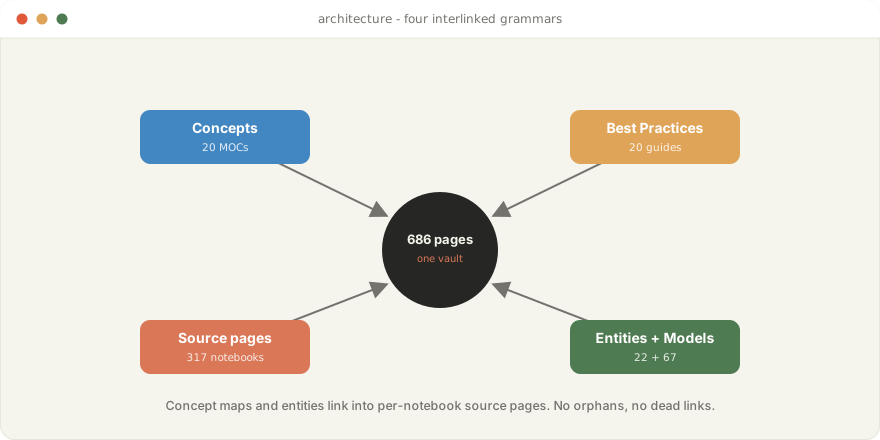
- Concepts (
wiki/concepts/): thematic Maps of Content. Start here to learn an area. - Source pages (
wiki/source/): one page per notebook, mirroring the repo tree, with distilled code patterns, models and APIs used, gotchas, and best practices. - Entities (
wiki/entities/): models, APIs, and SDKs. Each links to every notebook that uses it. - Best practices (
wiki/best-practices/): distilled, source-cited guidance per theme.
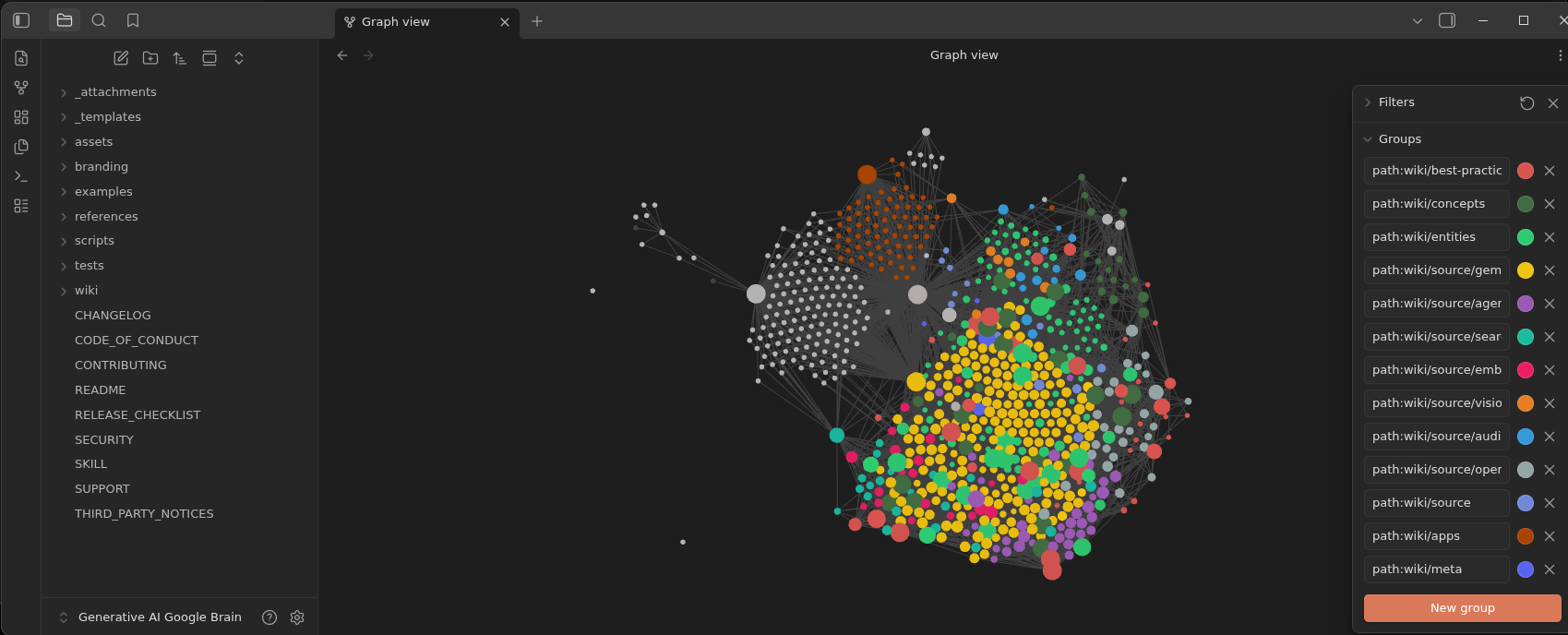
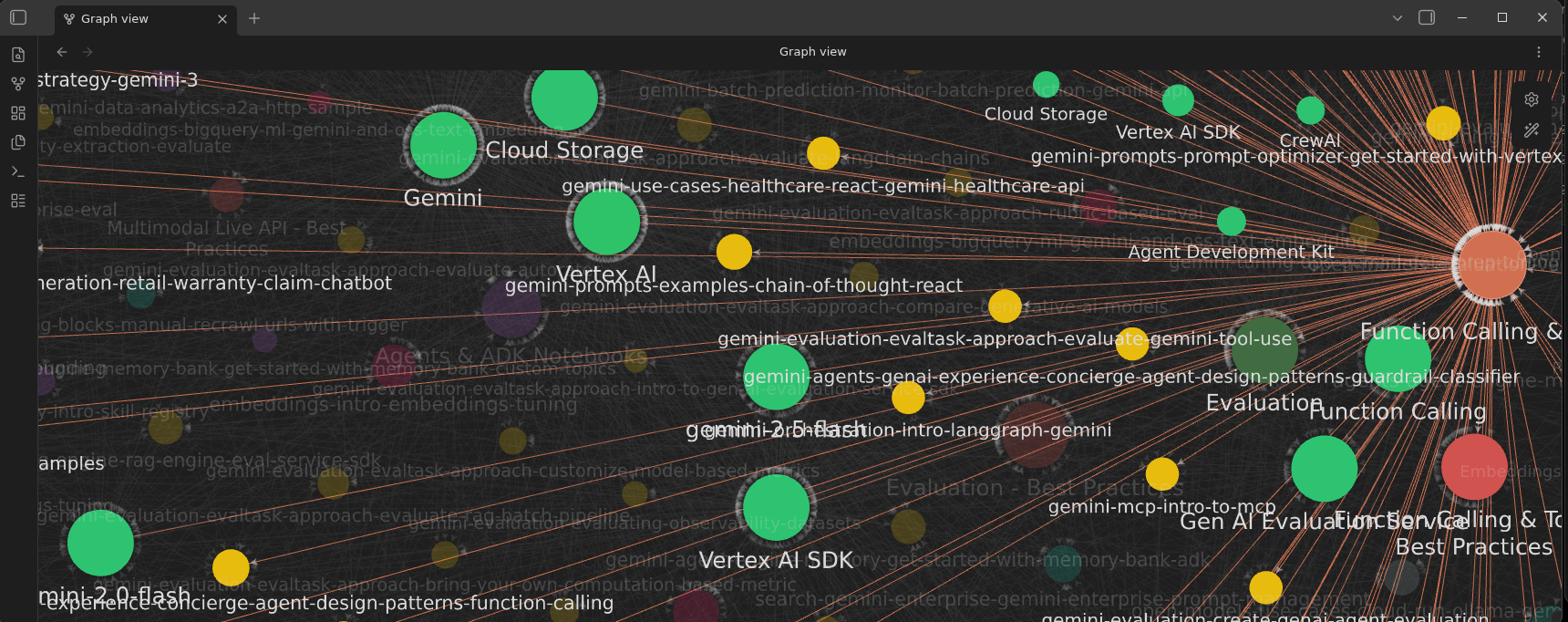
Here is the real Obsidian graph view of this brain: 686 pages, color-coded by area, fully connected with no orphans.
Pipeline
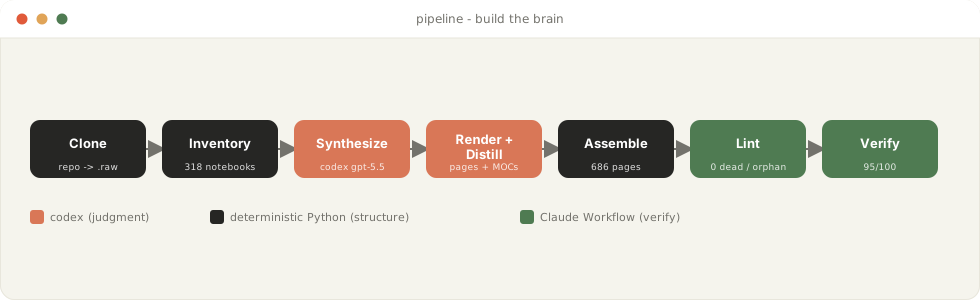
Division of labor. codex (gpt-5.5, xhigh) does the judgment: reading each notebook and distilling summaries, gotchas, and best practices. Deterministic Python owns the structure: provenance, wikilinks, the graph, and a lint gate that guarantees zero dead links and zero orphans. A Claude Workflow adversarially verifies. The model is never trusted for file paths, URLs, hashes, or links.
Methodology
The build follows a read, write, verify kernel:
- Perceive. Clone the repo immutably, inventory 318 notebooks, and strip each to lean text.
- Analyze. codex reads one notebook per call and returns a strict JSON extraction (models, APIs, code patterns, gotchas, best practices) tagged from a controlled vocabulary.
- Validate. Deterministic rendering plus a hard lint gate (zero dead links, zero orphans), then an independent 66-agent verification pass against the source notebooks.
- Act. Assemble concept maps, entity pages, and best-practice guides, all cross-linked, and ship only when the gate is green.
The full extraction contract is in references/EXTRACTION-PROMPT.md; verification results are in references/VERIFICATION.md.
Sample output
A source page (excerpt): gemini/use-cases/entity-extraction/evaluate.ipynb
Evaluates Gemini-based document classification on image samples and visualizes confusion matrices.
Summary. Loads Gemini project settings from a
.envfile, setsgemini-2.5-flashas the evaluation model, and runs document classification evaluation through local modules. It evaluates a stratified 120-sample set, then a focused 60-sample subset, prints summary metrics, and plots ordered confusion matrices.Models and APIs.
gemini-2.5-flash(linked to its model page) and Vertex AI.Gotchas.
GEMINI_PROJECT_IDmust be set or the notebook raisesValueError. Sample sizes are fixed at 120 and 60.Best practices. Use environment variables for configuration. Set a random state for reproducible sampling. Use
stratify=Truefor class-balanced samples. Inspect summary metrics together with confusion matrices.Related. Concepts: Evaluation, Applied Use Cases. Entities: Gemini. Plus embedded architecture diagrams from the notebook's directory.
Browse it on the web
No Obsidian required. The entire brain is published as a fast, fully searchable static site, built with Quartz from the same wiki/ vault:
agricidaniel.github.io/google-genai-brain
Full-text search, the interactive graph, backlinks, popovers, and dark mode all work in the browser. All 686 pages publish; the site rebuilds and redeploys on every push to main via .github/workflows/deploy.yml.
Build it yourself:
cd site && npm ci && npx quartz build(add--servefor a local preview atlocalhost:8080).
Use it
- Open this folder as a vault in Obsidian.
- Start at
wiki/meta/Start Here.md. - Open the graph view. Use backlinks on any entity page to find every notebook that uses it.
For agent use and rebuild commands, see SKILL.md.
Rebuild
The committed .raw/extracted/ lets you regenerate the deterministic layer offline:
python3 scripts/render_source_pages.py && python3 scripts/build_brain.py
python3 scripts/lint_vault.py     # expect LINT CLEAN
A full re-scrape (new Google notebooks) needs the codex CLI with gpt-5.5:
bash scripts/build_all.sh
Compared to
| Reading the repo on GitHub | Generic RAG over the repo | Generative AI Google Brain | |
|---|---|---|---|
| Browse by concept | No | Partial | Yes, 20 concept maps |
| Per-notebook summary + code patterns | No | Sometimes | Yes, 317 pages |
| Source-cited best practices | No | No | Yes, per theme |
| Find every notebook using a model | No | No | Yes, entity pages |
| Architecture diagrams in context | Scattered | No | Yes, embedded |
| Works offline in your notes | No | No | Yes, an Obsidian vault |
| Grounding guarantee | n/a | Weak | 95/100 verified, hashed |
Use cases
- GCP solutions architect. Find the right pattern (RAG, grounding, agents, evaluation) in minutes instead of opening 318 notebooks.
- Developer advocate or educator. Pull grounded, per-theme best practices and the matching architecture diagrams for a talk or workshop.
- AI engineer onboarding. Learn the Gemini and Vertex AI surface through concept maps that link straight to runnable examples.
- Team shipping a GenAI feature. Compare embedding and vector-store options and see exactly which notebooks use what before you commit.
FAQ
Is the content accurate? Source pages were adversarially verified at 95/100 with no hallucinations. The concept guides are synthesized across many notebooks and cite their sources. See references/VERIFICATION.md.
Does it need API keys or cloud access? No. It builds and reads with zero credentials and runs no cloud workloads.
How current is it? Snapshot of 2026-06-09. Re-run scripts/build_all.sh to refresh when Google pushes new notebooks.
Can I rebuild without paying for codex? Yes. The committed extractions regenerate the full vault deterministically. Only a fresh re-scrape needs codex.
What about Google's license? The upstream content is Apache-2.0 and remains Google's. This repo links back to every notebook and preserves attribution in THIRD_PARTY_NOTICES.md. Our original pipeline and synthesis are MIT.
Why Obsidian? The value is the graph: backlinks, the connection view, and local search over a fully interlinked knowledge base.
Built by
- Blog agricidaniel.com/blog
- AI Marketing Hub (free) skool.com/ai-marketing-hub
- AI Marketing Hub Pro skool.com/ai-marketing-hub-pro
- YouTube @AgriciDaniel
- GitHub @AgriciDaniel
Project info
License (MIT) · Contributing · Security · Support · Code of Conduct · Third-party notices · Changelog
Reference material only. Always verify against the linked upstream notebook and the official Vertex AI documentation before shipping production code.
Contributors

19 commits
Similar repos


Languages
TypeScript
69.7%
Python
17.9%
SCSS
6.8%
JavaScript
3.9%
CSS
1.4%
318 Google Cloud GenAI notebooks compiled into a 686-page, source-cited Obsidian second brain. Browsable web view at agricidaniel.github.io/google-genai-brain
TypeScript
22
19 commits
updated Jun 26, 2026
README
Generative AI Google Brain
The entire GoogleCloudPlatform/generative-ai repository compiled into a fully interlinked Obsidian second brain: concept maps, one page per notebook, an entity page for every model and API, and distilled best-practice guides, all cross-linked.
318 Google Cloud GenAI notebooks become 686 navigable, source-cited pages you can browse by concept, trace by relationship, and learn best practices from, without opening a single .ipynb.
Why this brain
- Browse by concept, not by folder. 20 thematic maps (Gemini, Agents and ADK, RAG and Grounding, Vertex AI Search, Evaluation, and more) sit on top of 317 per-notebook pages.
- Every claim is grounded. Each page links back to its source notebook on GitHub with a content hash. Adversarially verified at 95/100, with effectively zero hallucinations.
- Best practices, distilled. One source-cited guide per theme, plus the per-notebook practices that back it.
🌐 Open release. This public mirror lives at
AgriciDaniel/google-genai-brainand is built for the AI Marketing Hub Pro community. It bundles Google's Apache-2.0 sample content (see THIRD_PARTY_NOTICES); our pipeline and synthesis are MIT.
Coverage
| Pages | Count |
|---|---|
| Source pages (1 per notebook) | 317 |
| Concept maps + best-practice guides | 20 + 20 |
| Entity pages + model pages | 22 + 67 |
| Repository doc pages | 137 |
| Sample-app pages | 74 |
| Area indexes | 12 |
| Total wiki pages | 686 |
| Architecture diagrams and images | 494 |
Quality gate, enforced by lint_vault.py and CI: 0 dead links, 0 dead embeds, 0 orphan pages.
Architecture
Four interlinked grammars in one vault. Open the graph view and they connect.
- Concepts (
wiki/concepts/): thematic Maps of Content. Start here to learn an area. - Source pages (
wiki/source/): one page per notebook, mirroring the repo tree, with distilled code patterns, models and APIs used, gotchas, and best practices. - Entities (
wiki/entities/): models, APIs, and SDKs. Each links to every notebook that uses it. - Best practices (
wiki/best-practices/): distilled, source-cited guidance per theme.
Here is the real Obsidian graph view of this brain: 686 pages, color-coded by area, fully connected with no orphans.
Pipeline
Division of labor. codex (gpt-5.5, xhigh) does the judgment: reading each notebook and distilling summaries, gotchas, and best practices. Deterministic Python owns the structure: provenance, wikilinks, the graph, and a lint gate that guarantees zero dead links and zero orphans. A Claude Workflow adversarially verifies. The model is never trusted for file paths, URLs, hashes, or links.
Methodology
The build follows a read, write, verify kernel:
- Perceive. Clone the repo immutably, inventory 318 notebooks, and strip each to lean text.
- Analyze. codex reads one notebook per call and returns a strict JSON extraction (models, APIs, code patterns, gotchas, best practices) tagged from a controlled vocabulary.
- Validate. Deterministic rendering plus a hard lint gate (zero dead links, zero orphans), then an independent 66-agent verification pass against the source notebooks.
- Act. Assemble concept maps, entity pages, and best-practice guides, all cross-linked, and ship only when the gate is green.
The full extraction contract is in references/EXTRACTION-PROMPT.md; verification results are in references/VERIFICATION.md.
Sample output
A source page (excerpt): gemini/use-cases/entity-extraction/evaluate.ipynb
Evaluates Gemini-based document classification on image samples and visualizes confusion matrices.
Summary. Loads Gemini project settings from a
.envfile, setsgemini-2.5-flashas the evaluation model, and runs document classification evaluation through local modules. It evaluates a stratified 120-sample set, then a focused 60-sample subset, prints summary metrics, and plots ordered confusion matrices.Models and APIs.
gemini-2.5-flash(linked to its model page) and Vertex AI.Gotchas.
GEMINI_PROJECT_IDmust be set or the notebook raisesValueError. Sample sizes are fixed at 120 and 60.Best practices. Use environment variables for configuration. Set a random state for reproducible sampling. Use
stratify=Truefor class-balanced samples. Inspect summary metrics together with confusion matrices.Related. Concepts: Evaluation, Applied Use Cases. Entities: Gemini. Plus embedded architecture diagrams from the notebook's directory.
Browse it on the web
No Obsidian required. The entire brain is published as a fast, fully searchable static site, built with Quartz from the same wiki/ vault:
agricidaniel.github.io/google-genai-brain
Full-text search, the interactive graph, backlinks, popovers, and dark mode all work in the browser. All 686 pages publish; the site rebuilds and redeploys on every push to main via .github/workflows/deploy.yml.
Build it yourself:
cd site && npm ci && npx quartz build(add--servefor a local preview atlocalhost:8080).
Use it
- Open this folder as a vault in Obsidian.
- Start at
wiki/meta/Start Here.md. - Open the graph view. Use backlinks on any entity page to find every notebook that uses it.
For agent use and rebuild commands, see SKILL.md.
Rebuild
The committed .raw/extracted/ lets you regenerate the deterministic layer offline:
python3 scripts/render_source_pages.py && python3 scripts/build_brain.py
python3 scripts/lint_vault.py     # expect LINT CLEAN
A full re-scrape (new Google notebooks) needs the codex CLI with gpt-5.5:
bash scripts/build_all.sh
Compared to
| Reading the repo on GitHub | Generic RAG over the repo | Generative AI Google Brain | |
|---|---|---|---|
| Browse by concept | No | Partial | Yes, 20 concept maps |
| Per-notebook summary + code patterns | No | Sometimes | Yes, 317 pages |
| Source-cited best practices | No | No | Yes, per theme |
| Find every notebook using a model | No | No | Yes, entity pages |
| Architecture diagrams in context | Scattered | No | Yes, embedded |
| Works offline in your notes | No | No | Yes, an Obsidian vault |
| Grounding guarantee | n/a | Weak | 95/100 verified, hashed |
Use cases
- GCP solutions architect. Find the right pattern (RAG, grounding, agents, evaluation) in minutes instead of opening 318 notebooks.
- Developer advocate or educator. Pull grounded, per-theme best practices and the matching architecture diagrams for a talk or workshop.
- AI engineer onboarding. Learn the Gemini and Vertex AI surface through concept maps that link straight to runnable examples.
- Team shipping a GenAI feature. Compare embedding and vector-store options and see exactly which notebooks use what before you commit.
FAQ
Is the content accurate? Source pages were adversarially verified at 95/100 with no hallucinations. The concept guides are synthesized across many notebooks and cite their sources. See references/VERIFICATION.md.
Does it need API keys or cloud access? No. It builds and reads with zero credentials and runs no cloud workloads.
How current is it? Snapshot of 2026-06-09. Re-run scripts/build_all.sh to refresh when Google pushes new notebooks.
Can I rebuild without paying for codex? Yes. The committed extractions regenerate the full vault deterministically. Only a fresh re-scrape needs codex.
What about Google's license? The upstream content is Apache-2.0 and remains Google's. This repo links back to every notebook and preserves attribution in THIRD_PARTY_NOTICES.md. Our original pipeline and synthesis are MIT.
Why Obsidian? The value is the graph: backlinks, the connection view, and local search over a fully interlinked knowledge base.
Built by
- Blog agricidaniel.com/blog
- AI Marketing Hub (free) skool.com/ai-marketing-hub
- AI Marketing Hub Pro skool.com/ai-marketing-hub-pro
- YouTube @AgriciDaniel
- GitHub @AgriciDaniel
Project info
License (MIT) · Contributing · Security · Support · Code of Conduct · Third-party notices · Changelog
Reference material only. Always verify against the linked upstream notebook and the official Vertex AI documentation before shipping production code.
Similar repos
Contributors
19 commits
Languages
TypeScript
69.7%
Python
17.9%
SCSS
6.8%
JavaScript
3.9%
CSS
1.4%