Pythonic tool for orchestrating machine-learning/high performance/quantum-computing workflows in heterogeneous compute environments.
See the code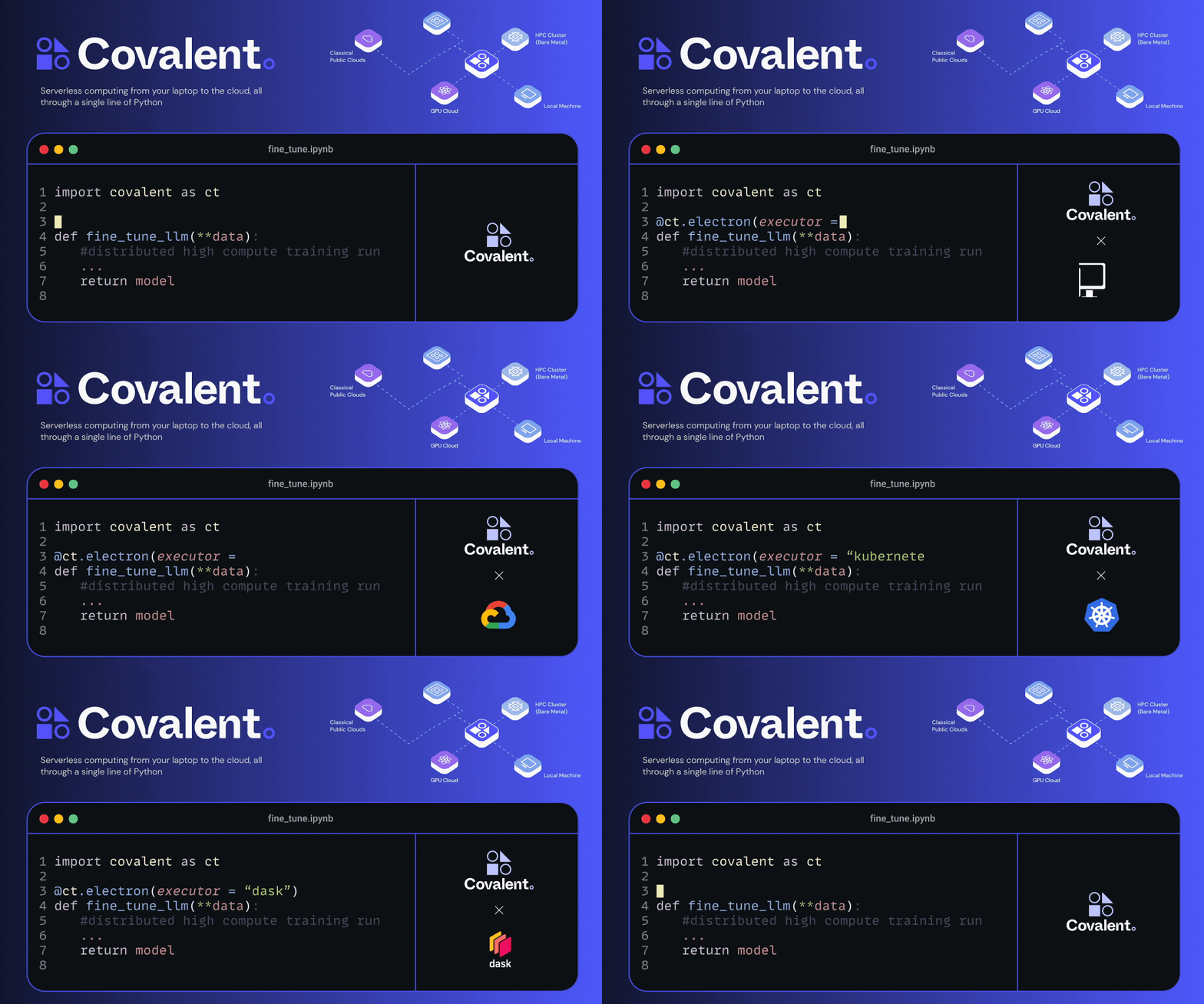









pip install covalent --upgrade
Check our Quick Start Guide for setup instructions or dive into your First Experiment. Learn more on the Concepts.
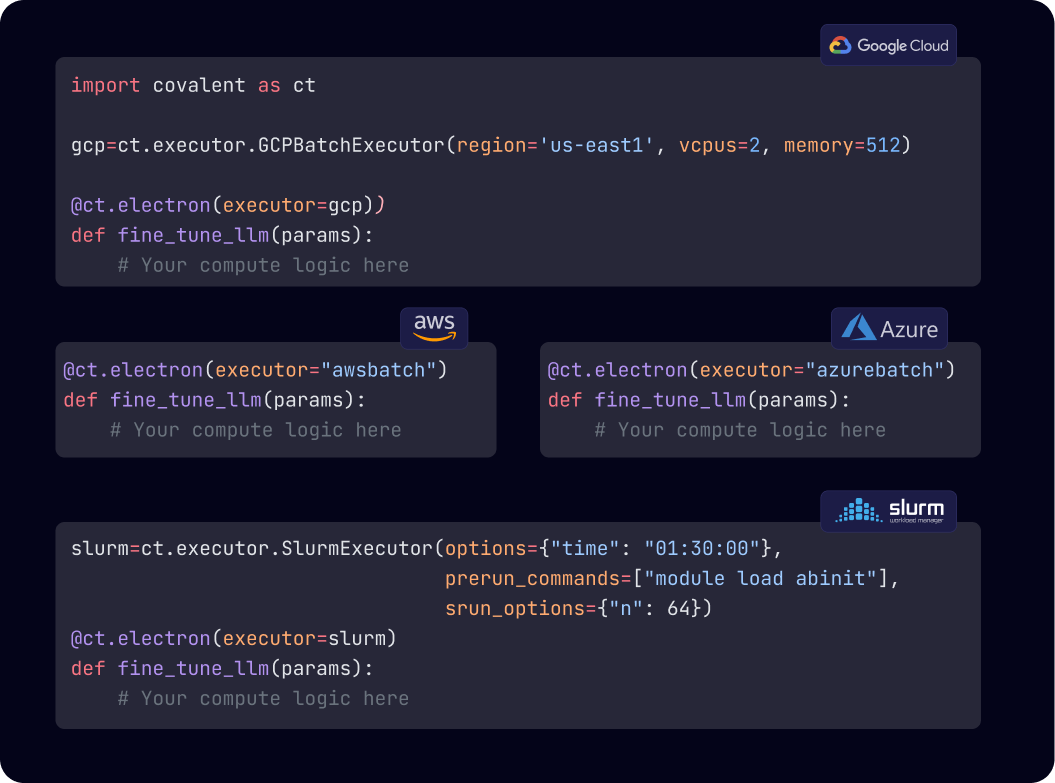
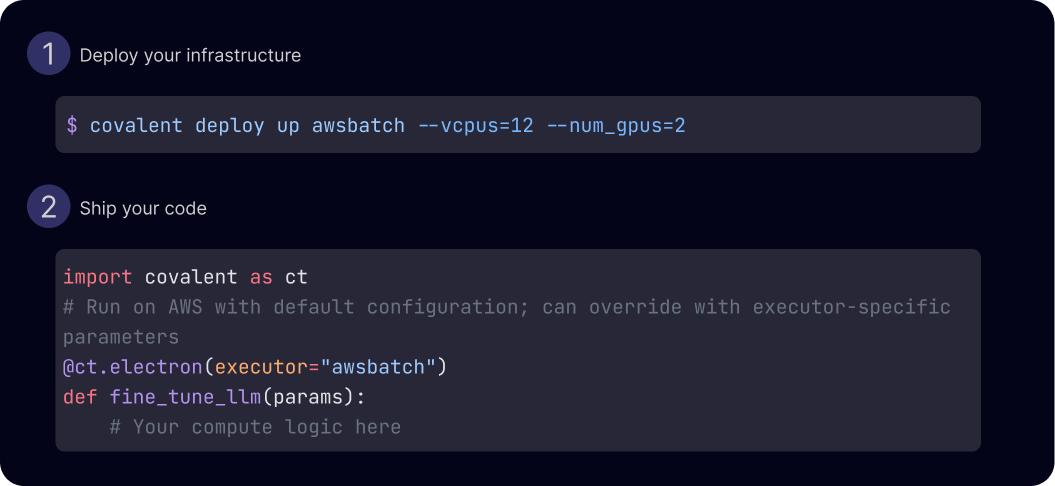
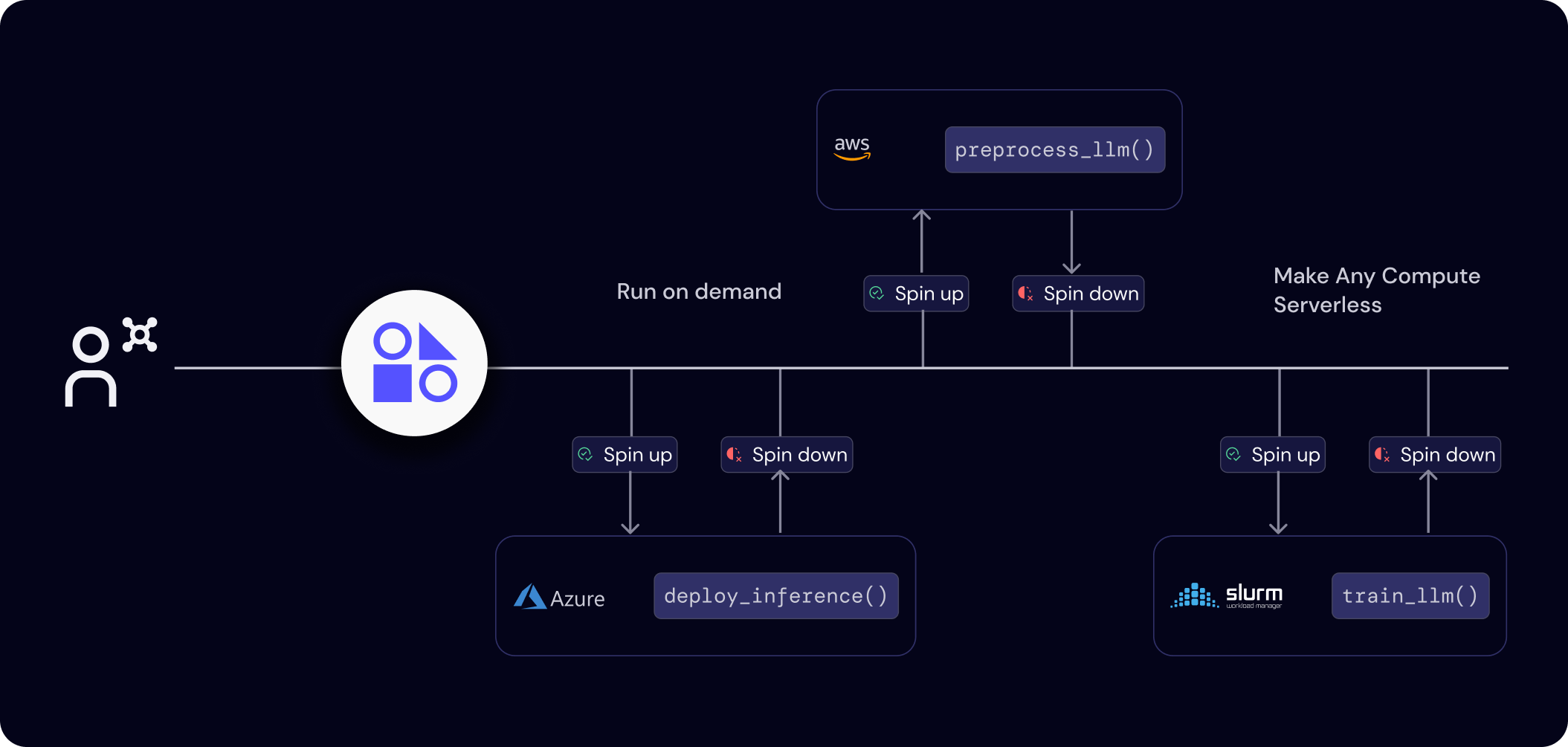
Covalent is a Python library for AI/ML engineers, developers, and researchers. It provides a straightforward approach to running compute jobs, like LLMs, generative AI, and scientific research, on various cloud platforms or on-prem clusters.
It is as simple as swapping the decorator with our executor plugins. Choose from existing plugins or create custom ones for tailored interactions with any infrastructure.
If you find Covalent useful or interesting, feel free to give us a ⭐ on GitHub! Your support helps us to continue developing and improving this framework.
| For AI/ML Practitioners and Developers | For Researchers |
|
|
If you find Covalent useful or interesting, feel free to give us a ⭐ on GitHub! Your support helps us to continue developing and improving this framework.
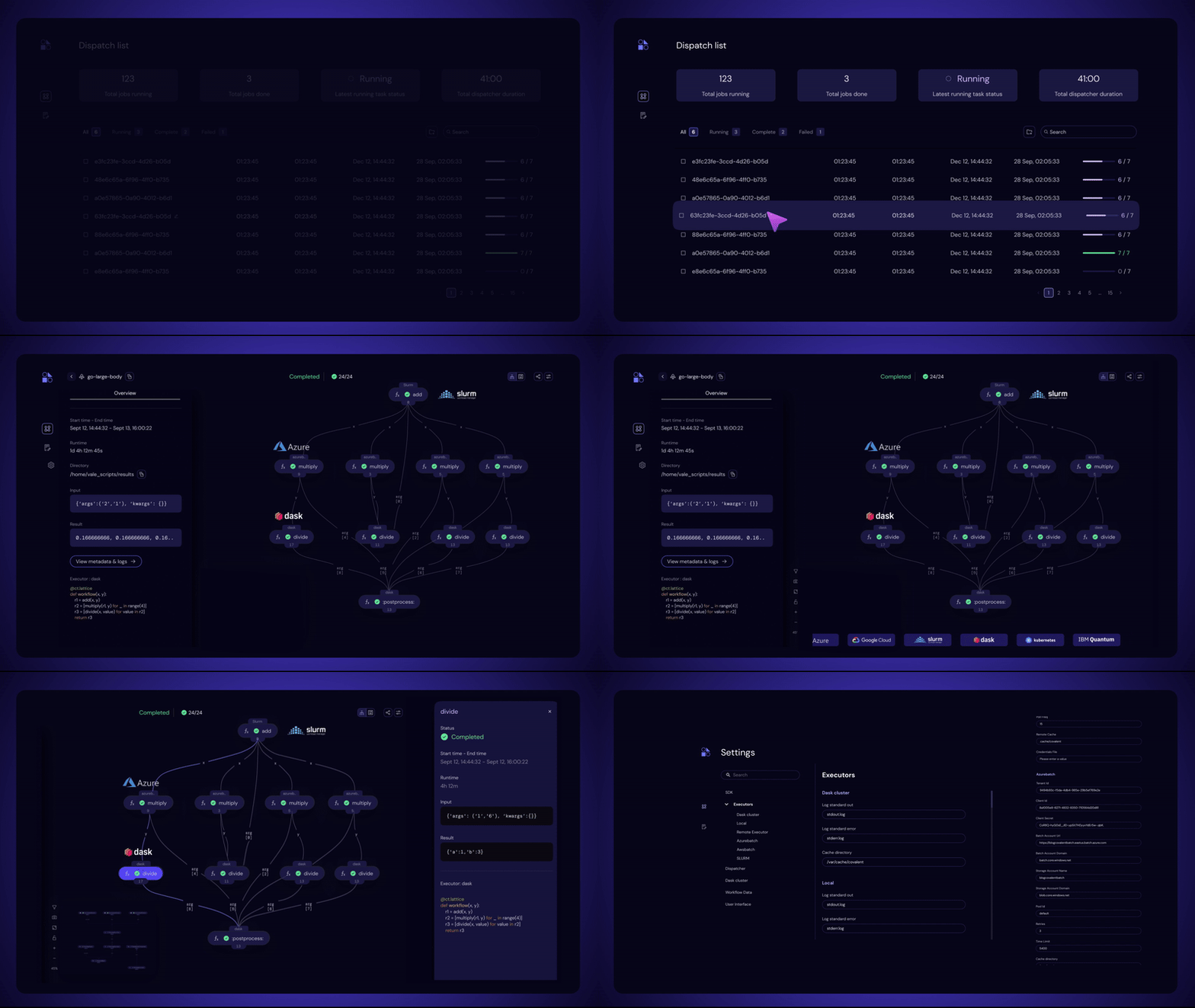
Jump right into practical examples to see Covalent in action. These tutorials cover a range of applications, giving you a hands-on experience:

Covalent integrates seamlessly with a variety of platforms. Discover our range of plugins to enhance your Covalent experience:








Get a quick overview of what Covalent offers. Our infographic summarizes the main features, providing you with a snapshot of our capabilities:
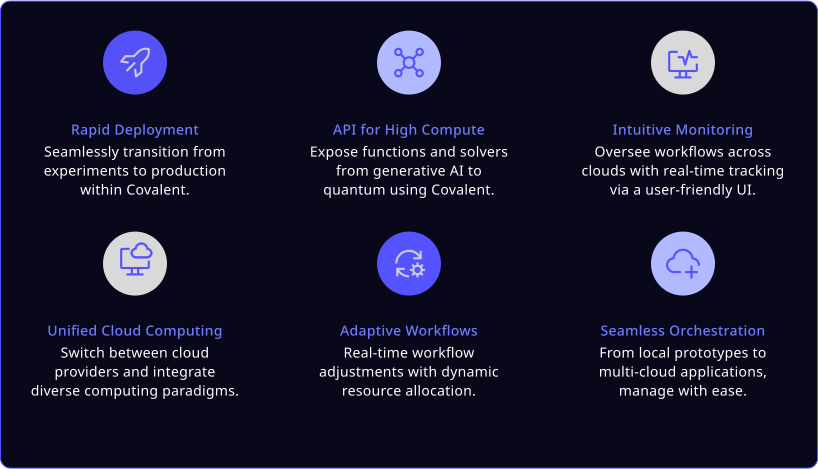
For a more in-depth description of Covalent's features and how they work, see the Concepts page in the documentation.




Covalent is developed using Python on Linux and macOS. The easiest way to install Covalent is by using the PyPI package manager.
pip install covalent --upgrade
For other methods of installation, please check the docs.
Deployments



To contribute to Covalent, refer to the Contribution Guidelines. We use GitHub's issue tracking to manage known issues, bugs, and pull requests. Get started by forking the develop branch and submitting a pull request with your contributions. Improvements to the documentation, including tutorials and how-to guides, are also welcome from the community. For more information on adding tutorials, check the Tutorial Guidelines. Participation in the Covalent community is governed by the Code of Conduct.
Please use the following citation in any publications.
https://doi.org/10.5281/zenodo.5903364
Covalent is licensed under the Apache 2.0 License. See the LICENSE file or contact the support team for more details.
For a detailed history of changes and new features, see the Changelog.
Overall
Maintained
Code review
PyPI
Latest release
Releases this year
645 followers · starred Feb 2023
358 followers · starred Oct 2024
301 followers · starred Feb 2023
127 followers · starred Mar 2024
Pythonic tool for orchestrating machine-learning/high performance/quantum-computing workflows in heterogeneous compute environments.
See the code
pip install covalent --upgrade
Check our Quick Start Guide for setup instructions or dive into your First Experiment. Learn more on the Concepts.
Covalent is a Python library for AI/ML engineers, developers, and researchers. It provides a straightforward approach to running compute jobs, like LLMs, generative AI, and scientific research, on various cloud platforms or on-prem clusters.
It is as simple as swapping the decorator with our executor plugins. Choose from existing plugins or create custom ones for tailored interactions with any infrastructure.
If you find Covalent useful or interesting, feel free to give us a ⭐ on GitHub! Your support helps us to continue developing and improving this framework.
| For AI/ML Practitioners and Developers | For Researchers |
|
|
If you find Covalent useful or interesting, feel free to give us a ⭐ on GitHub! Your support helps us to continue developing and improving this framework.
Jump right into practical examples to see Covalent in action. These tutorials cover a range of applications, giving you a hands-on experience:
Covalent integrates seamlessly with a variety of platforms. Discover our range of plugins to enhance your Covalent experience:
Get a quick overview of what Covalent offers. Our infographic summarizes the main features, providing you with a snapshot of our capabilities:
For a more in-depth description of Covalent's features and how they work, see the Concepts page in the documentation.
Covalent is developed using Python on Linux and macOS. The easiest way to install Covalent is by using the PyPI package manager.
pip install covalent --upgrade
For other methods of installation, please check the docs.
Deployments
To contribute to Covalent, refer to the Contribution Guidelines. We use GitHub's issue tracking to manage known issues, bugs, and pull requests. Get started by forking the develop branch and submitting a pull request with your contributions. Improvements to the documentation, including tutorials and how-to guides, are also welcome from the community. For more information on adding tutorials, check the Tutorial Guidelines. Participation in the Covalent community is governed by the Code of Conduct.
Please use the following citation in any publications.
https://doi.org/10.5281/zenodo.5903364
Covalent is licensed under the Apache 2.0 License. See the LICENSE file or contact the support team for more details.
For a detailed history of changes and new features, see the Changelog.
Overall
Maintained
Code review
PyPI
Latest release
Releases this year
645 followers · starred Feb 2023
358 followers · starred Oct 2024
301 followers · starred Feb 2023
127 followers · starred Mar 2024



