
README


Occamy-1.0
Open Pareto-frontier 35B Intelligence for Co-work





1. Model Introduction
Occamy-1.0 is a compact agentic model purpose-built for real-world co-work: long-horizon, stateful tasks that require coordinated use of search, code, tools, files, structured APIs, and productivity software. Starting from the post-trained Qwen3.6-35B-A3B checkpoint, Occamy concentrates further training on reliable execution, persistent state tracking, recovery, and follow-through rather than relearning general capabilities from scratch.
Key Features
- Co-work specialization: Designed for sustained execution across multi-step professional workflows, not isolated question answering.
- Compact inference footprint: A 35B-total, 3B-active Mixture-of-Experts model that keeps long-running agent workloads practical.
- Long-horizon continuity: Designed to keep work coherent across tool calls, delegated runs, and history rewrites such as context compaction.
- Broad agentic capability: Co-work gains are accompanied by strong tool calling, terminal coding, and instruction following.
- Execution-grounded training: Supervised fine-tuning spans general agentic work, long-horizon interaction, software engineering, and tool-call grounding.
- Open training stack: The multi-harness reinforcement-learning infrastructure used to train Occamy is released as Dressage.
[!NOTE] Occamy is optimized for common co-work workloads, not as a replacement for frontier models on every task. Retrieval-heavy and simulated-user tasks still have headroom, and native browser or desktop visual interaction is not part of the current co-work training interface.
2. Model Summary
| Architecture | Mixture-of-Experts causal model with vision encoder |
| Total Parameters | 35B |
| Activated Parameters | 3B |
| Number of Layers | 40 |
| Number of Experts | 256 |
| Activated Experts | 8 routed + 1 shared |
| Base Architecture Context | 262,144 tokens |
| SFT Sequence Length | 131,072 tokens |
| Starting Checkpoint | Qwen3.6-35B-A3B |
| Post-training | Full-parameter SFT, HDPO, model merging, and SAO |
Architecture fields follow the starting checkpoint's published model card. Occamy post-trains the language backbone without changing the architecture; the vision encoder and projector are frozen during SFT. The released checkpoint configuration remains the source of truth for serving limits.
3. Evaluation Results
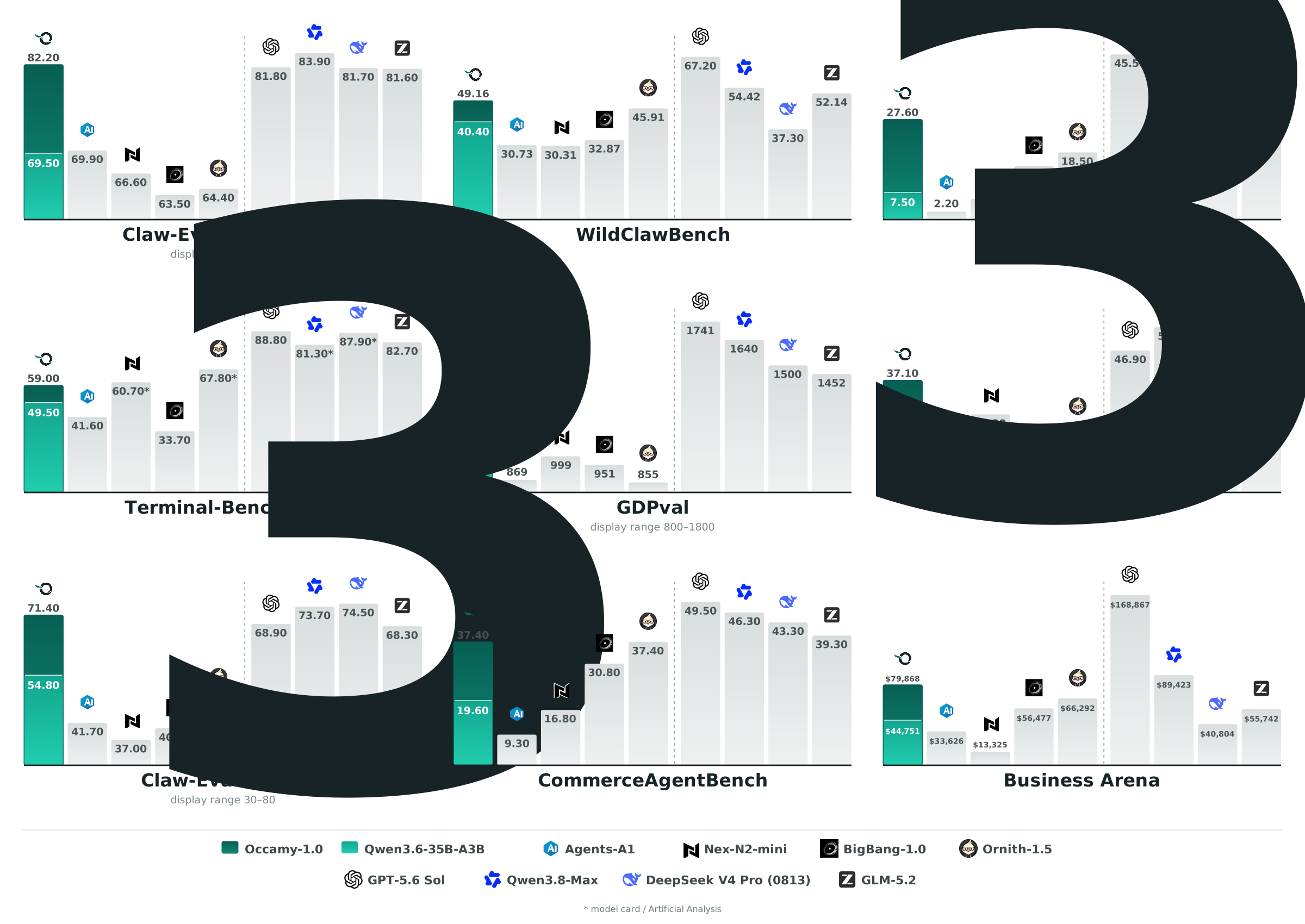
| Benchmark | Occamy-1.0 | Qwen3.6 35B-A3B | Agents-A1 | Nex-N2-mini | BigBang-1.0 | Ornith-1.5 |
|---|---|---|---|---|---|---|
| Claw-Eval (average) | 82.2 | 69.5 | 69.9 | 66.6 | 63.5 | 64.4 |
| Claw-Eval (Pass³) | 71.4 | 54.8 | 41.7 | 37.0 | 40.2 | 48.7 |
| WildClawBench | 49.16 | 40.4 | 30.73 | 30.31 | 32.87 | 45.91 |
| CommerceAgentBench | 37.40 | 19.6 | 9.3 | 16.8 | 30.8 | 37.40 |
| Business Arena | $79,868 | $44,751 | $33,626 | $13,325 | $56,477 | $66,292 |
| GDPval | 1,128 | 1,004 | 869 | 999 | 951 | 855 |
| OfficeQA Pro | 48.1 | 39.1 | 23.3 | 46.6 | 43.6 | 59.4 |
| τ³-Bench (Banking) | 37.1 | 11.9 | 7.2 | 25.8 | 10.3 | 21.7 |
| AutomationBench (Pass¹) | 27.6 | 7.5 | 2.2 | 5.7 | 14.8 | 18.5 |
| AutomationBench (partial) | 69.1 | 39.4 | 14.7 | 27.9 | 47.4 | 58.0 |
| BFCL v4 | 65.40 | 63.19 | 57.23 | 62.81 | 57.86 | 68.51 |
| VitaBench | 41.75 | 34.25 | 37.00 | 26.25 | 46.00 | 40.25 |
| Terminal-Bench 2.1 | 59.0 | 49.5 | 41.6 | 60.7* | 33.7 | 67.8* |
| IFEval | 91.53 | 86.90 | 91.60 | 91.60 | 90.50 | 81.80 |
Bold: Best result in each row; ties are both bolded. * Official model-card result.
4. Training Recipe
Occamy is trained through two complementary specialization tracks, followed by parameter-space consolidation and a final SAO stage:
                         Qwen3.6-35B-A3B
                                  │
                 ┌────────────────┴────────────────┐
                 │                                 │
                 ▼                                 ▼
        Marathon Expert                     Sprint Expert
           SFT → HDPO                             SFT
                 │                                 │
                 └────────────────┬────────────────┘
                                  ▼
                    Uniform parameter-space merge
                                  │
                                  ▼
                                 SAO
                                  │
                                  ▼
                             Occamy-1.0
The Marathon Expert learns sustained execution and accuracy-conditioned efficiency, while the Sprint Expert preserves broader agentic capability. A uniform parameter-space merge combines both experts into one checkpoint with no inference-time routing or ensembling, and a final Single-Rollout Asynchronous Optimization (SAO) stage refines the merged policy on a broad co-work mixture.
The deduplicated SFT union across both experts is:
| Data source | Trajectories | Average length | Tokens |
|---|---|---|---|
| General agentic | 5,418 | 37.7K | 204.1M |
| Long-horizon interactive agents | 923 | 95.8K | 88.4M |
| Terminal and software engineering | 1,228 | 35.1K | 43.1M |
| Tool-call grounding | 7,429 | 9.1K | 67.7M |
| Overall | 14,998 | 26.9K | 403.3M |
Training tasks are grounded in executable environments with observable state transitions and task-level grading. The open-source Dressage stack provides multi-harness execution, token-exact trajectory capture, sandbox integration, and multi-segment conversion for reinforcement learning.
5. Deployment
Quantized Checkpoints and MTP
Official quantized checkpoints and a separately adapted MTP draft head are available on Hugging Face:
| Release | Download |
|---|---|
| GGUF (Q4_K_M / Q8_0) | occamy-1.0-GGUF |
| FP8 | occamy-1.0-FP8 |
| NVFP4 | occamy-1.0-NVFP4 |
| Experimental MTP draft head | occamy-1.0-MTP |
See each model card for loading instructions, supported runtimes, and validation results. The MTP head is used with a separate base checkpoint; the validated native three-step SGLang path requires the included runtime patch. Performance after the final patch has not yet been measured.
Base Checkpoint
Occamy-1.0 keeps the Qwen3.6-35B-A3B architecture, so the upstream deployment recipe is the reference serving path. The examples below mirror that recipe with eight-way tensor parallelism and its full context length; adjust both to fit your hardware and confirm them against the released Occamy checkpoint configuration.
SGLang
The upstream model card recommends SGLang 0.5.10 or newer for the Qwen3.6 architecture.
python -m sglang.launch_server \
  --model-path Accio-Lab/Occamy-1.0 \
  --port 8000 \
  --tp-size 8 \
  --mem-fraction-static 0.8 \
  --context-length 262144 \
  --reasoning-parser qwen3 \
  --tool-call-parser qwen3_coder
vLLM
The upstream model card recommends vLLM 0.19.0 or newer for the Qwen3.6 architecture.
vllm serve Accio-Lab/Occamy-1.0 \
  --port 8000 \
  --tensor-parallel-size 8 \
  --max-model-len 262144 \
  --reasoning-parser qwen3 \
  --enable-auto-tool-choice \
  --tool-call-parser qwen3_coder
Both commands expose an OpenAI-compatible endpoint at http://localhost:8000/v1.
6. Model Usage
from openai import OpenAI

client = OpenAI(base_url="http://localhost:8000/v1", api_key="EMPTY")

response = client.chat.completions.create(
    model="Accio-Lab/Occamy-1.0",
    messages=[
        {
            "role": "user",
            "content": "Inspect this repository, fix the failing test, and explain the change.",
        }
    ],
    max_tokens=32768,
    temperature=1.0,
    top_p=0.95,
    presence_penalty=1.5,
    extra_body={
        "top_k": 20,
        "chat_template_kwargs": {
            "enable_thinking": True,
            "preserve_thinking": True,
        },
    },
)

print(response.choices[0].message.content)
For multi-turn agent runs, retain the complete assistant message returned by the server, including reasoning content and tool calls, then append tool results using the standard OpenAI chat-completions schema. This preserves the execution context that Occamy relies on across long workflows.
Agent Frameworks
Occamy was trained and evaluated across multiple harnesses, including OpenClaw, Hermes Agent, and Accio Work. It can be integrated with other tool-using agent frameworks through the same OpenAI-compatible API.
7. License
This repository is released under the Apache License 2.0. See the Hugging Face model card for the terms that apply to the model weights.
8. Contact and Correspondence
For research inquiries, model questions, or collaboration opportunities, please contact the corresponding authors:
For bug reports or feature requests, please open an issue.
Contributors

3 commits

1 commits
Similar repos


Languages
JavaScript
45.2%
CSS
27.2%
TypeScript
15.7%
HTML
11.9%
README
Occamy-1.0
Open Pareto-frontier 35B Intelligence for Co-work
1. Model Introduction
Occamy-1.0 is a compact agentic model purpose-built for real-world co-work: long-horizon, stateful tasks that require coordinated use of search, code, tools, files, structured APIs, and productivity software. Starting from the post-trained Qwen3.6-35B-A3B checkpoint, Occamy concentrates further training on reliable execution, persistent state tracking, recovery, and follow-through rather than relearning general capabilities from scratch.
Key Features
- Co-work specialization: Designed for sustained execution across multi-step professional workflows, not isolated question answering.
- Compact inference footprint: A 35B-total, 3B-active Mixture-of-Experts model that keeps long-running agent workloads practical.
- Long-horizon continuity: Designed to keep work coherent across tool calls, delegated runs, and history rewrites such as context compaction.
- Broad agentic capability: Co-work gains are accompanied by strong tool calling, terminal coding, and instruction following.
- Execution-grounded training: Supervised fine-tuning spans general agentic work, long-horizon interaction, software engineering, and tool-call grounding.
- Open training stack: The multi-harness reinforcement-learning infrastructure used to train Occamy is released as Dressage.
[!NOTE] Occamy is optimized for common co-work workloads, not as a replacement for frontier models on every task. Retrieval-heavy and simulated-user tasks still have headroom, and native browser or desktop visual interaction is not part of the current co-work training interface.
2. Model Summary
| Architecture | Mixture-of-Experts causal model with vision encoder |
| Total Parameters | 35B |
| Activated Parameters | 3B |
| Number of Layers | 40 |
| Number of Experts | 256 |
| Activated Experts | 8 routed + 1 shared |
| Base Architecture Context | 262,144 tokens |
| SFT Sequence Length | 131,072 tokens |
| Starting Checkpoint | Qwen3.6-35B-A3B |
| Post-training | Full-parameter SFT, HDPO, model merging, and SAO |
Architecture fields follow the starting checkpoint's published model card. Occamy post-trains the language backbone without changing the architecture; the vision encoder and projector are frozen during SFT. The released checkpoint configuration remains the source of truth for serving limits.
3. Evaluation Results
| Benchmark | Occamy-1.0 | Qwen3.6 35B-A3B | Agents-A1 | Nex-N2-mini | BigBang-1.0 | Ornith-1.5 |
|---|---|---|---|---|---|---|
| Claw-Eval (average) | 82.2 | 69.5 | 69.9 | 66.6 | 63.5 | 64.4 |
| Claw-Eval (Pass³) | 71.4 | 54.8 | 41.7 | 37.0 | 40.2 | 48.7 |
| WildClawBench | 49.16 | 40.4 | 30.73 | 30.31 | 32.87 | 45.91 |
| CommerceAgentBench | 37.40 | 19.6 | 9.3 | 16.8 | 30.8 | 37.40 |
| Business Arena | $79,868 | $44,751 | $33,626 | $13,325 | $56,477 | $66,292 |
| GDPval | 1,128 | 1,004 | 869 | 999 | 951 | 855 |
| OfficeQA Pro | 48.1 | 39.1 | 23.3 | 46.6 | 43.6 | 59.4 |
| τ³-Bench (Banking) | 37.1 | 11.9 | 7.2 | 25.8 | 10.3 | 21.7 |
| AutomationBench (Pass¹) | 27.6 | 7.5 | 2.2 | 5.7 | 14.8 | 18.5 |
| AutomationBench (partial) | 69.1 | 39.4 | 14.7 | 27.9 | 47.4 | 58.0 |
| BFCL v4 | 65.40 | 63.19 | 57.23 | 62.81 | 57.86 | 68.51 |
| VitaBench | 41.75 | 34.25 | 37.00 | 26.25 | 46.00 | 40.25 |
| Terminal-Bench 2.1 | 59.0 | 49.5 | 41.6 | 60.7* | 33.7 | 67.8* |
| IFEval | 91.53 | 86.90 | 91.60 | 91.60 | 90.50 | 81.80 |
Bold: Best result in each row; ties are both bolded. * Official model-card result.
4. Training Recipe
Occamy is trained through two complementary specialization tracks, followed by parameter-space consolidation and a final SAO stage:
                         Qwen3.6-35B-A3B
                                  │
                 ┌────────────────┴────────────────┐
                 │                                 │
                 ▼                                 ▼
        Marathon Expert                     Sprint Expert
           SFT → HDPO                             SFT
                 │                                 │
                 └────────────────┬────────────────┘
                                  ▼
                    Uniform parameter-space merge
                                  │
                                  ▼
                                 SAO
                                  │
                                  ▼
                             Occamy-1.0
The Marathon Expert learns sustained execution and accuracy-conditioned efficiency, while the Sprint Expert preserves broader agentic capability. A uniform parameter-space merge combines both experts into one checkpoint with no inference-time routing or ensembling, and a final Single-Rollout Asynchronous Optimization (SAO) stage refines the merged policy on a broad co-work mixture.
The deduplicated SFT union across both experts is:
| Data source | Trajectories | Average length | Tokens |
|---|---|---|---|
| General agentic | 5,418 | 37.7K | 204.1M |
| Long-horizon interactive agents | 923 | 95.8K | 88.4M |
| Terminal and software engineering | 1,228 | 35.1K | 43.1M |
| Tool-call grounding | 7,429 | 9.1K | 67.7M |
| Overall | 14,998 | 26.9K | 403.3M |
Training tasks are grounded in executable environments with observable state transitions and task-level grading. The open-source Dressage stack provides multi-harness execution, token-exact trajectory capture, sandbox integration, and multi-segment conversion for reinforcement learning.
5. Deployment
Quantized Checkpoints and MTP
Official quantized checkpoints and a separately adapted MTP draft head are available on Hugging Face:
| Release | Download |
|---|---|
| GGUF (Q4_K_M / Q8_0) | occamy-1.0-GGUF |
| FP8 | occamy-1.0-FP8 |
| NVFP4 | occamy-1.0-NVFP4 |
| Experimental MTP draft head | occamy-1.0-MTP |
See each model card for loading instructions, supported runtimes, and validation results. The MTP head is used with a separate base checkpoint; the validated native three-step SGLang path requires the included runtime patch. Performance after the final patch has not yet been measured.
Base Checkpoint
Occamy-1.0 keeps the Qwen3.6-35B-A3B architecture, so the upstream deployment recipe is the reference serving path. The examples below mirror that recipe with eight-way tensor parallelism and its full context length; adjust both to fit your hardware and confirm them against the released Occamy checkpoint configuration.
SGLang
The upstream model card recommends SGLang 0.5.10 or newer for the Qwen3.6 architecture.
python -m sglang.launch_server \
  --model-path Accio-Lab/Occamy-1.0 \
  --port 8000 \
  --tp-size 8 \
  --mem-fraction-static 0.8 \
  --context-length 262144 \
  --reasoning-parser qwen3 \
  --tool-call-parser qwen3_coder
vLLM
The upstream model card recommends vLLM 0.19.0 or newer for the Qwen3.6 architecture.
vllm serve Accio-Lab/Occamy-1.0 \
  --port 8000 \
  --tensor-parallel-size 8 \
  --max-model-len 262144 \
  --reasoning-parser qwen3 \
  --enable-auto-tool-choice \
  --tool-call-parser qwen3_coder
Both commands expose an OpenAI-compatible endpoint at http://localhost:8000/v1.
6. Model Usage
from openai import OpenAI

client = OpenAI(base_url="http://localhost:8000/v1", api_key="EMPTY")

response = client.chat.completions.create(
    model="Accio-Lab/Occamy-1.0",
    messages=[
        {
            "role": "user",
            "content": "Inspect this repository, fix the failing test, and explain the change.",
        }
    ],
    max_tokens=32768,
    temperature=1.0,
    top_p=0.95,
    presence_penalty=1.5,
    extra_body={
        "top_k": 20,
        "chat_template_kwargs": {
            "enable_thinking": True,
            "preserve_thinking": True,
        },
    },
)

print(response.choices[0].message.content)
For multi-turn agent runs, retain the complete assistant message returned by the server, including reasoning content and tool calls, then append tool results using the standard OpenAI chat-completions schema. This preserves the execution context that Occamy relies on across long workflows.
Agent Frameworks
Occamy was trained and evaluated across multiple harnesses, including OpenClaw, Hermes Agent, and Accio Work. It can be integrated with other tool-using agent frameworks through the same OpenAI-compatible API.
7. License
This repository is released under the Apache License 2.0. See the Hugging Face model card for the terms that apply to the model weights.
8. Contact and Correspondence
For research inquiries, model questions, or collaboration opportunities, please contact the corresponding authors:
For bug reports or feature requests, please open an issue.
Similar repos
Contributors
3 commits
1 commits
Languages
JavaScript
45.2%
CSS
27.2%
TypeScript
15.7%
HTML
11.9%