Fine-tuned RoBERTuito for Spanish emotion classification (6 emotions, custom survey dataset)
Jupyter Notebook
1
12 commits
updated Jul 23, 2026
This project fine-tunes RoBERTuito, a RoBERTa model pretrained on Spanish, to classify short autobiographical texts into six emotions: happiness, sadness, disgust, anger, fear and surprise. It was developed as an NLP research project at BUAP (Benemérita Universidad Autónoma de Puebla).
Most emotion classification research and tooling targets English. Spanish is spoken by more than 480 million people, and models trained on English text transfer poorly to Spanish because of differences in syntax, informal register, and culturally specific ways of expressing emotion. Reliable emotion classifiers in Spanish are useful for mental health screening tools, social media monitoring, and customer feedback analysis in Spanish-speaking markets, none of which are well served by translating text into English first.
RoBERTuito is a RoBERTa-based model pretrained from scratch on approximately 500 million Spanish tweets, rather than being one of ~100 languages in a shared vocabulary like XLM-R or multilingual BERT. Because its entire pretraining budget and vocabulary are spent on Spanish (including the informal, colloquial register typical of user-generated text), it starts from a better representation of Spanish than a multilingual model would for this kind of short, informal, first-person text. This project uses pysentimiento/robertuito-base-uncased.
The dataset (data/emotion_survey.csv) is a custom survey, not a public benchmark. It was collected via a Google Form from 341 respondents, mostly students at the Facultad de Ciencias de la Computación (BUAP). Each respondent answered 12 open-ended prompts, two per emotion (e.g. "Recuerda un momento en el que lograste algo que realmente deseabas" for happiness, "Recuerda un día en el que sentiste que todo te salía mal" for sadness). Respondent IDs are anonymized, but the free-text answers are personal, self-reported narratives.
Labels: Felicidad (happiness), Tristeza (sadness), Disgusto (disgust), Ira (anger), Miedo (fear), Sorpresa (surprise).
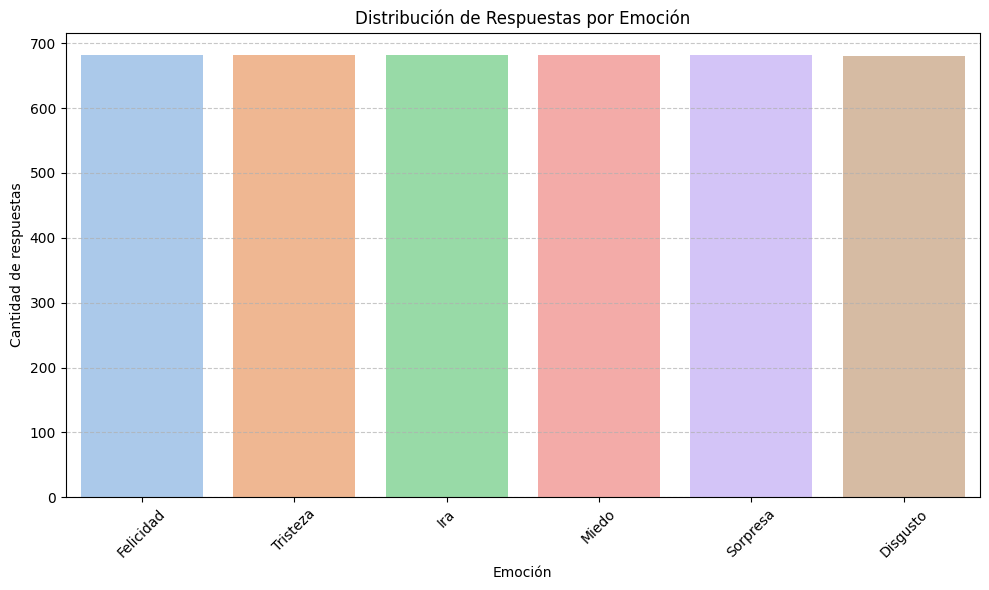
Before filtering, each emotion has close to the same number of raw answers (Felicidad 682, Tristeza 682, Disgusto 681, Ira 682, Miedo 682, Sorpresa 682), so the dataset is approximately balanced by construction — every respondent answers two prompts per emotion. After removing empty, very short (fewer than 3 words), or boilerplate answers ("no", "nada", "no recuerdo", etc.), 1,860 examples remain, split 1,488 / 372 (80% / 20%, stratified, seed 42).
The dataset is included in this repository for reproducibility only. It contains personal narrative data from real survey participants and is not covered by the MIT license — see Limitations and the note in LICENSE.
Two pipelines were explored:
notebooks/emotion_classification_robertuito.ipynb, first half): grammar correction (language_tool_python), text normalization, spaCy tokenization and lemmatization, TF-IDF vectorization, then SVM / KNN / Naive Bayes / decision trees / Random Forest. This serves as a non-transformer baseline.src/train.py): raw text is tokenized directly with the RoBERTuito tokenizer (max_length=128, which covers the large majority of answers without truncation) and fed to RobertaForSequenceClassification via Hugging Face Trainer.Fine-tuning hyperparameters, exactly as used:
| Hyperparameter | Value |
|---|---|
| Base model | pysentimiento/robertuito-base-uncased |
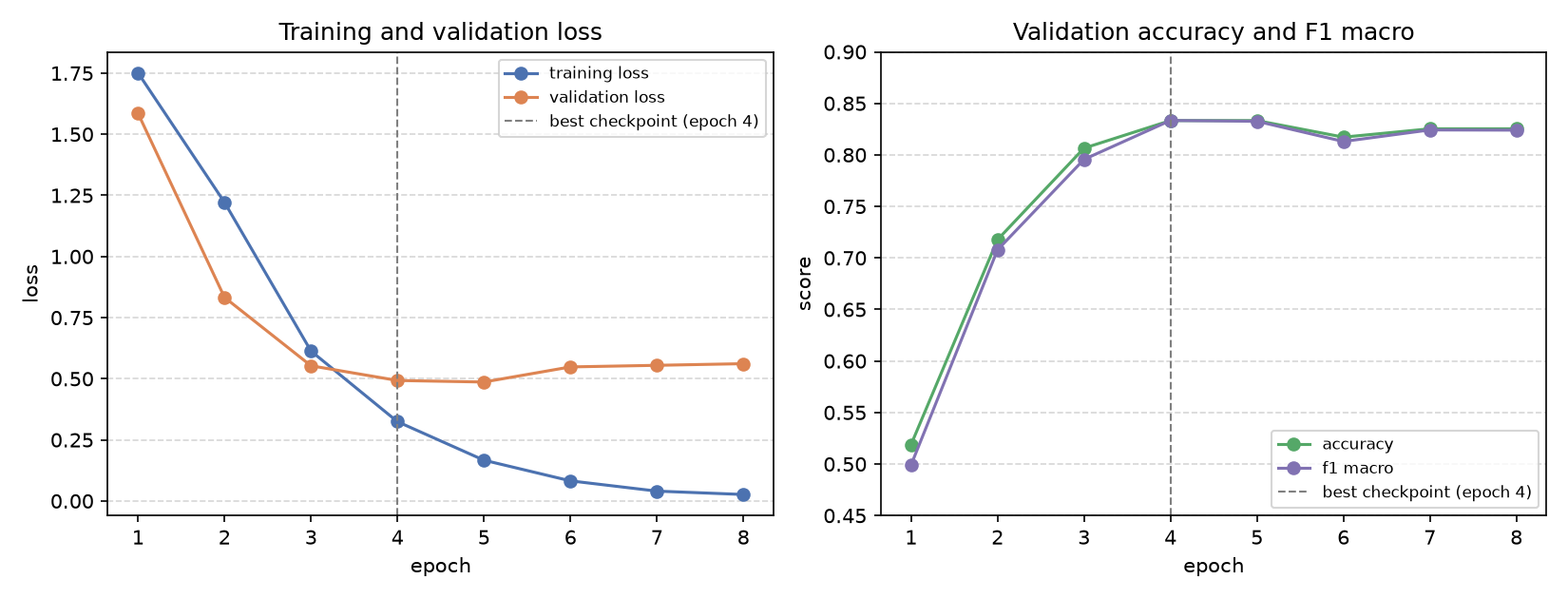
| Epochs | 8 (best checkpoint selected by validation F1 macro: epoch 4) |
| Batch size | 16 |
| Learning rate | 2e-5 |
| Weight decay | 0.1 |
| Warmup steps | 200 |
| Max sequence length | 128 |
| Train / test split | 80% / 20%, stratified, seed 42 |
| Mixed precision | fp16 |
A small, unfinished grid search over learning rate, epochs, batch size and weight decay (itertools.product over 16 combinations) was also run; of the 6 combinations that completed before the search was interrupted, the best reached 85.2% accuracy / 0.850 F1 macro (lr=2e-5, epochs=12, batch_size=8, weight_decay=0.01). This was not run to completion and is not the headline result.
Three setups were evaluated on the same 372-example held-out test set:
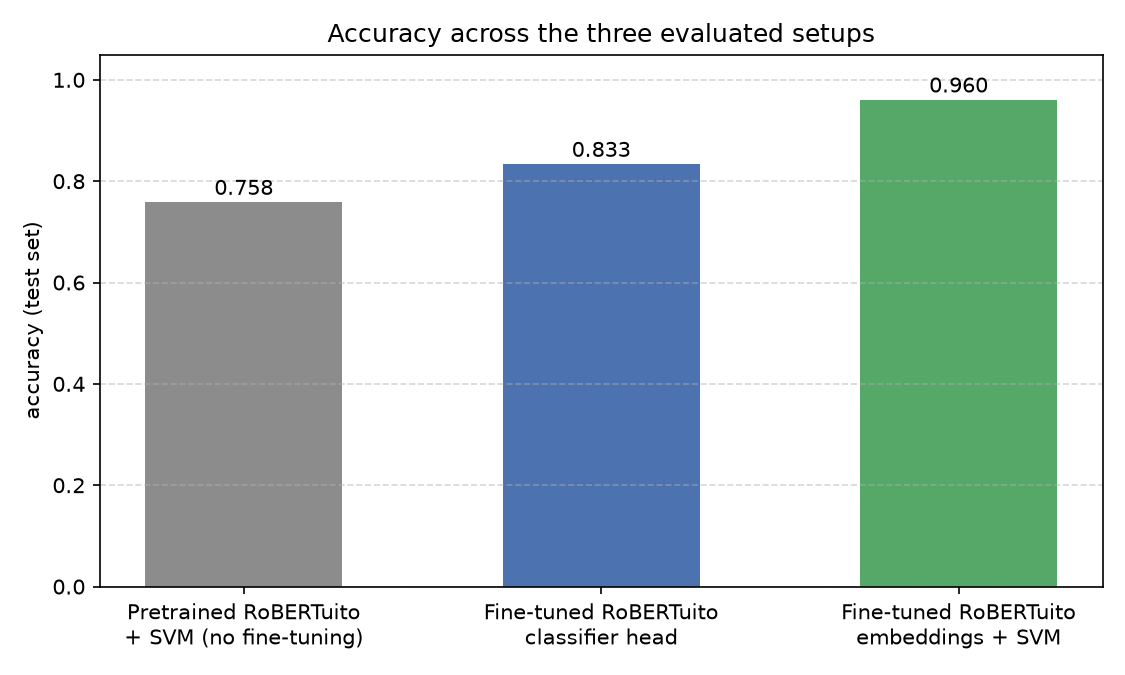
RobertaForSequenceClassification fine-tuned with Trainer, and the number to cite as "the fine-tuned transformer's" own performance.These are two different architectures, not two measurements of the same model, and both numbers are legitimate — see Limitations for a caveat that applies to the second one.
Training curves (fine-tuned classifier head):
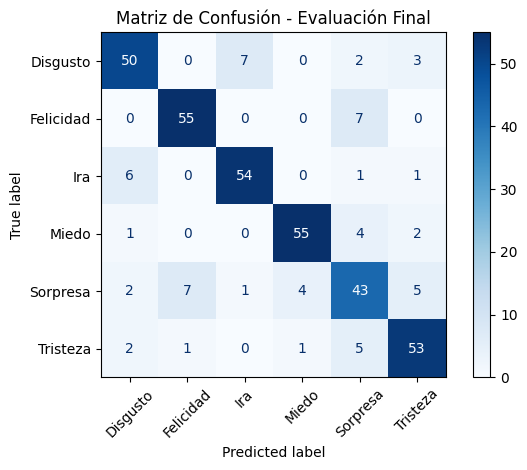
Confusion matrix, fine-tuned classifier head (83.3% accuracy):
Confusion matrix, SVM on fine-tuned embeddings (96.0% accuracy):
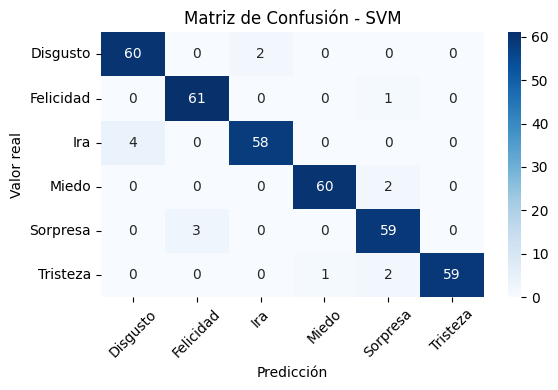
Per-class precision / recall for the SVM-on-embeddings setup (62 test examples per class):
| Emotion | Precision | Recall | F1 |
|---|---|---|---|
| Disgusto | 0.94 | 0.97 | 0.95 |
| Felicidad | 0.95 | 0.98 | 0.97 |
| Ira | 0.97 | 0.94 | 0.95 |
| Miedo | 0.98 | 0.97 | 0.98 |
| Sorpresa | 0.92 | 0.95 | 0.94 |
| Tristeza | 1.00 | 0.95 | 0.98 |
Class distribution in the raw survey data:
load_best_model_at_end picks the best epoch using the same 372-example validation set that is then reported as the final result, and that same set is reused again to evaluate the SVM trained on fine-tuned embeddings. This is common practice with small datasets but is not the same as evaluating on a fully independent held-out set, and likely inflates the reported numbers somewhat.git clone https://github.com/ALNM7/fine-tuned-transformers-emotions.git
cd fine-tuned-transformers-emotions
pip install -r requirements.txt
python -m spacy download es_core_news_sm
To reproduce the fine-tuned classifier head end to end:
cd src
python train.py --csv-path ../data/emotion_survey.csv --output-dir robertuito_emotion_model
To run inference with a trained model:
python src/predict.py --model-dir src/robertuito_emotion_model "Que agradable sorpresa el que hayas venido"
The full exploratory analysis, the TF-IDF baseline, and the fine-tuning + evaluation code with their original outputs are in notebooks/emotion_classification_robertuito.ipynb.
fine-tuned-transformers-emotions/
├── notebooks/
│   └── emotion_classification_robertuito.ipynb   exploratory analysis, TF-IDF baseline, RoBERTuito fine-tuning and evaluation
├── src/
│   ├── data.py      dataset loading and text filtering shared by train.py
│   ├── train.py     standalone script that reproduces the fine-tuning run
│   └── predict.py   inference on a saved fine-tuned model
├── figures/         exported evaluation figures embedded in this README
├── data/
│   └── emotion_survey.csv   raw survey data (see Limitations for usage restrictions)
├── requirements.txt
└── LICENSE          MIT, code only (see note in the file)
Fine-tuned RoBERTuito for Spanish emotion classification (6 emotions, custom survey dataset)
Jupyter Notebook
1
12 commits
updated Jul 23, 2026
This project fine-tunes RoBERTuito, a RoBERTa model pretrained on Spanish, to classify short autobiographical texts into six emotions: happiness, sadness, disgust, anger, fear and surprise. It was developed as an NLP research project at BUAP (Benemérita Universidad Autónoma de Puebla).
Most emotion classification research and tooling targets English. Spanish is spoken by more than 480 million people, and models trained on English text transfer poorly to Spanish because of differences in syntax, informal register, and culturally specific ways of expressing emotion. Reliable emotion classifiers in Spanish are useful for mental health screening tools, social media monitoring, and customer feedback analysis in Spanish-speaking markets, none of which are well served by translating text into English first.
RoBERTuito is a RoBERTa-based model pretrained from scratch on approximately 500 million Spanish tweets, rather than being one of ~100 languages in a shared vocabulary like XLM-R or multilingual BERT. Because its entire pretraining budget and vocabulary are spent on Spanish (including the informal, colloquial register typical of user-generated text), it starts from a better representation of Spanish than a multilingual model would for this kind of short, informal, first-person text. This project uses pysentimiento/robertuito-base-uncased.
The dataset (data/emotion_survey.csv) is a custom survey, not a public benchmark. It was collected via a Google Form from 341 respondents, mostly students at the Facultad de Ciencias de la Computación (BUAP). Each respondent answered 12 open-ended prompts, two per emotion (e.g. "Recuerda un momento en el que lograste algo que realmente deseabas" for happiness, "Recuerda un día en el que sentiste que todo te salía mal" for sadness). Respondent IDs are anonymized, but the free-text answers are personal, self-reported narratives.
Labels: Felicidad (happiness), Tristeza (sadness), Disgusto (disgust), Ira (anger), Miedo (fear), Sorpresa (surprise).
Before filtering, each emotion has close to the same number of raw answers (Felicidad 682, Tristeza 682, Disgusto 681, Ira 682, Miedo 682, Sorpresa 682), so the dataset is approximately balanced by construction — every respondent answers two prompts per emotion. After removing empty, very short (fewer than 3 words), or boilerplate answers ("no", "nada", "no recuerdo", etc.), 1,860 examples remain, split 1,488 / 372 (80% / 20%, stratified, seed 42).
The dataset is included in this repository for reproducibility only. It contains personal narrative data from real survey participants and is not covered by the MIT license — see Limitations and the note in LICENSE.
Two pipelines were explored:
notebooks/emotion_classification_robertuito.ipynb, first half): grammar correction (language_tool_python), text normalization, spaCy tokenization and lemmatization, TF-IDF vectorization, then SVM / KNN / Naive Bayes / decision trees / Random Forest. This serves as a non-transformer baseline.src/train.py): raw text is tokenized directly with the RoBERTuito tokenizer (max_length=128, which covers the large majority of answers without truncation) and fed to RobertaForSequenceClassification via Hugging Face Trainer.Fine-tuning hyperparameters, exactly as used:
| Hyperparameter | Value |
|---|---|
| Base model | pysentimiento/robertuito-base-uncased |
| Epochs | 8 (best checkpoint selected by validation F1 macro: epoch 4) |
| Batch size | 16 |
| Learning rate | 2e-5 |
| Weight decay | 0.1 |
| Warmup steps | 200 |
| Max sequence length | 128 |
| Train / test split | 80% / 20%, stratified, seed 42 |
| Mixed precision | fp16 |
A small, unfinished grid search over learning rate, epochs, batch size and weight decay (itertools.product over 16 combinations) was also run; of the 6 combinations that completed before the search was interrupted, the best reached 85.2% accuracy / 0.850 F1 macro (lr=2e-5, epochs=12, batch_size=8, weight_decay=0.01). This was not run to completion and is not the headline result.
Three setups were evaluated on the same 372-example held-out test set:
RobertaForSequenceClassification fine-tuned with Trainer, and the number to cite as "the fine-tuned transformer's" own performance.These are two different architectures, not two measurements of the same model, and both numbers are legitimate — see Limitations for a caveat that applies to the second one.
Training curves (fine-tuned classifier head):
Confusion matrix, fine-tuned classifier head (83.3% accuracy):
Confusion matrix, SVM on fine-tuned embeddings (96.0% accuracy):
Per-class precision / recall for the SVM-on-embeddings setup (62 test examples per class):
| Emotion | Precision | Recall | F1 |
|---|---|---|---|
| Disgusto | 0.94 | 0.97 | 0.95 |
| Felicidad | 0.95 | 0.98 | 0.97 |
| Ira | 0.97 | 0.94 | 0.95 |
| Miedo | 0.98 | 0.97 | 0.98 |
| Sorpresa | 0.92 | 0.95 | 0.94 |
| Tristeza | 1.00 | 0.95 | 0.98 |
Class distribution in the raw survey data:
load_best_model_at_end picks the best epoch using the same 372-example validation set that is then reported as the final result, and that same set is reused again to evaluate the SVM trained on fine-tuned embeddings. This is common practice with small datasets but is not the same as evaluating on a fully independent held-out set, and likely inflates the reported numbers somewhat.git clone https://github.com/ALNM7/fine-tuned-transformers-emotions.git
cd fine-tuned-transformers-emotions
pip install -r requirements.txt
python -m spacy download es_core_news_sm
To reproduce the fine-tuned classifier head end to end:
cd src
python train.py --csv-path ../data/emotion_survey.csv --output-dir robertuito_emotion_model
To run inference with a trained model:
python src/predict.py --model-dir src/robertuito_emotion_model "Que agradable sorpresa el que hayas venido"
The full exploratory analysis, the TF-IDF baseline, and the fine-tuning + evaluation code with their original outputs are in notebooks/emotion_classification_robertuito.ipynb.
fine-tuned-transformers-emotions/
├── notebooks/
│   └── emotion_classification_robertuito.ipynb   exploratory analysis, TF-IDF baseline, RoBERTuito fine-tuning and evaluation
├── src/
│   ├── data.py      dataset loading and text filtering shared by train.py
│   ├── train.py     standalone script that reproduces the fine-tuning run
│   └── predict.py   inference on a saved fine-tuned model
├── figures/         exported evaluation figures embedded in this README
├── data/
│   └── emotion_survey.csv   raw survey data (see Limitations for usage restrictions)
├── requirements.txt
└── LICENSE          MIT, code only (see note in the file)