[CVPR 2025 HIghlight] XLRS-Bench: ould Your Multimodal LLMs Understand Extremely Large Ultra-High-Resolution Remote Sensing Imagery?
64
17 commits
updated Sep 24, 2026
2025.10.31: Full data for captioning and visual grounding tasks are available on huggingface.2025.07.26: Intern-S1, the most advanced scientific open-source multimodal reasoning model to date, benchmarked on XLRS-Bench.2025.05.28: Training data and finetuned model, code are available at GeoLLaVA-8K.2025.05.16: XLRS-Bench-lite is released on Hugging Face.2025.05.06: XLRS-Bench has been selected for a public competition by China’s Ministry of Education and will be fully released on August 4th, as requested by the organizers.2025.04.04: Selected as Highlight by CVPR 2025!2025.04.01: The dataset is currently under final review and will be released in one month.2025.02.27: XLRS-Bench has been accepted by CVPR 2025! 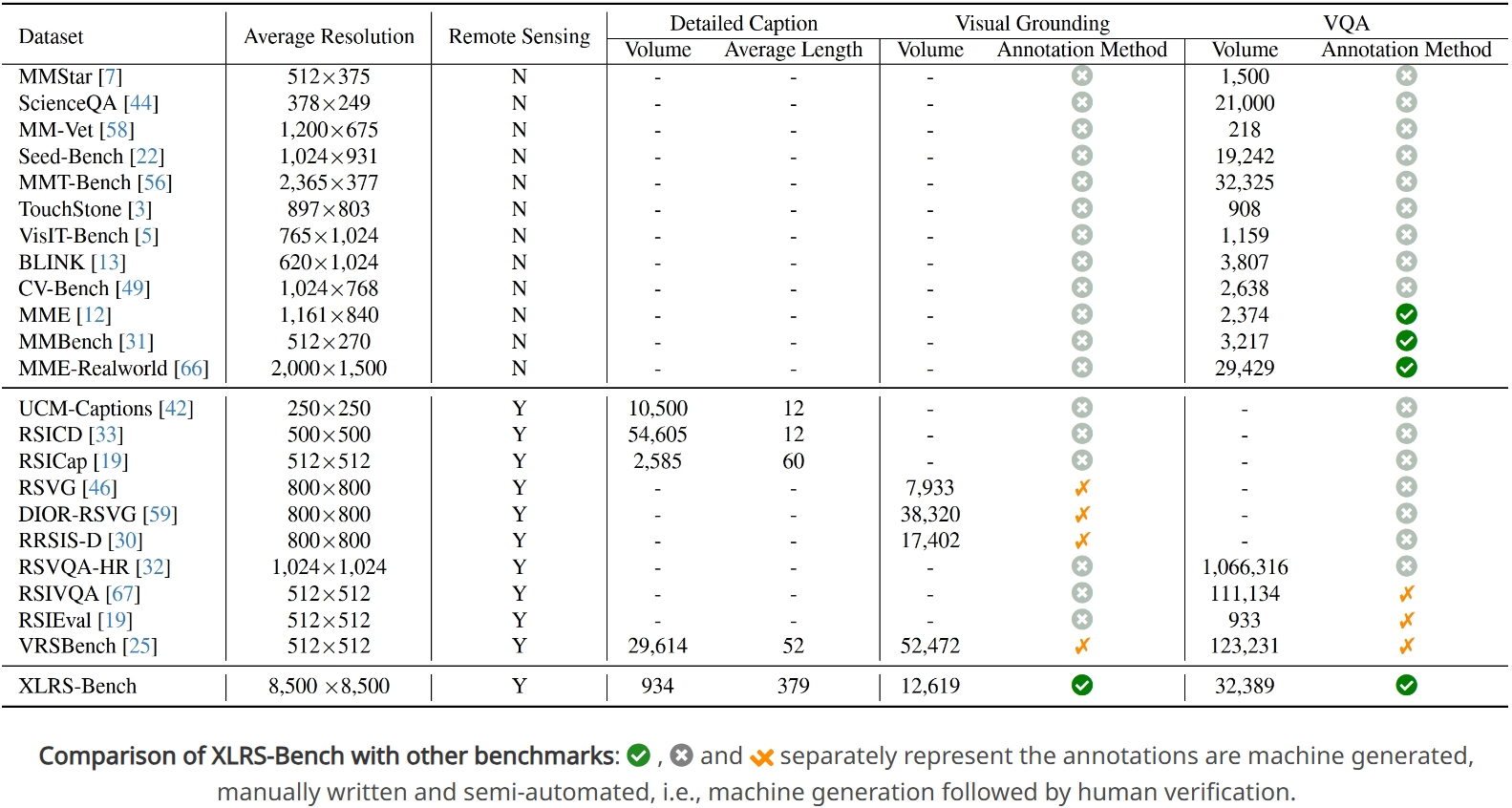
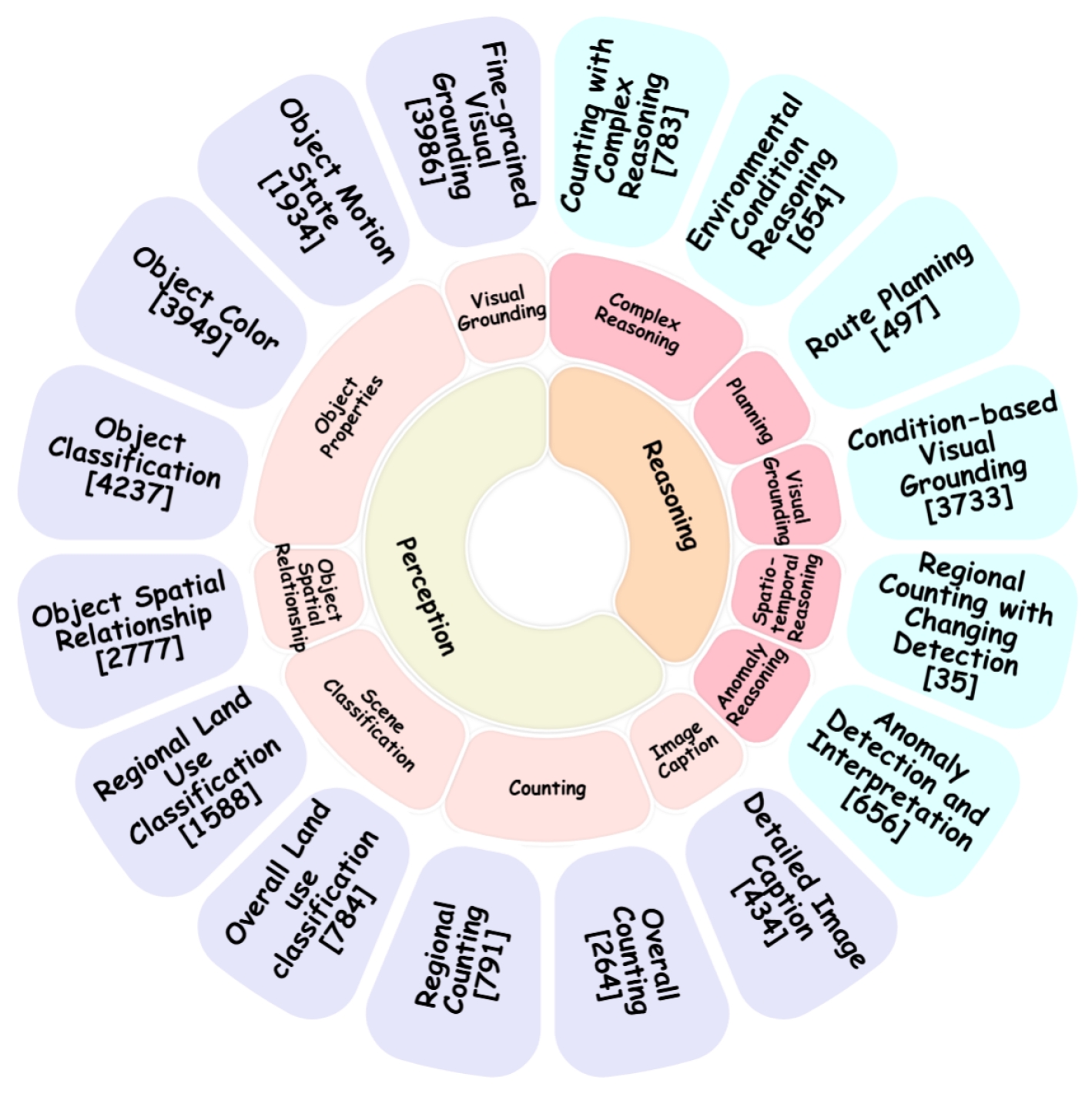
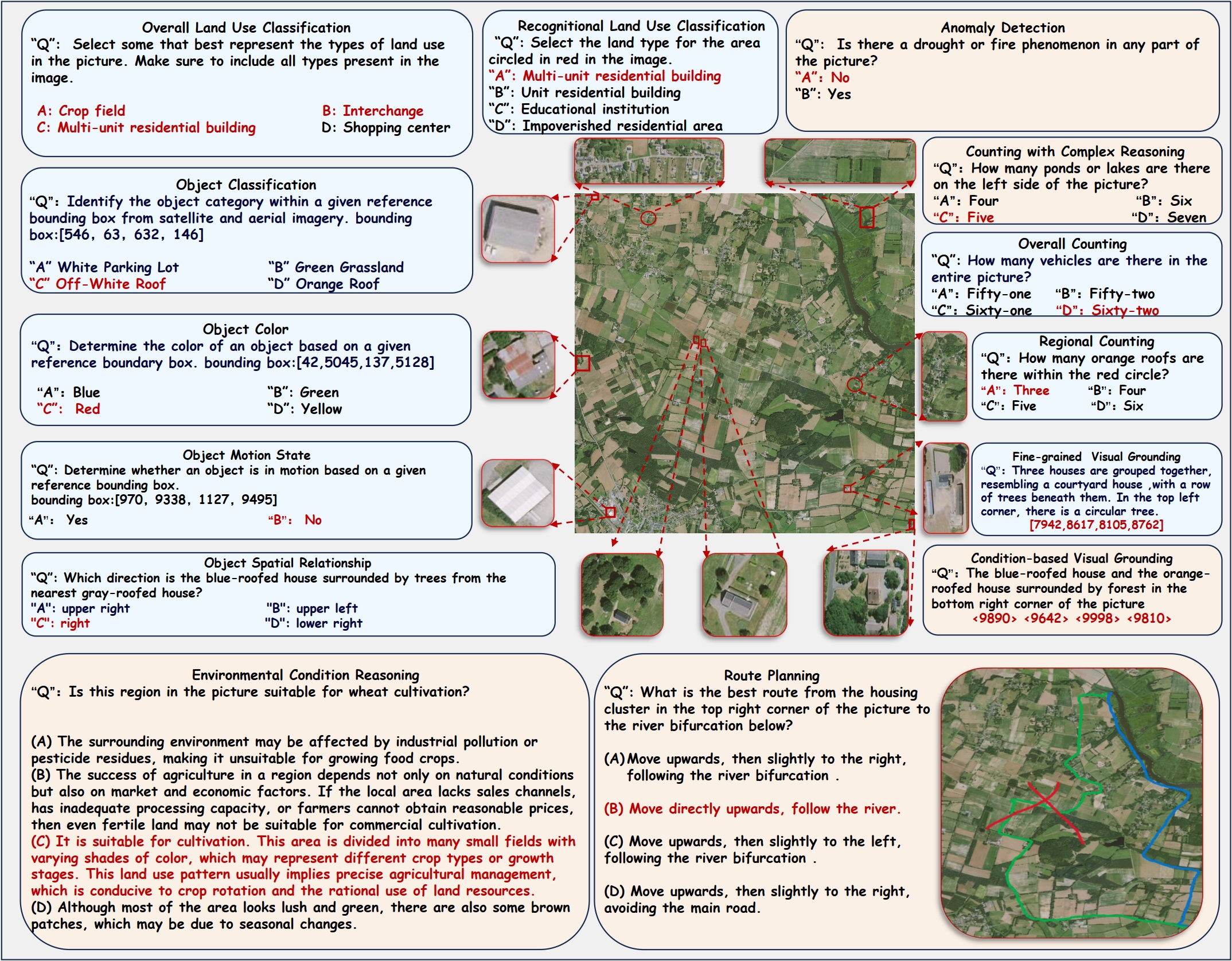
Remote sensing (RS) images have become essential for monitoring and understanding human environments, driving advancements in applications like precision agriculture, urban planning, and disaster assessment. While recent studies have proposed benchmarks and metrics to assess MLLM performance in RS, these efforts remain limited in image size, annotation method and evaluation dimensions. We present XLRS-Bench, a comprehensive benchmark for evaluating the perception and reasoning capabilities of MLLMs in ultra-high-resolution RS scenarios, featuring the largest average image size of 8,500 × 8,500 observed thus far. Our dataset encompasses 45,942 annotations across 16 tasks, all expertly curated by a team of 45 experts. The main advantages of XLRS-Bench compared to existing MLLM benchmarks as follows:
Annotations of this dataset is released under a Creative Commons Attribution-NonCommercial 4.0 International License. For images from:
DOTA
RGB images from Google Earth and CycloMedia (for academic use only; commercial use is prohibited, and Google Earth terms of use apply).
ITCVD
Licensed under CC-BY-NC-SA-4.0.
MiniFrance, HRSCD
Released under IGN’s "licence ouverte".
Toronto, Potsdam:
The Toronto test data images are derived from the Downtown Toronto dataset provided by Optech Inc., First Base Solutions Inc., GeoICT Lab at York University, and ISPRS WG III/4, and are subject to the following conditions:
Disclaimer:
If any party believes their rights are infringed, please contact us immediately at [email protected]. We will promptly remove any infringing content.
The common prompt used in VQA follows this format:
[Image] [Question] The choices are listed below:
(A) [Choice A]
(B) [Choice B]
(C) [Choice C]
(D) [Choice D]
Select the best answer for the multiple-choice question based on the image. Only respond with the letter corresponding to the correct answer (A, B, C, D).
The answer is:
or for VQA task Overall Land Use Classification please use:
Select the best answer(s) for the multiple-choice question based on the image. There may be more than one correct option. Only respond with the letter(s) corresponding to the correct answer(s) (A, B, C, D), with multiple choices separated by spaces.
For Visual Grounding and Detailed Image Captioning, please refer to the files in the evaluation folder.
All available datasets are added to https://huggingface.co/collections/initiacms/xlrs-bench
| Dataset | Content | split |
|---|---|---|
| initiacms/XLRS-Bench-lite | lite version for XLRS-Bench, containing VQA data only | train |
| initiacms/XLRS-Bench-lite_VLM | lite version for XLRS-Bench, containing VQA data only, used by VLMEvalKit | train |
| initiacms/XLRS-Bench_caption_en | all caption data in English | train |
| initiacms/XLRS-Bench_caption_zh | all caption data in Chinese | train |
| initiacms/XLRS-Bench_visual_grounding_en | all visual grounding data in English | train/test |
| initiacms/XLRS-Bench_visual_grounding_zh | all visual grounding data in Chinese | train/test |
Using lmms-eval for evaluation:
accelerate launch --num_processes 8 --main_process_port 12345 -m lmms_eval \
    --model "qwen2_5_vl" \
    --model_args "pretrained=Qwen/Qwen2.5-VL-7B-Instruct,use_flash_attention_2=True"  \
    --tasks xlrs-lite \
    --batch_size 1 \
    --log_samples \
    --log_samples_suffix qwen2_5_vl_xlrs_lite \
    --output_path ./logs/
To add your model to our leaderboard, please send your model responses to [email protected]. Refer to the evaluation/samples folder for the required format.
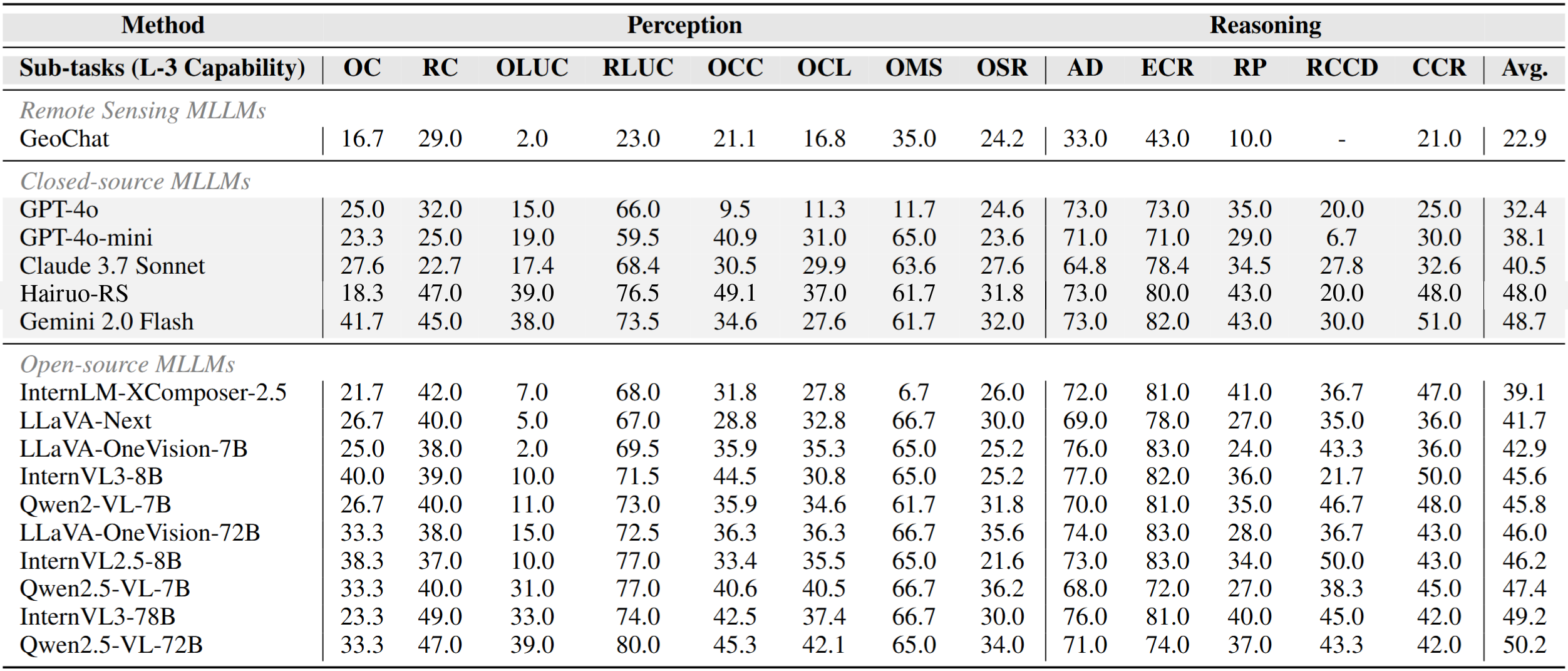
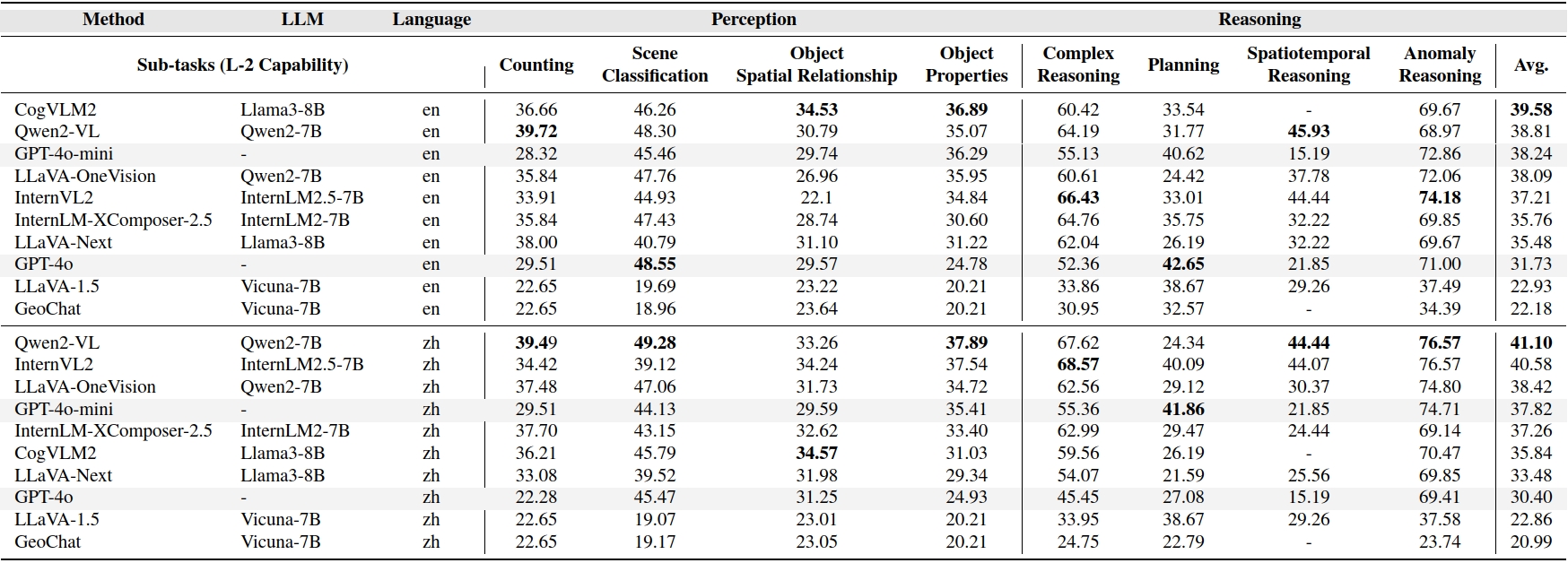
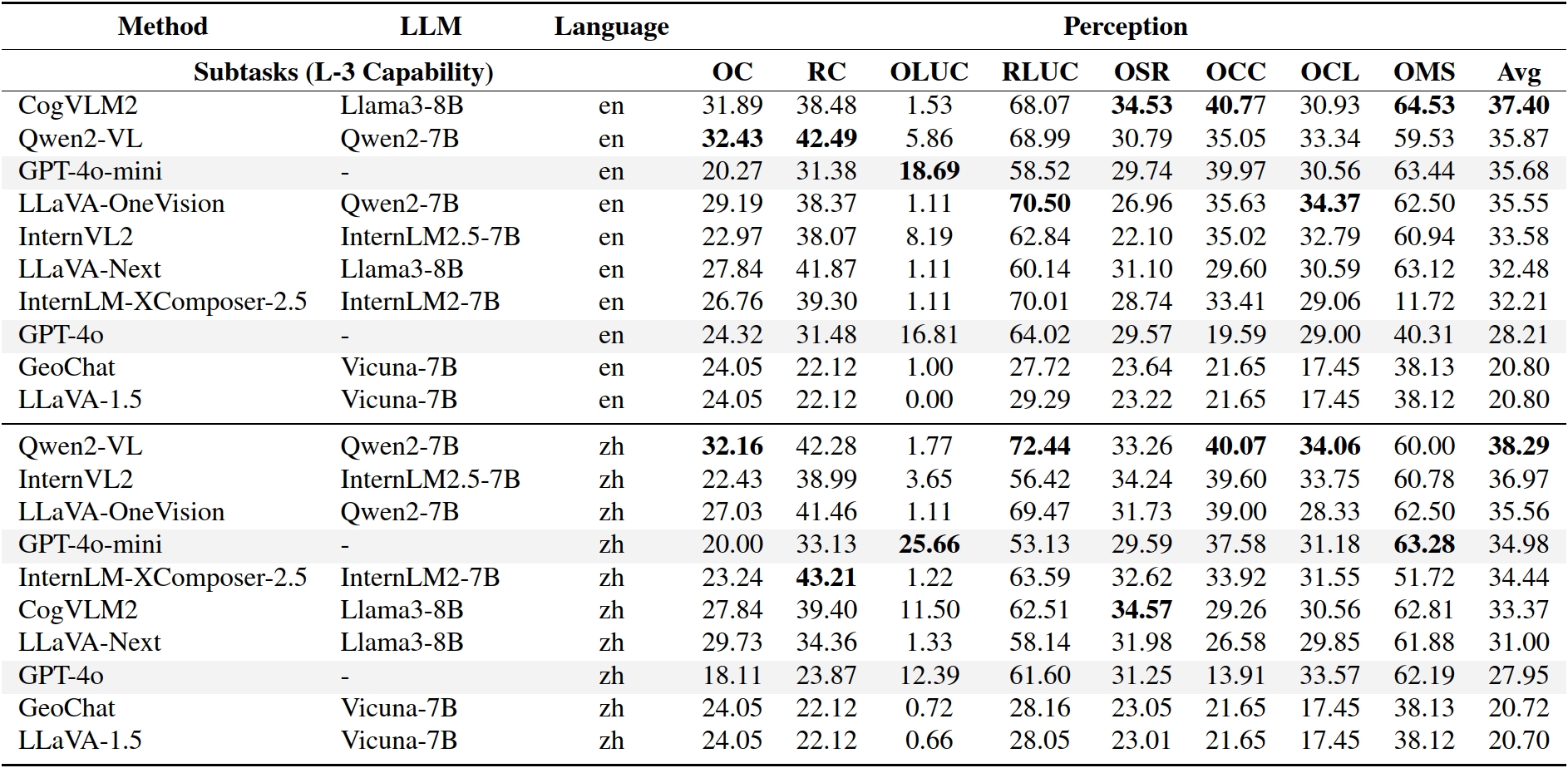
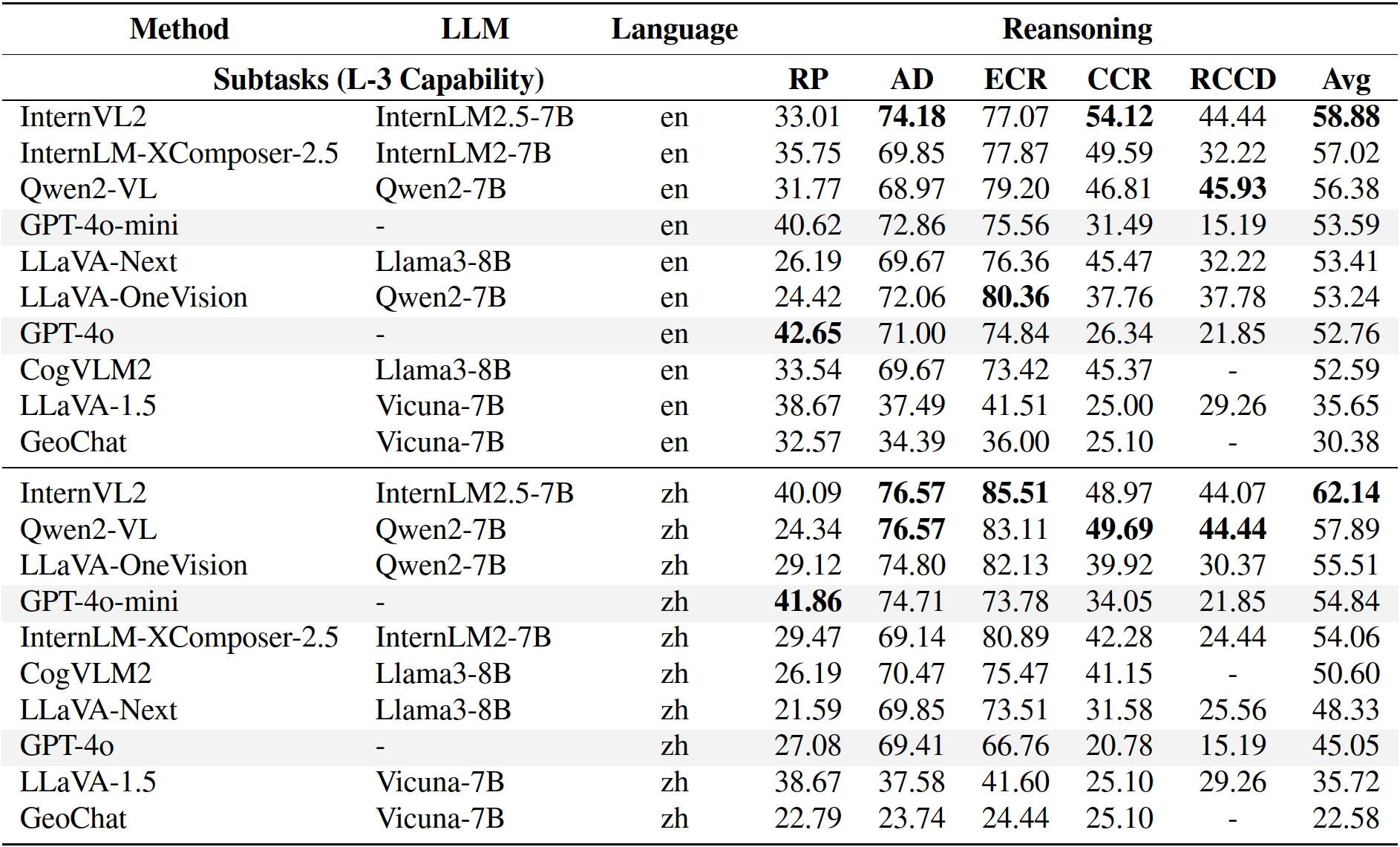
Models are ranked based on their average performance. Proprietary models are highlighted in gray. Task domains are indicated by abbreviations (e.g., “OC” for Overall Counting, “RC” for Regional Counting, etc.).
XLRS-Bench-lite (Avg. stands for macro average across all L3 tasks):
XLRS-Bench (Avg. stands for micro average across all L3 tasks, we will add both micro and macro results soon):
L-2 performance on VQA tasks.
L-3 perception dimension on VQA tasks.
L-3 reasoning dimension on VQA tasks.
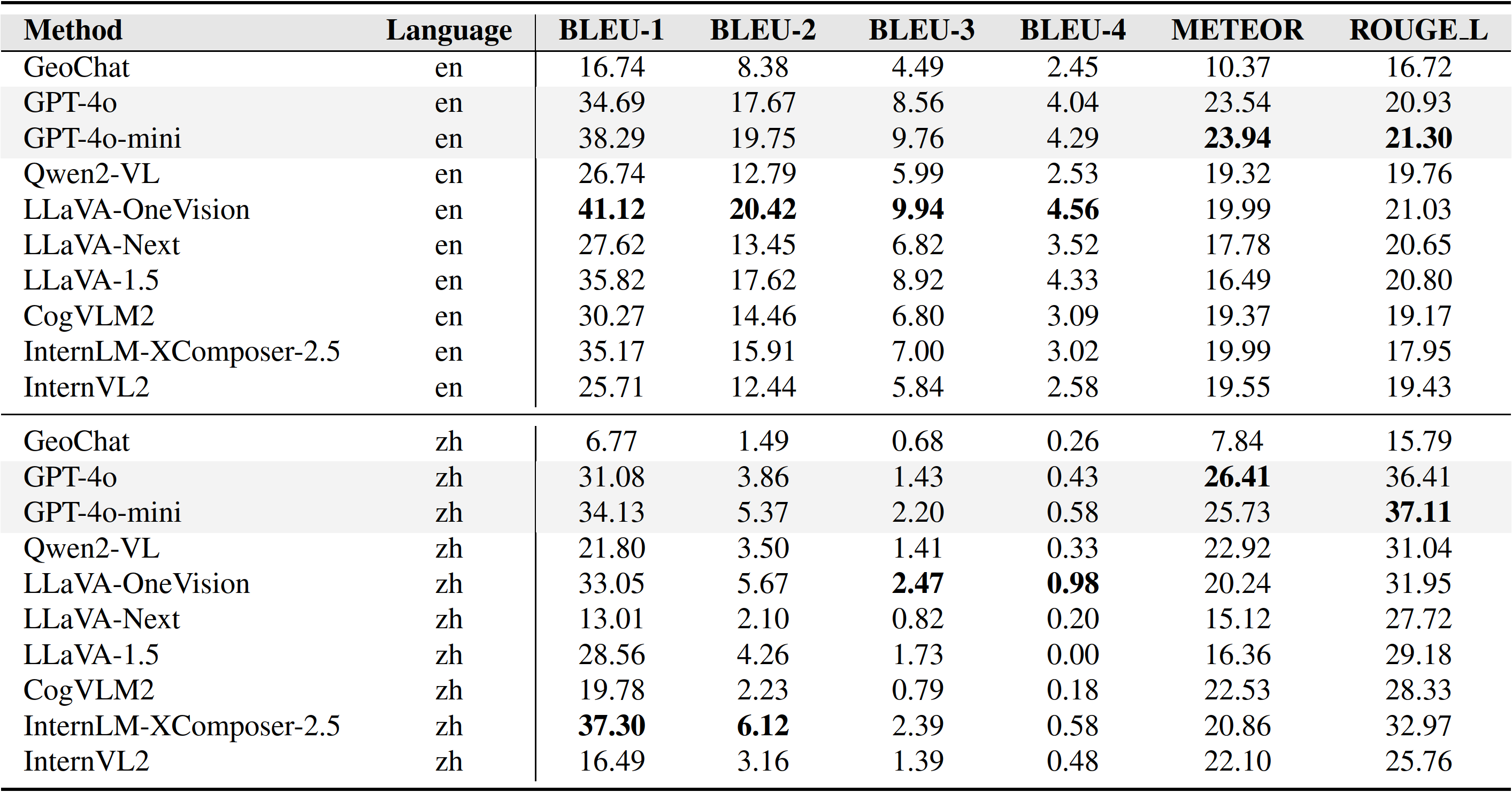
Visual grounding performance.

Detailed image captioning performance.
If you find our work helpful, please consider citing:
@inproceedings{wang2025xlrs,
  title={Xlrs-bench: Could your multimodal llms understand extremely large ultra-high-resolution remote sensing imagery?},
  author={Wang, Fengxiang and Wang, Hongzhen and Guo, Zonghao and Wang, Di and Wang, Yulin and Chen, Mingshuo and Ma, Qiang and Lan, Long and Yang, Wenjing and Zhang, Jing and others},
  booktitle={Proceedings of the Computer Vision and Pattern Recognition Conference},
  pages={14325--14336},
  year={2025}
}

@article{wang2025geollava,
  title={GeoLLaVA-8K: Scaling Remote-Sensing Multimodal Large Language Models to 8K Resolution},
  author={Wang, Fengxiang and Chen, Mingshuo and Li, Yueying and Wang, Di and Wang, Haotian and Guo, Zonghao and Wang, Zefan and Shan, Boqi and Lan, Long and Wang, Yulin and others},
  journal={arXiv preprint arXiv:2505.21375},
  year={2025}
}
For any other questions please contact:
[CVPR 2025 HIghlight] XLRS-Bench: ould Your Multimodal LLMs Understand Extremely Large Ultra-High-Resolution Remote Sensing Imagery?
64
17 commits
updated Sep 24, 2026
2025.10.31: Full data for captioning and visual grounding tasks are available on huggingface.2025.07.26: Intern-S1, the most advanced scientific open-source multimodal reasoning model to date, benchmarked on XLRS-Bench.2025.05.28: Training data and finetuned model, code are available at GeoLLaVA-8K.2025.05.16: XLRS-Bench-lite is released on Hugging Face.2025.05.06: XLRS-Bench has been selected for a public competition by China’s Ministry of Education and will be fully released on August 4th, as requested by the organizers.2025.04.04: Selected as Highlight by CVPR 2025!2025.04.01: The dataset is currently under final review and will be released in one month.2025.02.27: XLRS-Bench has been accepted by CVPR 2025!
Remote sensing (RS) images have become essential for monitoring and understanding human environments, driving advancements in applications like precision agriculture, urban planning, and disaster assessment. While recent studies have proposed benchmarks and metrics to assess MLLM performance in RS, these efforts remain limited in image size, annotation method and evaluation dimensions. We present XLRS-Bench, a comprehensive benchmark for evaluating the perception and reasoning capabilities of MLLMs in ultra-high-resolution RS scenarios, featuring the largest average image size of 8,500 × 8,500 observed thus far. Our dataset encompasses 45,942 annotations across 16 tasks, all expertly curated by a team of 45 experts. The main advantages of XLRS-Bench compared to existing MLLM benchmarks as follows:
Annotations of this dataset is released under a Creative Commons Attribution-NonCommercial 4.0 International License. For images from:
DOTA
RGB images from Google Earth and CycloMedia (for academic use only; commercial use is prohibited, and Google Earth terms of use apply).
ITCVD
Licensed under CC-BY-NC-SA-4.0.
MiniFrance, HRSCD
Released under IGN’s "licence ouverte".
Toronto, Potsdam:
The Toronto test data images are derived from the Downtown Toronto dataset provided by Optech Inc., First Base Solutions Inc., GeoICT Lab at York University, and ISPRS WG III/4, and are subject to the following conditions:
Disclaimer:
If any party believes their rights are infringed, please contact us immediately at [email protected]. We will promptly remove any infringing content.
The common prompt used in VQA follows this format:
[Image] [Question] The choices are listed below:
(A) [Choice A]
(B) [Choice B]
(C) [Choice C]
(D) [Choice D]
Select the best answer for the multiple-choice question based on the image. Only respond with the letter corresponding to the correct answer (A, B, C, D).
The answer is:
or for VQA task Overall Land Use Classification please use:
Select the best answer(s) for the multiple-choice question based on the image. There may be more than one correct option. Only respond with the letter(s) corresponding to the correct answer(s) (A, B, C, D), with multiple choices separated by spaces.
For Visual Grounding and Detailed Image Captioning, please refer to the files in the evaluation folder.
All available datasets are added to https://huggingface.co/collections/initiacms/xlrs-bench
| Dataset | Content | split |
|---|---|---|
| initiacms/XLRS-Bench-lite | lite version for XLRS-Bench, containing VQA data only | train |
| initiacms/XLRS-Bench-lite_VLM | lite version for XLRS-Bench, containing VQA data only, used by VLMEvalKit | train |
| initiacms/XLRS-Bench_caption_en | all caption data in English | train |
| initiacms/XLRS-Bench_caption_zh | all caption data in Chinese | train |
| initiacms/XLRS-Bench_visual_grounding_en | all visual grounding data in English | train/test |
| initiacms/XLRS-Bench_visual_grounding_zh | all visual grounding data in Chinese | train/test |
Using lmms-eval for evaluation:
accelerate launch --num_processes 8 --main_process_port 12345 -m lmms_eval \
    --model "qwen2_5_vl" \
    --model_args "pretrained=Qwen/Qwen2.5-VL-7B-Instruct,use_flash_attention_2=True"  \
    --tasks xlrs-lite \
    --batch_size 1 \
    --log_samples \
    --log_samples_suffix qwen2_5_vl_xlrs_lite \
    --output_path ./logs/
To add your model to our leaderboard, please send your model responses to [email protected]. Refer to the evaluation/samples folder for the required format.
Models are ranked based on their average performance. Proprietary models are highlighted in gray. Task domains are indicated by abbreviations (e.g., “OC” for Overall Counting, “RC” for Regional Counting, etc.).
XLRS-Bench-lite (Avg. stands for macro average across all L3 tasks):
XLRS-Bench (Avg. stands for micro average across all L3 tasks, we will add both micro and macro results soon):
L-2 performance on VQA tasks.
L-3 perception dimension on VQA tasks.
L-3 reasoning dimension on VQA tasks.
Visual grounding performance.
Detailed image captioning performance.
If you find our work helpful, please consider citing:
@inproceedings{wang2025xlrs,
  title={Xlrs-bench: Could your multimodal llms understand extremely large ultra-high-resolution remote sensing imagery?},
  author={Wang, Fengxiang and Wang, Hongzhen and Guo, Zonghao and Wang, Di and Wang, Yulin and Chen, Mingshuo and Ma, Qiang and Lan, Long and Yang, Wenjing and Zhang, Jing and others},
  booktitle={Proceedings of the Computer Vision and Pattern Recognition Conference},
  pages={14325--14336},
  year={2025}
}

@article{wang2025geollava,
  title={GeoLLaVA-8K: Scaling Remote-Sensing Multimodal Large Language Models to 8K Resolution},
  author={Wang, Fengxiang and Chen, Mingshuo and Li, Yueying and Wang, Di and Wang, Haotian and Guo, Zonghao and Wang, Zefan and Shan, Boqi and Lan, Long and Wang, Yulin and others},
  journal={arXiv preprint arXiv:2505.21375},
  year={2025}
}
For any other questions please contact:



