An 11 MB model that makes typed decisions on CPU (choice, yes/no, score) with calibrated probabilities. No LLM, no tokens.
See the codeAn 11 MB model that makes typed decisions on CPU. No LLM, no tokens.
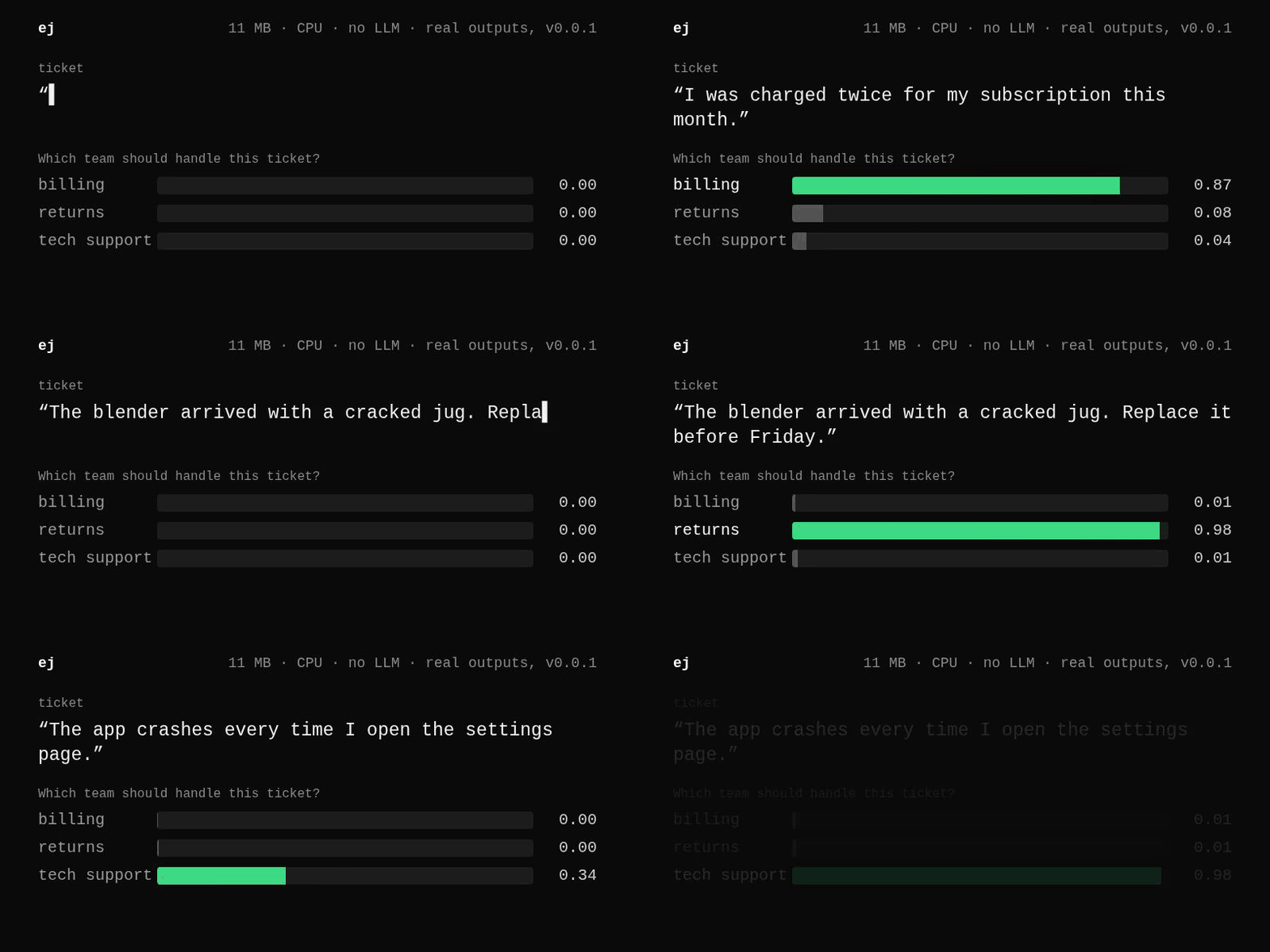
pip install ejai
import ej

model = ej.load('5ak3t/ej', revision='v0.0.1')
q = {'type': 'choice', 'instructions': 'Which team should handle this ticket?',
     'options': [{'key': 'billing', 'text': 'Billing and payments'}, {'key': 'tech', 'text': 'Technical problems'}]}
(probs,) = model.predict([{'state': 'I was charged twice this month.', 'questions': {'team': q}}])
print(probs['team'])   # [P(billing), P(tech)]: about [0.97, 0.03]





You give ej a state (free text, or a JSON object as text) and a set of typed questions; it returns one probability
distribution per question. There is no LLM at inference. This repository holds the package, the training and evaluation
code, and the benchmark; the weights are on the Hugging Face Hub.
Architecture and method: technical report forthcoming.
choice (any option texts, chosen at run time), noul (a yes/no statement) and
score (ordered levels). Every question of a record is answered in the same pass.model.ejpack (ejpack v1) is checked section by section (sha256) before anything is decoded;
classes come from an allowlist.ej.load(path, low_memory=True) keeps the weights compressed in memory: identical predictions, lower peak memory,
slower (Memory and latency).model.adapt, AdaptedModel.observe).python -m ej.train) and evaluate it with the same evaluator that
produced every number below (python -m ej.eval).| Question type | You give | You get |
|---|---|---|
choice | instructions + a list of option texts (any labels, chosen at run time) | P(option) for each option |
noul | a yes/no statement, options false / true | [P(false), P(true)] |
score | instructions + ordered level texts | a distribution over the levels |
| Model | Base (licence) | Size: counted / on disk / resident | CPU latency, 1 thread, one record per call (td) | Unseen workflows: macro_real accuracy | Card |
|---|---|---|---|---|---|
| ej 0.0.1 | intfloat/e5-small-v2 (MIT) | 10.87 MiB / 11.4 MB / 128 MB (35 MB with low_memory=True) | warm 214 ms (317 ms with low_memory=True) | .419 [.379, .458] | ej-0.0.1 |
Sizes: counted = a bit-level bound on the stored parameters; on disk = the one file model.ejpack (11,384,312 bytes),
which is the whole download (no base model is fetched); resident = peak live model tensors while predicting (default, and
with low_memory=True). Process memory
and the box: Memory and latency; benchmark latency: Latency.
Final test suites of ej 0.0.1, scored once for the release (2026-10-08), with 95% record-cluster CIs (benchmarks/results/). Development suites were used to choose among many candidates, so development numbers are selected and optimistic; they are not reported as results here.
| final suite | records / questions | NLL [95% CI] | micro accuracy [95% CI] | ECE15 [95% CI]; calibrated on this suite? |
|---|---|---|---|---|
| td (seen workflows) | 300 / 1,500 | .663 [.613, .716] | .721 [.695, .746] | .071 [.050, .094]; no |
zs_td (security_incidents, selected on) | 100 / 500 | 1.145 [1.113, 1.180] | .422 [.388, .452] | .094 [.068, .135]; no |
| zs_massive (leak-free) | 1,000 / 1,000 | .481 [.430, .530] | .832 [.808, .857] | .051 [.041, .073]; no |
| tickets (in-house) | 169 / 507 | .629 [.583, .680] | .712 [.679, .746] | .033 [.028, .080]; yes |
| tickets_ood (in-house, style shift) | 147 / 441 | .715 [.650, .787] | .683 [.639, .726] | .050 [.039, .099]; yes |
Unseen workflows (zs_wide final, 147 workflows never trained on, read once): group-macro accuracy over the real sources macro_real .419 [.379, .458] (105 workflows: SNI .456, SGD .571, ABCD .229; t interval over workflows within sources). GLM-synthetic workflows, reported separately: .358 [.323, .394] (42 workflows). This is the number to expect on a new workflow before adaptation.
Against six rivals on the same final suites (micro accuracy, paired CIs; BENCHMARKS.md): td below laya, level with Jev and Julia-1, above the other three; zs_td below all six; zs_massive below Jev, laya, kev-0.8b and OpenThai-SystemOne, above Julia-1 and gliclass-edge. On the in-house ticket suites ej's NLL is lower than every rival's. No latency, size or calibration ranking is claimed.
Status (2026-10-09): ej 0.0.1. Weights: huggingface.co/5ak3t/ej, revision
v0.0.1, one filemodel.ejpack(11,384,312 bytes, SHA-256e990e1846cba43f8…, full value below).ej.load("5ak3t/ej", revision="v0.0.1")fetches it. Every number in this README was measured with these weights.
| Version | State key | Weights | Notes |
|---|---|---|---|
| ej 0.0.1 | 3b3e66d28fb423f9 | huggingface.co/5ak3t/ej, revision v0.0.1: one file model.ejpack, 11,384,312 bytes | docs/releases/0.0.1.md |
Before decoding anything, ej.load checks the pack's header digest and every section's sha256, the contents of a known
release against the digest shipped in ej.integrity.KNOWN_PACKS, and the runtime modules against their manifest; a pack
downloaded from the Hub must also match its file SHA-256 in ej.integrity.KNOWN_PACK_FILES:
e990e1846cba43f8405a969c606057f2fd6e2076595f4a34d202e8fc531891b0.
Python >= 3.10 (tested on 3.11.15, CPU). The lower bounds in pyproject.toml are the tested versions.
pip install ejai            # the PyPI name is ejai; the import name is ej.  'ejai[eval]', 'ejai[train]' add the extras
# from source:
git clone https://github.com/5ak3t/ej && cd ej
pip install -e .            # inference;  -e '.[eval]' adds the evaluator, -e '.[train]' the training extras
ej.load('5ak3t/ej', revision='v0.0.1') downloads the published model.ejpack (only that file, into the Hugging Face
cache) and checks its SHA-256. A local model.ejpack, or one you build (python -m ej.train fit, then python -m ej.train export; below), loads the same way from its path.
import ej

model = ej.load('5ak3t/ej', revision='v0.0.1')   # or a local path: ej.load('model.ejpack')
record = {
    'state': '{"customer_tier": "gold", "message": "The blender arrived with a cracked jug. Replace it before Friday."}',
    'questions': {
        'route': {'type': 'choice', 'instructions': 'Which team should handle this request?',
                  'options': [{'key': 'returns', 'text': 'Returns and replacements for damaged or wrong items'},
                              {'key': 'billing', 'text': 'Billing, invoices and payment problems'}]},
        'needs_human': {'type': 'noul', 'instructions': 'The customer is upset enough that a human agent should reply.',
                        'options': ej.NOUL_OPTIONS},
        'urgency': {'type': 'score', 'instructions': 'How urgent is this request?',
                    'options': [{'key': '0', 'text': 'Low: can wait a week'},
                                {'key': '1', 'text': 'Medium: answer within two days'},
                                {'key': '2', 'text': 'High: answer today'}]},
    },
}
(probs,) = model.predict([record])
print(probs['route'])          # [p_returns, p_billing], sums to 1
python examples/quickstart.py --weights 5ak3t/ej --revision v0.0.1 [--records file.jsonl] does the same for
ej.EXAMPLE_RECORD or your file (--weights model.ejpack for a local file). ej.load('model.ejpack', low_memory=True) gives the same predictions with less memory, more slowly. A weights
directory (safetensors + JSON, what fit writes) also loads; that format builds the encoder from the base model, which it
fetches from the Hugging Face Hub on first use.
Input. {"id": "optional", "state": "...", "questions": {"<qid>": {"type": "choice | noul | score", "instructions": "...", "options": [{"key": "k1", "text": "short description"}, ...]}}}. At least 2 options per question, keys unique;
noul options are exactly false and true (ej.NOUL_OPTIONS); score options are ordered, lowest first. Records are
validated (ej.validate_records, raises ej.RecordError). Output. One dict per record, {qid: [p_1, ..., p_K]} in
option order, plain floats summing to 1 (within 1e-9).
Determinism and process hygiene. Predictions are deterministic for a fixed thread count and chunking; chunk size,
batch composition and thread count move probabilities only at float-noise level (measured max |Δp| about 6e-7).
ej.load leaves torch's thread count, its random state and transformers unchanged; predict(records, threads=None, chunk_size=None) sets threads only inside the call. One loaded model per process. Environment: EJ_CACHE (default
~/.cache/ej; receives the pack's tokenizer files), EJ_COLD=1 (bypass the prediction-time caches), HF_HOME (the
Hugging Face cache: the downloaded model.ejpack, and the base model of a weights directory) and HF_HUB_OFFLINE=1
(offline with a filled cache).
Record independence. Zero-shot predict is record-independent: each record's output depends only on that record (up
to float noise). adapt is an opt-in, per-workflow transductive mode: it pools option statistics across that workflow's
labelled records, so use one adapted model per workflow with a fixed option set (the same question ids and option keys).
labelled = [{**r, 'answers': {'route': 'returns', 'needs_human': 'true', 'urgency': '2'}} for r in my_records[:8]]
adapted = model.adapt(examples=labelled)   # per-(question, option) logit offsets; the weights do not change
adapted.observe(more_labelled)             # fold in labelled records as they arrive (same result as adapting at once)
probs = adapted.predict(new_records)
Measured on the development suites (k (few-shot) = the number of labelled records per workflow): on 154 unseen workflows (111 public-source + 43 GLM-synthetic) k = 8 moves group-macro accuracy .356 → .389, +.032 [−.011, +.076]: covers 0; on the single held-out zs_td workflow .396 → .545 at k = 16; on the seen td workflows +.016 [+.003, +.029]. What the labelled records teach is mostly the workflow's label prior: an add-one count of the labelled answers alone comes within +.008 [−.0001, +.016] of the adapted model at k = 8 (record-cluster bootstrap CIs). Details and the dropped label-free variant: docs/adaptation.md.
Every model gets the same blind records (benchmarks/run_bench.py: gold removed, one record per call after a warm-up,
threads checked inside the timed calls) and is scored with the same functions (NLL, micro accuracy, ECE15, certified
automation; benchmarks/scoring.py = ej.eval.metrics). Final suites are read once per release; every cell carries a
record-cluster CI and every ej-vs-rival difference a paired CI, and an ordering is stated only where that CI excludes 0.
Rivals carry contamination flags (benchmarks/METHOD.md). No suite file ships here: the public
suites are rebuilt from the public datasets with benchmarks/suites/ (sha256 in SHA256SUMS); the ticket suites are
private. Summary: BENCHMARKS.md.
benchmarks/run_bench.py, one record per call after a warm-up record, wall clock, 1 torch thread set inside each call
and checked (threads_measured = [1]), development suites, with the weights-directory format of the same model (both
formats give identical predictions). Box: Intel(R) Xeon(R) Processor @ 2.80GHz, 4 logical cores,
Python 3.11.15, torch 2.5.1 CPU; 1-minute load average 1.02-1.10; 2026-10-08.
| development suite | records | warm: mean / median ms per record | cold (EJ_COLD=1): mean / median ms per record |
|---|---|---|---|
| td (JSON states, 5 questions) | 164 | 356.6 / 363.1 | 1,922.0 / 1,413.7 |
Warm = texts seen in earlier records (such as option texts) are not re-encoded; cold = every text encoded again.
Summaries: benchmarks/results/latency/. Batching is faster per record. Rival latencies were measured on another day
under unrecorded load, so they are not comparable with these numbers and are not ranked against them.
Measured on 2026-10-09 on the same kind of box (Intel(R) Xeon(R) Processor @ 2.80GHz, 4 logical cores, shared and
contended, torch 2.5.1 CPU), one configuration per fresh process, with the procedure of benchmarks/pack_memory.py, on
the development tree's copy of this packed runtime (same code before it moved into the package). Memory: 72 development
records (24 each of td, zs_td, zs_wide) predicted in one call at 2 threads, cold; RSS from /proc/self/status, the peak
reset just before predict; model tensors = live torch tensors (one count per storage), peak sampled inside the encoder's
forward. Latency: predict([r]) on the first 50 development td records, 1 thread, after one warm-up record.
| runtime | RSS after import torch | peak RSS during predict | model tensors, peak | warm ms per record | cold ms per record |
|---|---|---|---|---|---|
| default | 204 MB | 558 MB | 128 MB | 214 | 1,061 |
low_memory=True | 204 MB | 455 MB | 35 MB | 317 (about 1.5x) | 1,385 |
Most of the process memory is code (torch, transformers), not the model. Predictions are identical in both runtimes
(max |Δp| = 0.0, tests/test_pack_weights.py). These latencies come from another day, load and harness than the table
above, so the two tables are not comparable with each other.
pip install -e '.[train]'
python -m ej.train fit --pool pool.jsonl --out my-weights      # all steps; checkpoints in my-weights.work, resumable
python -m ej.train export --weights my-weights --out model.ejpack   # the packed model file (what ej.load takes)
python -m ej.eval score --suite my_suite.jsonl --weights model.ejpack
The pool is JSONL in the input format plus source (the held-out group unit) and gold: {qid: {label, probs}}. The steps
(encoder on a GPU, teachers, distil, fit on CPU) can run one by one; the fit is the recipe of ej 0.0.1. The
0.0.1 training pool itself cannot be rebuilt from public data alone (its ticket corpus is not released). Pool format, public
sources and their licences, compute: docs/training.md.
To compare two recipes, fit each several times with different seeds and use python -m ej.eval compare (seed-aware).
| path | what |
|---|---|
ej/ | the package: load, Model.predict, Model.adapt, AdaptedModel.observe, records, integrity checks, process scope, pickle-free codec |
ej/pack/ | the packed format ejpack v1: writer, sha256-checked pickle-free reader, encoder build from the pack, low-memory mode (low_memory=True) |
ej/_runtime/ | the prediction code (39 sha256-pinned modules; README) |
ej/train/, ej/eval/ | training (python -m ej.train) and evaluation (python -m ej.eval score / compare) |
benchmarks/ | runner, scoring, rival adapters, suite builders + checksums, method, aggregate results |
docs/ | model card, data card, release notes, training, adaptation |
examples/, tests/, scripts/ | quickstart; tests (pytest; set EJ_WEIGHTS=model.ejpack for the prediction tests); hf_layout.py, state_key.py, check_file_length.py |
@software{ej_2026,
  title   = {ej: calibrated typed decisions on device},
  author  = {Saket Bhushan},
  year    = {2026},
  version = {0.0.1},
  url     = {https://github.com/5ak3t/ej},
  note    = {Weights: https://huggingface.co/5ak3t/ej, revision v0.0.1}
}
LICENSE); releases up to 0.0.1.post2 were published with the code under Apache-2.0. Weights:
CC BY-SA 4.0 (LICENSES/CC-BY-SA-4.0.txt); adaptations must be shared under CC BY-SA 4.0 or a compatible licence.
Base model intfloat/e5-small-v2: MIT (LICENSES/MIT-e5-small-v2.txt).An 11 MB model that makes typed decisions on CPU (choice, yes/no, score) with calibrated probabilities. No LLM, no tokens.
See the codeAn 11 MB model that makes typed decisions on CPU. No LLM, no tokens.
pip install ejai
import ej

model = ej.load('5ak3t/ej', revision='v0.0.1')
q = {'type': 'choice', 'instructions': 'Which team should handle this ticket?',
     'options': [{'key': 'billing', 'text': 'Billing and payments'}, {'key': 'tech', 'text': 'Technical problems'}]}
(probs,) = model.predict([{'state': 'I was charged twice this month.', 'questions': {'team': q}}])
print(probs['team'])   # [P(billing), P(tech)]: about [0.97, 0.03]
You give ej a state (free text, or a JSON object as text) and a set of typed questions; it returns one probability
distribution per question. There is no LLM at inference. This repository holds the package, the training and evaluation
code, and the benchmark; the weights are on the Hugging Face Hub.
Architecture and method: technical report forthcoming.
choice (any option texts, chosen at run time), noul (a yes/no statement) and
score (ordered levels). Every question of a record is answered in the same pass.model.ejpack (ejpack v1) is checked section by section (sha256) before anything is decoded;
classes come from an allowlist.ej.load(path, low_memory=True) keeps the weights compressed in memory: identical predictions, lower peak memory,
slower (Memory and latency).model.adapt, AdaptedModel.observe).python -m ej.train) and evaluate it with the same evaluator that
produced every number below (python -m ej.eval).| Question type | You give | You get |
|---|---|---|
choice | instructions + a list of option texts (any labels, chosen at run time) | P(option) for each option |
noul | a yes/no statement, options false / true | [P(false), P(true)] |
score | instructions + ordered level texts | a distribution over the levels |
| Model | Base (licence) | Size: counted / on disk / resident | CPU latency, 1 thread, one record per call (td) | Unseen workflows: macro_real accuracy | Card |
|---|---|---|---|---|---|
| ej 0.0.1 | intfloat/e5-small-v2 (MIT) | 10.87 MiB / 11.4 MB / 128 MB (35 MB with low_memory=True) | warm 214 ms (317 ms with low_memory=True) | .419 [.379, .458] | ej-0.0.1 |
Sizes: counted = a bit-level bound on the stored parameters; on disk = the one file model.ejpack (11,384,312 bytes),
which is the whole download (no base model is fetched); resident = peak live model tensors while predicting (default, and
with low_memory=True). Process memory
and the box: Memory and latency; benchmark latency: Latency.
Final test suites of ej 0.0.1, scored once for the release (2026-10-08), with 95% record-cluster CIs (benchmarks/results/). Development suites were used to choose among many candidates, so development numbers are selected and optimistic; they are not reported as results here.
| final suite | records / questions | NLL [95% CI] | micro accuracy [95% CI] | ECE15 [95% CI]; calibrated on this suite? |
|---|---|---|---|---|
| td (seen workflows) | 300 / 1,500 | .663 [.613, .716] | .721 [.695, .746] | .071 [.050, .094]; no |
zs_td (security_incidents, selected on) | 100 / 500 | 1.145 [1.113, 1.180] | .422 [.388, .452] | .094 [.068, .135]; no |
| zs_massive (leak-free) | 1,000 / 1,000 | .481 [.430, .530] | .832 [.808, .857] | .051 [.041, .073]; no |
| tickets (in-house) | 169 / 507 | .629 [.583, .680] | .712 [.679, .746] | .033 [.028, .080]; yes |
| tickets_ood (in-house, style shift) | 147 / 441 | .715 [.650, .787] | .683 [.639, .726] | .050 [.039, .099]; yes |
Unseen workflows (zs_wide final, 147 workflows never trained on, read once): group-macro accuracy over the real sources macro_real .419 [.379, .458] (105 workflows: SNI .456, SGD .571, ABCD .229; t interval over workflows within sources). GLM-synthetic workflows, reported separately: .358 [.323, .394] (42 workflows). This is the number to expect on a new workflow before adaptation.
Against six rivals on the same final suites (micro accuracy, paired CIs; BENCHMARKS.md): td below laya, level with Jev and Julia-1, above the other three; zs_td below all six; zs_massive below Jev, laya, kev-0.8b and OpenThai-SystemOne, above Julia-1 and gliclass-edge. On the in-house ticket suites ej's NLL is lower than every rival's. No latency, size or calibration ranking is claimed.
Status (2026-10-09): ej 0.0.1. Weights: huggingface.co/5ak3t/ej, revision
v0.0.1, one filemodel.ejpack(11,384,312 bytes, SHA-256e990e1846cba43f8…, full value below).ej.load("5ak3t/ej", revision="v0.0.1")fetches it. Every number in this README was measured with these weights.
| Version | State key | Weights | Notes |
|---|---|---|---|
| ej 0.0.1 | 3b3e66d28fb423f9 | huggingface.co/5ak3t/ej, revision v0.0.1: one file model.ejpack, 11,384,312 bytes | docs/releases/0.0.1.md |
Before decoding anything, ej.load checks the pack's header digest and every section's sha256, the contents of a known
release against the digest shipped in ej.integrity.KNOWN_PACKS, and the runtime modules against their manifest; a pack
downloaded from the Hub must also match its file SHA-256 in ej.integrity.KNOWN_PACK_FILES:
e990e1846cba43f8405a969c606057f2fd6e2076595f4a34d202e8fc531891b0.
Python >= 3.10 (tested on 3.11.15, CPU). The lower bounds in pyproject.toml are the tested versions.
pip install ejai            # the PyPI name is ejai; the import name is ej.  'ejai[eval]', 'ejai[train]' add the extras
# from source:
git clone https://github.com/5ak3t/ej && cd ej
pip install -e .            # inference;  -e '.[eval]' adds the evaluator, -e '.[train]' the training extras
ej.load('5ak3t/ej', revision='v0.0.1') downloads the published model.ejpack (only that file, into the Hugging Face
cache) and checks its SHA-256. A local model.ejpack, or one you build (python -m ej.train fit, then python -m ej.train export; below), loads the same way from its path.
import ej

model = ej.load('5ak3t/ej', revision='v0.0.1')   # or a local path: ej.load('model.ejpack')
record = {
    'state': '{"customer_tier": "gold", "message": "The blender arrived with a cracked jug. Replace it before Friday."}',
    'questions': {
        'route': {'type': 'choice', 'instructions': 'Which team should handle this request?',
                  'options': [{'key': 'returns', 'text': 'Returns and replacements for damaged or wrong items'},
                              {'key': 'billing', 'text': 'Billing, invoices and payment problems'}]},
        'needs_human': {'type': 'noul', 'instructions': 'The customer is upset enough that a human agent should reply.',
                        'options': ej.NOUL_OPTIONS},
        'urgency': {'type': 'score', 'instructions': 'How urgent is this request?',
                    'options': [{'key': '0', 'text': 'Low: can wait a week'},
                                {'key': '1', 'text': 'Medium: answer within two days'},
                                {'key': '2', 'text': 'High: answer today'}]},
    },
}
(probs,) = model.predict([record])
print(probs['route'])          # [p_returns, p_billing], sums to 1
python examples/quickstart.py --weights 5ak3t/ej --revision v0.0.1 [--records file.jsonl] does the same for
ej.EXAMPLE_RECORD or your file (--weights model.ejpack for a local file). ej.load('model.ejpack', low_memory=True) gives the same predictions with less memory, more slowly. A weights
directory (safetensors + JSON, what fit writes) also loads; that format builds the encoder from the base model, which it
fetches from the Hugging Face Hub on first use.
Input. {"id": "optional", "state": "...", "questions": {"<qid>": {"type": "choice | noul | score", "instructions": "...", "options": [{"key": "k1", "text": "short description"}, ...]}}}. At least 2 options per question, keys unique;
noul options are exactly false and true (ej.NOUL_OPTIONS); score options are ordered, lowest first. Records are
validated (ej.validate_records, raises ej.RecordError). Output. One dict per record, {qid: [p_1, ..., p_K]} in
option order, plain floats summing to 1 (within 1e-9).
Determinism and process hygiene. Predictions are deterministic for a fixed thread count and chunking; chunk size,
batch composition and thread count move probabilities only at float-noise level (measured max |Δp| about 6e-7).
ej.load leaves torch's thread count, its random state and transformers unchanged; predict(records, threads=None, chunk_size=None) sets threads only inside the call. One loaded model per process. Environment: EJ_CACHE (default
~/.cache/ej; receives the pack's tokenizer files), EJ_COLD=1 (bypass the prediction-time caches), HF_HOME (the
Hugging Face cache: the downloaded model.ejpack, and the base model of a weights directory) and HF_HUB_OFFLINE=1
(offline with a filled cache).
Record independence. Zero-shot predict is record-independent: each record's output depends only on that record (up
to float noise). adapt is an opt-in, per-workflow transductive mode: it pools option statistics across that workflow's
labelled records, so use one adapted model per workflow with a fixed option set (the same question ids and option keys).
labelled = [{**r, 'answers': {'route': 'returns', 'needs_human': 'true', 'urgency': '2'}} for r in my_records[:8]]
adapted = model.adapt(examples=labelled)   # per-(question, option) logit offsets; the weights do not change
adapted.observe(more_labelled)             # fold in labelled records as they arrive (same result as adapting at once)
probs = adapted.predict(new_records)
Measured on the development suites (k (few-shot) = the number of labelled records per workflow): on 154 unseen workflows (111 public-source + 43 GLM-synthetic) k = 8 moves group-macro accuracy .356 → .389, +.032 [−.011, +.076]: covers 0; on the single held-out zs_td workflow .396 → .545 at k = 16; on the seen td workflows +.016 [+.003, +.029]. What the labelled records teach is mostly the workflow's label prior: an add-one count of the labelled answers alone comes within +.008 [−.0001, +.016] of the adapted model at k = 8 (record-cluster bootstrap CIs). Details and the dropped label-free variant: docs/adaptation.md.
Every model gets the same blind records (benchmarks/run_bench.py: gold removed, one record per call after a warm-up,
threads checked inside the timed calls) and is scored with the same functions (NLL, micro accuracy, ECE15, certified
automation; benchmarks/scoring.py = ej.eval.metrics). Final suites are read once per release; every cell carries a
record-cluster CI and every ej-vs-rival difference a paired CI, and an ordering is stated only where that CI excludes 0.
Rivals carry contamination flags (benchmarks/METHOD.md). No suite file ships here: the public
suites are rebuilt from the public datasets with benchmarks/suites/ (sha256 in SHA256SUMS); the ticket suites are
private. Summary: BENCHMARKS.md.
benchmarks/run_bench.py, one record per call after a warm-up record, wall clock, 1 torch thread set inside each call
and checked (threads_measured = [1]), development suites, with the weights-directory format of the same model (both
formats give identical predictions). Box: Intel(R) Xeon(R) Processor @ 2.80GHz, 4 logical cores,
Python 3.11.15, torch 2.5.1 CPU; 1-minute load average 1.02-1.10; 2026-10-08.
| development suite | records | warm: mean / median ms per record | cold (EJ_COLD=1): mean / median ms per record |
|---|---|---|---|
| td (JSON states, 5 questions) | 164 | 356.6 / 363.1 | 1,922.0 / 1,413.7 |
Warm = texts seen in earlier records (such as option texts) are not re-encoded; cold = every text encoded again.
Summaries: benchmarks/results/latency/. Batching is faster per record. Rival latencies were measured on another day
under unrecorded load, so they are not comparable with these numbers and are not ranked against them.
Measured on 2026-10-09 on the same kind of box (Intel(R) Xeon(R) Processor @ 2.80GHz, 4 logical cores, shared and
contended, torch 2.5.1 CPU), one configuration per fresh process, with the procedure of benchmarks/pack_memory.py, on
the development tree's copy of this packed runtime (same code before it moved into the package). Memory: 72 development
records (24 each of td, zs_td, zs_wide) predicted in one call at 2 threads, cold; RSS from /proc/self/status, the peak
reset just before predict; model tensors = live torch tensors (one count per storage), peak sampled inside the encoder's
forward. Latency: predict([r]) on the first 50 development td records, 1 thread, after one warm-up record.
| runtime | RSS after import torch | peak RSS during predict | model tensors, peak | warm ms per record | cold ms per record |
|---|---|---|---|---|---|
| default | 204 MB | 558 MB | 128 MB | 214 | 1,061 |
low_memory=True | 204 MB | 455 MB | 35 MB | 317 (about 1.5x) | 1,385 |
Most of the process memory is code (torch, transformers), not the model. Predictions are identical in both runtimes
(max |Δp| = 0.0, tests/test_pack_weights.py). These latencies come from another day, load and harness than the table
above, so the two tables are not comparable with each other.
pip install -e '.[train]'
python -m ej.train fit --pool pool.jsonl --out my-weights      # all steps; checkpoints in my-weights.work, resumable
python -m ej.train export --weights my-weights --out model.ejpack   # the packed model file (what ej.load takes)
python -m ej.eval score --suite my_suite.jsonl --weights model.ejpack
The pool is JSONL in the input format plus source (the held-out group unit) and gold: {qid: {label, probs}}. The steps
(encoder on a GPU, teachers, distil, fit on CPU) can run one by one; the fit is the recipe of ej 0.0.1. The
0.0.1 training pool itself cannot be rebuilt from public data alone (its ticket corpus is not released). Pool format, public
sources and their licences, compute: docs/training.md.
To compare two recipes, fit each several times with different seeds and use python -m ej.eval compare (seed-aware).
| path | what |
|---|---|
ej/ | the package: load, Model.predict, Model.adapt, AdaptedModel.observe, records, integrity checks, process scope, pickle-free codec |
ej/pack/ | the packed format ejpack v1: writer, sha256-checked pickle-free reader, encoder build from the pack, low-memory mode (low_memory=True) |
ej/_runtime/ | the prediction code (39 sha256-pinned modules; README) |
ej/train/, ej/eval/ | training (python -m ej.train) and evaluation (python -m ej.eval score / compare) |
benchmarks/ | runner, scoring, rival adapters, suite builders + checksums, method, aggregate results |
docs/ | model card, data card, release notes, training, adaptation |
examples/, tests/, scripts/ | quickstart; tests (pytest; set EJ_WEIGHTS=model.ejpack for the prediction tests); hf_layout.py, state_key.py, check_file_length.py |
@software{ej_2026,
  title   = {ej: calibrated typed decisions on device},
  author  = {Saket Bhushan},
  year    = {2026},
  version = {0.0.1},
  url     = {https://github.com/5ak3t/ej},
  note    = {Weights: https://huggingface.co/5ak3t/ej, revision v0.0.1}
}
LICENSE); releases up to 0.0.1.post2 were published with the code under Apache-2.0. Weights:
CC BY-SA 4.0 (LICENSES/CC-BY-SA-4.0.txt); adaptations must be shared under CC BY-SA 4.0 or a compatible licence.
Base model intfloat/e5-small-v2: MIT (LICENSES/MIT-e5-small-v2.txt).


