
Biologically-constrained JEPA for disease progression - predicts who will decline, not just labels. Real ADNI data (2,347 patients), patient-level inference, honest evaluation incl. LLM head-to-head.
Python
1
3 commits
updated Sep 28, 2026
See what people are saying
README
biological-jepa
Disease progression modeling with a biologically-constrained JEPA — from recognition to reasoning.
Medical AI today labels a scan; it does not reason about how the disease will move. This project implements and tests the idea that a JEPA (Joint-Embedding Predictive Architecture) trained to predict the latent future state of a patient — and penalized whenever its predicted trajectory violates known biology — produces disease trajectories that are more biologically plausible than standard pattern-matching models.
Evaluated on real longitudinal data: an ADNI sample (2,347 participants, ~9,300 training trajectories, baseline amyloid/tau/hippocampal markers, longitudinal MMSE/ADAS13/CDR-SB, conversion labels) and OASIS-2 (150 subjects, 373 visits), with a synthetic Alzheimer cascade used as ground truth for rule verification.
The idea in one figure
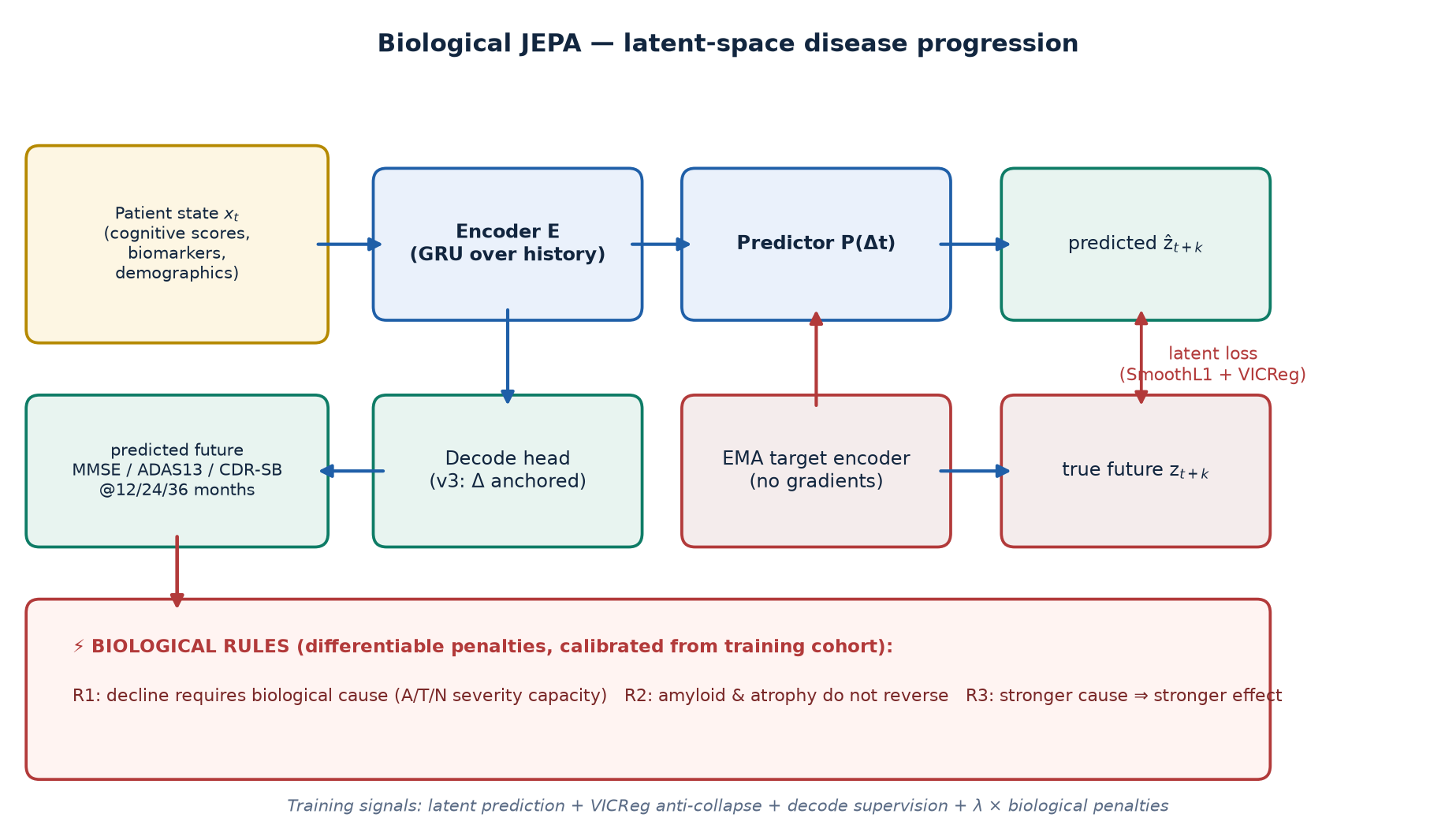
Why latent prediction: raw-value prediction forces the model to also model measurement noise, scanner variation, and missing-entry artifacts — the "messy and often missing" reality of medical data. Predicting in representation space lets unpredictable detail dissolve and keeps the disease trajectory as the learning target. The biological penalty then shapes what trajectories the model is allowed to imagine: an effect requires a cause.
Headline results (ADNI, 5-fold subject-level CV × 3 seeds, patient-level inference)
| JEPA-v2 | JEPA-v2+Bio | GRU | HGB | Ridge | Carry-fwd | |
|---|---|---|---|---|---|---|
| MMSE MAE @12 mo ↓ | 1.530 | 1.517 (λ2: 1.518) | 1.577 | 1.545 | 1.599 | 1.696 |
| CDR-SB MAE @36 mo ↓ | 1.222 | 1.196 (λ2: 1.206) | 1.201 | 1.202 | 1.298 | 1.408 |
| bio-penalty ablation (patient-level permutation) | — | ADAS13 p=0.0025 ✓ (survives Bonferroni) · CDRSB p=0.0001 ✓ · MMSE p=0.34 | ||||
| MAE at 75% input degradation ↓ | 3.99 | 4.08 | 3.98 | 4.43 | 4.12 | — |
Conversion AUC — two different measurements, never mixed:
- 15-run CV aggregate (mixed follow-up windows): JEPA+Bio 0.683 — Ridge leads this metric (0.725).
- Single held-out fold, prospective design (baseline input, fixed 36-month window, time-under-risk labels, n=141): JEPA+Bio λ2 0.952 vs GRU 0.927 vs HGB 0.935 — a hard-test result, NOT a CV aggregate.
Three honest statements:
- The biological constraints help on 2 of 3 clinical scales (ADAS13 and CDR-SB survive full Bonferroni correction at the patient level; MMSE does not — the earlier pair-level p=0.0002 was inflated and is superseded).
- Robustness to missing data is the structural win: at 25-50% input degradation the JEPA family is the most accurate of all models (JEPA+Bio within ~1% of its unconstrained ablation), and its relative degradation at 75% (+85%) is far below HGB's (+96%); GRU is the closest competitor (+75%) with worse absolute error.
- Honest losses: HGB keeps CDR-SB (best at 24 mo, significantly better pooled); Ridge keeps conversion AUC.
Full tables, significance details, and limitations: docs/RESULTS.md.
The rule engine is verified for implementation consistency against a synthetic Alzheimer cascade with known ground truth (11/11 tests, including two regression tests added after external review: rules constrain the prediction — not gated by future ground truth — and R3 operates on unique patients with observed cells only). Compliant trajectories incur ≈ 0 penalty; unsupported decline, pathology reversal, and anti-causal ordering are flagged with >10× margin. These tests validate the code against its own pre-specified rules; they do not validate the rules as clinical causal truth. See docs/BIOLOGICAL_RULES.md.
Quickstart
git clone https://github.com/0ans/biological-jepa.git && cd biological-jepa
make setup          # venv + torch/pandas/sklearn
make data           # downloads & verifies both real datasets (checksums printed)
make test           # 11 unit tests incl. rule-engine vs ground truth
make experiments    # 8 models × 15 runs × 2 studies + hard tests (~45 min on a laptop)
Try it on a patient (trains in ~40 s, then predicts the 3-year trajectory):
python scripts/predict_patient.py                 # 3 held-out patients
python scripts/predict_patient.py --sid ADNI_77   # a specific held-out patient
Results land in experiments/{adni,oasis}/: results.json (15-run CV +
significance), hard_tests.json (missingness stress + rollout), and figures.
See experiments/README.md for a map of every artifact.
Repository layout
src/biojepa/
├── data/            adni.py · oasis.py · synthetic.py · dataset.py (splits, K-fold, pairs, masks)
├── model/
│   ├── jepa.py      v1 snapshot encoder · v2 history encoder · EMA target · VICReg · latent rollout
│   ├── bio_rules.py differentiable rule engine (R1 capacity, R2 monotonicity, R3 ordering)
│   └── baselines.py carry-forward · ridge · HGB · supervised GRU
├── pipeline.py      train-fit standardizers, per-pair tensors, capacity calibration
├── train.py · evaluate.py (bootstrap · stress · rollout) · run_experiments.py
docs/                RESULTS · RESEARCH_LOG (incl. failures) · BIOLOGICAL_RULES · ADNI_ACCESS
experiments/         committed results.json + hard_tests.json + figures (evidence)
tests/               rule-engine ground-truth tests + end-to-end smoke
Data & ethics
Participant-level data are not committed. scripts/download_data.py
fetches the ADNI sample (via the abaR R package redistribution) and the
OASIS-2 longitudinal CSV from public research mirrors, verifies them, and
prints checksums. For production-grade runs, register at
adni.loni.usc.edu (free, DUA) — the loader
targets the ADNIMERGE schema; see docs/ADNI_ACCESS.md.
Honest limitations
- The accessible ADNI sample has baseline-only A/T/N biomarkers, so trajectory-monotonicity rules are verified on the synthetic cascade and applied to OASIS brain volumes; full ADNI activates them on real PET/MRI.
- HGB remains the single-target accuracy leader (CDR-SB@24/36) and ridge the conversion-AUC leader — JEPA+Bio's demonstrated edge is plausibility, robustness to missing data, and statistically significant accuracy gains over its own unconstrained ablation.
- OASIS-2 numbers are small-n pipeline validation only.
See docs/RESEARCH_LOG.md for the full honest account, including everything that failed along the way.
Citation
@software{alharbi2026biologicaljepa,
  author = {Al-Harbi, Anas},
  title  = {biological-jepa: biologically-constrained JEPA for disease progression},
  year   = {2026},
  url    = {https://github.com/0ans/biological-jepa}
}
Foundations: JEPA/LeCun et al.; V-JEPA 2 (Assran et al., 2025); LeJEPA (Balestriero & LeCun, 2025); AD biomarker cascade (Jack et al., 2010, 2013, 2016); ADNI and OASIS-2 datasets.
License
MIT — see LICENSE.
Similar repos


Languages
Python
99.4%
Biologically-constrained JEPA for disease progression - predicts who will decline, not just labels. Real ADNI data (2,347 patients), patient-level inference, honest evaluation incl. LLM head-to-head.
Python
1
3 commits
updated Sep 28, 2026
See what people are saying
README
biological-jepa
Disease progression modeling with a biologically-constrained JEPA — from recognition to reasoning.
Medical AI today labels a scan; it does not reason about how the disease will move. This project implements and tests the idea that a JEPA (Joint-Embedding Predictive Architecture) trained to predict the latent future state of a patient — and penalized whenever its predicted trajectory violates known biology — produces disease trajectories that are more biologically plausible than standard pattern-matching models.
Evaluated on real longitudinal data: an ADNI sample (2,347 participants, ~9,300 training trajectories, baseline amyloid/tau/hippocampal markers, longitudinal MMSE/ADAS13/CDR-SB, conversion labels) and OASIS-2 (150 subjects, 373 visits), with a synthetic Alzheimer cascade used as ground truth for rule verification.
The idea in one figure
Why latent prediction: raw-value prediction forces the model to also model measurement noise, scanner variation, and missing-entry artifacts — the "messy and often missing" reality of medical data. Predicting in representation space lets unpredictable detail dissolve and keeps the disease trajectory as the learning target. The biological penalty then shapes what trajectories the model is allowed to imagine: an effect requires a cause.
Headline results (ADNI, 5-fold subject-level CV × 3 seeds, patient-level inference)
| JEPA-v2 | JEPA-v2+Bio | GRU | HGB | Ridge | Carry-fwd | |
|---|---|---|---|---|---|---|
| MMSE MAE @12 mo ↓ | 1.530 | 1.517 (λ2: 1.518) | 1.577 | 1.545 | 1.599 | 1.696 |
| CDR-SB MAE @36 mo ↓ | 1.222 | 1.196 (λ2: 1.206) | 1.201 | 1.202 | 1.298 | 1.408 |
| bio-penalty ablation (patient-level permutation) | — | ADAS13 p=0.0025 ✓ (survives Bonferroni) · CDRSB p=0.0001 ✓ · MMSE p=0.34 | ||||
| MAE at 75% input degradation ↓ | 3.99 | 4.08 | 3.98 | 4.43 | 4.12 | — |
Conversion AUC — two different measurements, never mixed:
- 15-run CV aggregate (mixed follow-up windows): JEPA+Bio 0.683 — Ridge leads this metric (0.725).
- Single held-out fold, prospective design (baseline input, fixed 36-month window, time-under-risk labels, n=141): JEPA+Bio λ2 0.952 vs GRU 0.927 vs HGB 0.935 — a hard-test result, NOT a CV aggregate.
Three honest statements:
- The biological constraints help on 2 of 3 clinical scales (ADAS13 and CDR-SB survive full Bonferroni correction at the patient level; MMSE does not — the earlier pair-level p=0.0002 was inflated and is superseded).
- Robustness to missing data is the structural win: at 25-50% input degradation the JEPA family is the most accurate of all models (JEPA+Bio within ~1% of its unconstrained ablation), and its relative degradation at 75% (+85%) is far below HGB's (+96%); GRU is the closest competitor (+75%) with worse absolute error.
- Honest losses: HGB keeps CDR-SB (best at 24 mo, significantly better pooled); Ridge keeps conversion AUC.
Full tables, significance details, and limitations: docs/RESULTS.md.
The rule engine is verified for implementation consistency against a synthetic Alzheimer cascade with known ground truth (11/11 tests, including two regression tests added after external review: rules constrain the prediction — not gated by future ground truth — and R3 operates on unique patients with observed cells only). Compliant trajectories incur ≈ 0 penalty; unsupported decline, pathology reversal, and anti-causal ordering are flagged with >10× margin. These tests validate the code against its own pre-specified rules; they do not validate the rules as clinical causal truth. See docs/BIOLOGICAL_RULES.md.
Quickstart
git clone https://github.com/0ans/biological-jepa.git && cd biological-jepa
make setup          # venv + torch/pandas/sklearn
make data           # downloads & verifies both real datasets (checksums printed)
make test           # 11 unit tests incl. rule-engine vs ground truth
make experiments    # 8 models × 15 runs × 2 studies + hard tests (~45 min on a laptop)
Try it on a patient (trains in ~40 s, then predicts the 3-year trajectory):
python scripts/predict_patient.py                 # 3 held-out patients
python scripts/predict_patient.py --sid ADNI_77   # a specific held-out patient
Results land in experiments/{adni,oasis}/: results.json (15-run CV +
significance), hard_tests.json (missingness stress + rollout), and figures.
See experiments/README.md for a map of every artifact.
Repository layout
src/biojepa/
├── data/            adni.py · oasis.py · synthetic.py · dataset.py (splits, K-fold, pairs, masks)
├── model/
│   ├── jepa.py      v1 snapshot encoder · v2 history encoder · EMA target · VICReg · latent rollout
│   ├── bio_rules.py differentiable rule engine (R1 capacity, R2 monotonicity, R3 ordering)
│   └── baselines.py carry-forward · ridge · HGB · supervised GRU
├── pipeline.py      train-fit standardizers, per-pair tensors, capacity calibration
├── train.py · evaluate.py (bootstrap · stress · rollout) · run_experiments.py
docs/                RESULTS · RESEARCH_LOG (incl. failures) · BIOLOGICAL_RULES · ADNI_ACCESS
experiments/         committed results.json + hard_tests.json + figures (evidence)
tests/               rule-engine ground-truth tests + end-to-end smoke
Data & ethics
Participant-level data are not committed. scripts/download_data.py
fetches the ADNI sample (via the abaR R package redistribution) and the
OASIS-2 longitudinal CSV from public research mirrors, verifies them, and
prints checksums. For production-grade runs, register at
adni.loni.usc.edu (free, DUA) — the loader
targets the ADNIMERGE schema; see docs/ADNI_ACCESS.md.
Honest limitations
- The accessible ADNI sample has baseline-only A/T/N biomarkers, so trajectory-monotonicity rules are verified on the synthetic cascade and applied to OASIS brain volumes; full ADNI activates them on real PET/MRI.
- HGB remains the single-target accuracy leader (CDR-SB@24/36) and ridge the conversion-AUC leader — JEPA+Bio's demonstrated edge is plausibility, robustness to missing data, and statistically significant accuracy gains over its own unconstrained ablation.
- OASIS-2 numbers are small-n pipeline validation only.
See docs/RESEARCH_LOG.md for the full honest account, including everything that failed along the way.
Citation
@software{alharbi2026biologicaljepa,
  author = {Al-Harbi, Anas},
  title  = {biological-jepa: biologically-constrained JEPA for disease progression},
  year   = {2026},
  url    = {https://github.com/0ans/biological-jepa}
}
Foundations: JEPA/LeCun et al.; V-JEPA 2 (Assran et al., 2025); LeJEPA (Balestriero & LeCun, 2025); AD biomarker cascade (Jack et al., 2010, 2013, 2016); ADNI and OASIS-2 datasets.
License
MIT — see LICENSE.
Similar repos
Languages
Python
99.4%